Quick answer: Most law firms benefit most from choosing an SEO agency that specializes in legal marketing. It is the only model that covers technical SEO, legal content, local SEO, link building, and AI search visibility at once. In-house SEO fits large or multi-office firms that can fund a full team. A freelancer fits solo and small firms with a narrow, steady workload.
Budgets used to drive law firms’ decisions when choosing in-house SEOs,agencies, or freelancers.
In 2026, it's also a capability question. Clients now find lawyers through Google's map pack, organic results, Google AI Overviews, and AI assistants like ChatGPT. Winning across all of them takes more skills than most single hires have.
This guide compares all three models on cost, skills, risk, and AI search performance, then gives you a framework to choose based on your firm's size and practice area.
Key Takeaways
- No model is best for every firm. The right choice depends on budget, competition in your market, and how much management time you have.
- Modern law firm SEO consists of 7 jobs, not 1: technical SEO, practice-area content, local SEO, links and digital PR, AI search visibility, measurement, and intake tracking.
- In-house SEO gives you the most control but costs the most and depends on one person's skills.
- An SEO agency for law firms gives you a full team and continuity, but your firm shares attention with other clients.
- A freelancer for law firms may cost the least but has capped hours and stops when they stop.
- AI search raises the bar. Showing up in AI Overviews and ChatGPT depends on brand mentions, reviews, and consistent entity data across the web, which takes several specialties working together.
- Your firm stays responsible for compliance. Under ABA Model Rule 5.3, lawyers must supervise the marketing work of non-lawyers, including outside vendors.
In-House SEO vs. Agency vs. Freelancer for Law Firms: Side-by-Side Comparison
An in-house SEO operates as a salaried employee who works only on your firm. An agency provides an outside team of specialists you pay on a monthly retainer. A freelancer works as an independent contractor you pay hourly, per project, or on a small retainer.
Here is how they compare for a law firm in 2026.
| Factor | In-house SEO | SEO agency | Freelancer |
|---|---|---|---|
| Who does the work | 1 employee (or a small team) | Team of specialists | 1 independent contractor |
| Cost structure | Salary + benefits + tools + training | Monthly retainer | Hourly, per project, or small retainer |
| Typical monthly cost (2026) | ~$8,500–$15,000/month (fully loaded, one hire) | $2,500–$20,000+/month | $1,000–$4,500/month, or $75–$200/hour |
| Time to start | Slowest (hiring + ramp-up) | Fast (onboarding) | Fastest |
| Skill range | Limited to one person's strengths | Broad: technical, content, local, links, AI search | Deep in one or two specialties at most |
| AI search capability | Depends on the hire | Strongest if the agency runs dedicated AI search work | Usually limited to one piece (e.g., content or schema) |
| Management effort for the firm | High | Low to moderate | Moderate |
| Continuity risk | High: program stops if they leave | Low: team covers turnover | High: program pauses if they can't work |
| Legal-industry knowledge | Grows over time inside the firm | High with a legal-specialist agency | Varies widely |
| Best for | Large and multi-office firms | Competitive markets and practice areas (PI, criminal defense, family law in metros) | Solo and small local firms with a narrow scope |
What Makes the Choice Harder in the AI Search Era
Law firm SEO in 2026 covers seven separate jobs, from technical fixes to AI search visibility, and each one needs a different skill set.
That is the main reason the in-house vs. agency vs. freelancer decision has changed: A single person rarely does all seven well.
- Technical SEO: site speed, crawlability, indexing, and schema markup.
- Practice-area content: attorney-reviewed pages for each case type and location.
- Local SEO: Google Business Profile, reviews, and citations that drive map pack rankings.
- Links and digital PR: earning links and brand mentions from news sites, legal directories, and local organizations.
- AI search visibility: getting your firm named in Google AI Overviews, AI Mode, ChatGPT, Gemini, and Perplexity. See our GEO for law firms guide.
- Measurement: tracking rankings, AI citations, calls, and signed cases, not just traffic.
- Intake and conversion: making sure the leads SEO generates turn into signed cases.
Google says it does not place special requirements to appear in AI Overviews and AI Mode beyond standard SEO best practices.
In practice, that means firms earn AI visibility through the same fundamentals done well and consistently: helpful content, technical health, and a strong, consistent brand presence across the web. One person cannot easily sustain consistency at that scale.
In-House SEO for Law Firms
In-house SEO offers the most control and firm knowledge, but it usually costs more than the other options and depends heavily on one person's skills.
Pros of In-House SEO
- Deep firm knowledge. They learn your practice areas, intake process, and attorneys' strengths.
- Direct control. You can change priorities or publish urgent updates the same day.
- Easy attorney access. Working from inside the firm allows them to get lawyers to review content and give expert quotes faster.
- Full-time focus. They don’t split their attention across other clients.
Cons of In-House SEO
- Highest total cost. You pay for salary, benefits, payroll taxes, SEO tools, and training.
- Skill gaps. One hire rarely excels at technical SEO, legal copywriting, digital PR, and AI search at the same time.
- Slow start. Recruiting, onboarding, and ramp-up delay results.
- Single point of failure. If they leave or burn out, your SEO program stops.
- Insular thinking. Without exposure to other firms and markets, they can struggle to spot what works elsewhere.
Best for: large or multi-office firms that can fund a full marketing department, or firms that pair an in-house marketing lead with outside specialists (see the hybrid model below).
SEO Agency for Law Firms
An SEO agency for law firms assigns a team of strategists, technical specialists, writers, and link builders to your firm for a monthly retainer. Agencies offer the widest skill range and continuity, but your firm shares the team's attention with other clients.
Pros of an SEO Agency
- A full bench of specialists. Technical, content, local, links, and AI search work run at the same time.
- Continuity. If someone on your account leaves, the team keeps the work moving.
- Tools included. The retainer includes enterprise SEO, rank tracking, and AI visibility tools.
- Pattern recognition. A legal-specialist agency sees what works across many firms and markets, including early shifts in AI search.
- Built-in legal experience. Specialist agencies already know practice-area content and attorney advertising rules.
Cons of an SEO Agency
- Shared attention. You're one of several clients, so communication runs on a set schedule.
- Quality varies widely. Generalist agencies often lack legal expertise, and some lock firms into long contracts or own the content, logos, websites, and other intellectual property they produce.
- Less firm-specific context at the start. The agency needs time and input from your team to learn your cases and intake.
Best for: established firms in competitive practice areas and metro markets, such as personal injury, criminal defense, and family law, that need several workstreams running at once.
Freelance SEO for Law Firms
A freelancer or independent SEO contractor handles specific tasks like technical audits, citation cleanup, or practice-area pages. Freelancers cost less than other options and offer direct communication, but their hours are capped and work stops when they're unavailable.
Pros of a Freelancer
- Lowest cost. No agency overhead, so you pay mainly for the work itself.
- Direct communication. You talk to the person doing the work.
- Deep specialty. Many freelancers are experts in one area, such as technical SEO or legal writing.
- Flexible terms. They commonly work on a project or month-to-month basis.
Cons of a Freelancer
- Capacity limits. One person can't scale content, links, and AI search work at once.
- Single point of failure. Illness, vacation, or a better-paying client puts your SEO on hold.
- Gaps in AI search work. Earning brand mentions and digital PR at scale usually takes a team.
Best for: solo practitioners and small local firms with a defined, modest monthly scope, or as a specialist add-on to an in-house lead.
Which Model Wins for AI Search Visibility?
For AI search visibility, the agency model usually provides the most advantages because AI engines draw on many signals at once: content, reviews, brand mentions, directory data, and technical health.
A strong in-house team can match it with enough budget. A single freelancer can cover only part of it.
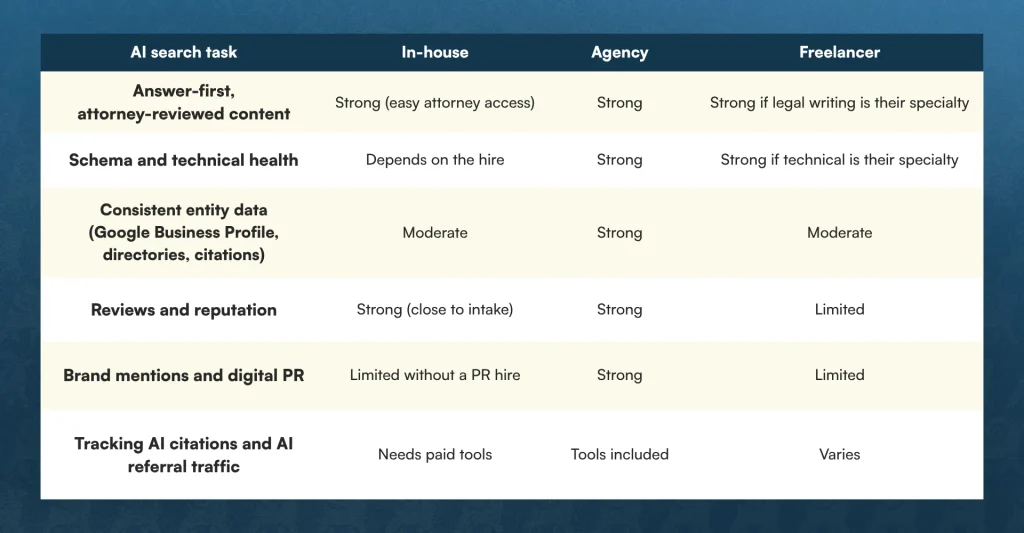
Note: All of this depends on the scope of the contract, and some of these tasks can escalate the agency's fee.
The Hybrid Model: In-House Lead + Outside Specialists
A hybrid model pairs an in-house marketing lead, who owns strategy and works with the attorneys, with an agency or freelancers who handle specialized execution.
Many growing firms use this model because it combines firm knowledge with a full set of skills.
- In-house marketing director + SEO agency: The director owns goals, budget, and attorney input. The agency runs SEO, content, links, and AI search.
- In-house generalist + freelance specialists: The employee manages day-to-day work and brings in freelancers for technical audits or legal writing.
- Agency + in-house content reviewer: The agency produces content, then a paralegal or attorney reviews it for accuracy and compliance.
Make a hybrid model work with one owner, one shared keyword and content plan, and one report that tracks cases, not just traffic.
How to Choose: A Decision Framework for Law Firms
Choose the model that matches your firm's size, the degree of competition in your practice area in your market, and how much time your team can spend managing SEO.
Use the table below as a starting point.
| Your firm | Recommended model | Why |
|---|---|---|
| Solo or small firm, low-competition local market | Freelancer or small specialist agency | Narrow scope—local SEO and a few strong pages go a long way |
| Small to mid-size firm, moderately competitive market (e.g., estate planning, immigration) | Legal-specialist agency or hybrid | Several workstreams needed, but not a full internal team |
| Any firm in a high-competition metro practice area (PI, criminal defense, family law) | Legal-specialist agency | Needs technical, content, links, local, and AI search work at once |
| Multi-office or national firm with a marketing department | In-house team + agency (hybrid) | In-house owns strategy, while agency adds scale and specialties |
5 questions to ask before you decide
- What is our realistic monthly SEO budget, including tools and management time?
- How competitive is our practice area in our market?
- Who at the firm will own SEO, review content, and read reports?
- Which of the seven SEO jobs do we already cover, and which do we not?
- What happens to our program if one key person leaves?
Who Handles Compliance When You Outsource SEO?
Your law firm bears responsibility for marketing compliance no matter who does the work. ABA Model Rule 5.3 requires lawyers to make reasonable efforts to ensure that non-lawyers working for the firm, including outside vendors, act in line with the lawyer's professional obligations.
That covers advertising claims, testimonials, and website content.
Read ABA Model Rule 5.3: Responsibilities Regarding Nonlawyer Assistance and check your state's version.
Whichever marketing model you choose:
- Put content ownership and account access (website, Google Business Profile, analytics) in your firm's name.
- Ask any agency or freelancer how they handle your state's attorney advertising rules.
This section is general information, not legal advice.
How to Vet an In-House Hire, Agency, or Freelancer
Vet any SEO option by asking for legal-industry results, who will actually do the work, whether they measure success in cases, and who owns the content and accounts. Google's own guidance on hiring an SEO also warns that no one can guarantee a #1 ranking.
- Show me law firm results. Ask for case studies in your practice area. (See Rankings.io case studies.)
- How do you handle AI search? Ask how they track AI Overview and ChatGPT visibility.
- What do you report? Calls, form fills, and signed cases should sit next to rankings and traffic. See ROI for law firms.
- What does month one look like? Expect an audit, a plan, and quick technical wins.
- Who owns the work? Your firm should own the website, content, and every account.
- What are the contract terms? Know the minimum term and the exit process.
- Do you promise rankings? Treat any guarantee as a red flag.
For more, read 8 questions to ask before you hire an SEO for lawyers.
When Rankings.io Is (and Isn't) the Right Fit
Rankings.io is a legal-specialist agency focused on law firm SEO, AI SEO, and law firm marketing, with deep experience in personal injury.
We are not the right fit for every firm. If you're a solo practitioner in a low-competition market with a small budget, a skilled freelancer may serve you better.
Frequently Asked Questions About In-House SEO vs. Agency vs. Freelancer
Does SEO work for law firms?
Yes, SEO works for law firms because people with legal problems search Google, Google Maps, and AI assistants to find lawyers. Strong rankings for practice-area and location searches generate calls and form fills without paying per click. Results depend on market competition, content quality, reviews, and links.
What is a disadvantage of using an in-house advertising agency?
The main disadvantages of an in-house advertising or SEO team are high fixed costs, limited skill range, and key-person risk. Salaries, benefits, and tools add up fast, a small team rarely covers every specialty, and the program stalls if a key employee leaves. In-house teams can also miss trends seen across other firms.
Which SEO company is best for law firms?
The best SEO company for a law firm specializes in legal marketing, shows case studies in your practice area, reports on signed cases rather than just traffic, and gives your firm ownership of its content and accounts. Avoid any company that guarantees rankings.
Why would someone choose an agency role instead of an in-house role?
SEO professionals often choose agency roles for variety, faster skill growth, and exposure to many clients and markets. In-house roles offer deeper focus on one business and more direct influence. For law firms, the same trade-off applies: Agencies can bring breadth, in-house hires can bring depth.
Is an SEO agency cheaper than in-house SEO for a law firm?
For most small and mid-size law firms, an SEO agency costs less than an in-house team with the same skill range. One in-house hire costs salary, benefits, and tools, while an agency retainer includes a full team and tools.
Can a freelancer handle AI search optimization for a law firm?
A freelancer can handle parts of AI search optimization, such as schema markup or answer-first content. Full AI search visibility also needs reviews, brand mentions, digital PR, and consistent directory data, which usually takes a team. Most firms pair a freelancer with other support for AI search.
How long does law firm SEO take to show results?
Law firm SEO usually shows early gains in local and long-tail rankings first, with larger case growth over time. Timing depends on competition, website health, and the starting point.
When should a law firm bring SEO in-house?
A law firm should bring SEO in-house when it has opened multiple offices or serves several practice areas, built an established marketing department, and can fund the budget to hire specialists instead of one generalist. Most firms at that stage keep an agency for technical, link building, and AI search work.