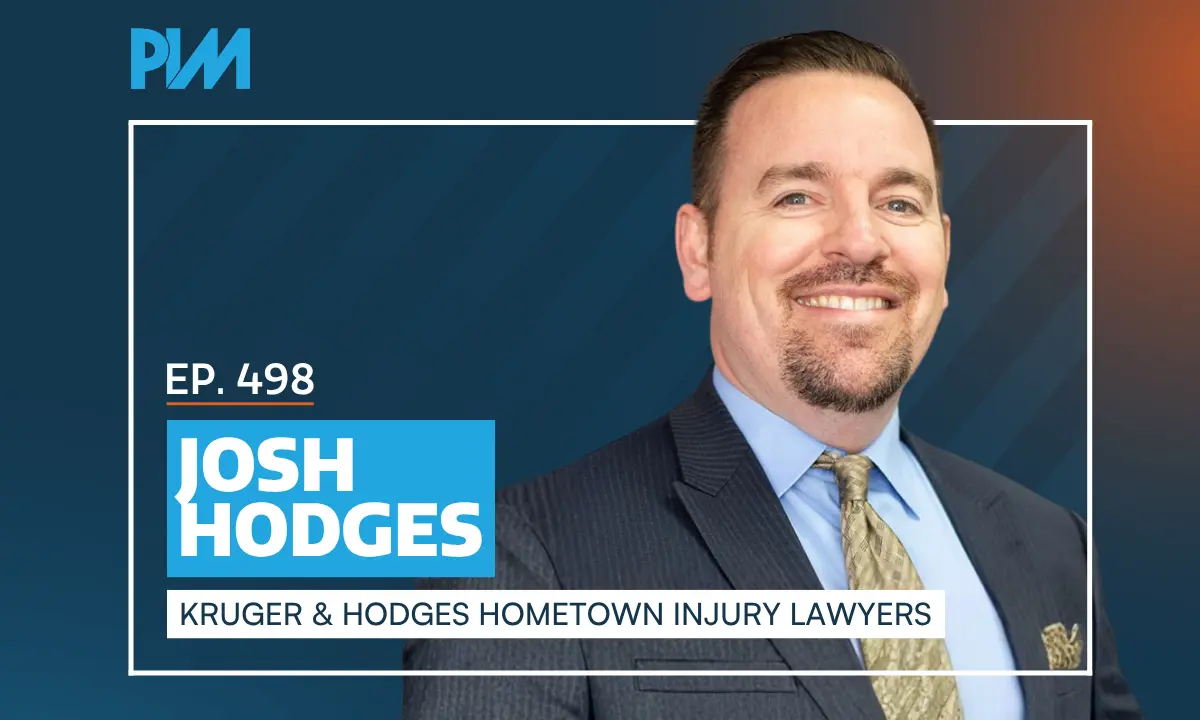
Josh Hodges:
No one's going to out-Hamilton me. Money can get you so far, but we're out doing stuff in our town, every day.
Chris Dreyer:
When you get deliberate about your market, you don't need to win the entire country. You just have to completely own your backyard.
Josh Hodges:
I mean, alone I'd run an ad and I've hired people in businesses who said they could give me cases or leads, and I just always got a high volume of crap. You weren't building much brand value that way, I didn't think.
Chris Dreyer:
In personal injury, so many firms get trapped behind a screen chasing low quality leads and vanity clicks. But genuine compounding brand equity isn't built through an algorithm, it's built belly-to-belly, looking people in the eye, and shaking hands on Main Street.
Josh Hodges:
I'd rather have 500 viewers that really cared about something in my hometown or a town around me, than a million spread out throughout the world.
Chris Dreyer:
Today's guest is Josh Hodges, Co-founder of Kruger & Hodges, and known across Southwest Ohio as the Hometown Lawyer. After walking away from big law, Josh returned to his hometown of Hamilton to build a practice from scratch, scaling from zero cases and a single part-time assistant, to a 30 person powerhouse across multiple offices. Today, we cover a competitive moat hidden in the rural justice gap, how 500 community spotlight videos built an effortless recruiting pipeline, and how a family crisis forced him out of the courtroom to develop homegrown talent.
This is Personal Injury Mastermind. I'm Chris Dreyer, Founder and CEO of Rankings.io. A marketing agency specializing in personal injury law firms, we help PI firms dominate search, attract more high value auto accident, truck accident, and catastrophic injury cases, and build market leading practices. Let's get into it.
I want to dig in. The Hometown Lawyer, you started the firm 2018 in hometown of Hamilton.
Josh Hodges:
Yeah.
Chris Dreyer:
And after years on the defense side, at one of the biggest firms in the Midwest, you eventually launched the Hometown Lawyer. It's a unique brand, it's a sharp brand. So I guess, what was that moment first that, "Hey, I'm going to walk away from the defense side and go out and start my own"? Talk to me about that decision.
Josh Hodges:
Yeah. I really wasn't on defense too long because I didn't become an attorney till I was 32. So I worked a lot in working class, I worked in a factory, I worked at DICK'S Sporting Goods. I worked at the DMV giving driving tests to kids and people who got suspended or whatever, people out of prison, getting their license back. So, I did that for years.
And I went to the local community college or the branch campus of Miami here in Hamilton at night for a decade. I never thought I'd get done, to be honest, but I just kept going because my work paid for 80% of it if I got a B. So that was good enough reason, I guess, my wife telling me. Before I knew it, I was 29. I actually had a college degree, took me that long. A lot of people were already attorneys by then.
But then I went to law school and I did get into law school and got a job at a big fancy big law firm, which was a good job but it just... and I liked there, it wasn't awful, I don't have a sob story about it like some people. If you read online about big law, it's a bunch of tears and stuff. But yeah, they pay you six figures right out of law school, I expected it was going to kind of suck sometimes. I mean, I've worked jobs that sucked and I got paid 12 bucks an hour for, so it wasn't awful.
But really, it was more that I saw my town. Hamilton was full of factory jobs, that's why I'm here. My family moved up here from Kentucky back in the '50s and '60s. But when I was a kid, all those jobs pretty much went away and the town was struggling, like a lot of towns in the Midwest. I mean, Hamilton is like a ton of towns, probably in Illinois where you are too, where they were booming in the '50s, '60s, '70s. And the '80s and '90s, when I was coming up, they were on the downside and it was pretty depressing.
But I saw by the time I was in my 30s, Hamilton had been trying to turn itself around and a lot of other towns like that were too. So, I became a believer in that movement a little bit, and I just kept getting calls from people I grew up with. I was the only lawyer they knew and they wanted me to help them because they got hit by a car or they got a DUI or whatever it may have been.
And my firm, it was a corporate firm. I represented the government. So if the city got sued, I represented them. So yeah, it's hard to explain to them, "What do you mean you can't help me?" To the kids I grew up with. Well, I'm not that type of lawyer. You know? And most people just think you're a lawyer, you can do anything. So, I had to turn down a lot of people. And I think the second year I was in big law, I just kept track. Man, that was probably at least 60 or 70 grand and stuff I just said no to and I'm not even marketing myself at all. So I just got the stomach one day, told my boss to quit, and I was scared because that was the best job probably anyone in my family had ever had, definitely anyone in my mind. And just left and been going ever since.
About a year later, I started branding myself the Hometown Lawyer, just because I was in my hometown and I figured all the big guys have so much more money, I just wanted to be more local. And then-
Chris Dreyer:
So you started originally with the trade name?
Josh Hodges:
No, Kruger & Hodges is the law firm, but online I started saying, "The Hometown Lawyer," and my TikTok and my Facebook was the Hometown Lawyer.
Chris Dreyer:
Got it.
Josh Hodges:
The firm was not. I added that later, but I said, "We're the Hometown Lawyers," and then tried to live up to it, it wasn't just the trade. I wanted to go be the Hometown Lawyer, which is a lot harder than just saying you are.
And I think it was honestly, funny enough, it was like a John Morgan podcast. He's like the opposite end, the giant, biggest of them all. You know? Someone asked him on one of the podcasts years and years ago I was listening to, what would he do if he was just a little guy and someone like him was coming in and bullying him, and he said, "I'd be embarrassed if someone outworked me in my hometown." And I just always thought about that. Like, yeah, no one's going to out-Hamilton me. It would be hard. If they did, I would almost be proud of them, because it ain't going to be easy. And money can get you so far, but we're out doing stuff in our town every day. It's not a big enough town to where a real giant firm would want to do that. Probably doesn't make sense for them to.
Chris Dreyer:
How many people are in Hamilton?
Josh Hodges:
- So it's like a midsize city, but the other towns we work in are smaller. It's the biggest one we're in. So it's not huge, it's not like 60,000-person town. All the big giant firms aren't trying to plant big, deep roots there. It probably doesn't make sense, but there is enough people to get a business going, in my opinion. There's other towns that I've looked around the country like that, that's where I think the opportunity is.
Chris Dreyer:
I mean, I'm in one smaller right now. So...
Josh Hodges:
Yeah, I mean 30, 40,000, even. I mean, you still do pretty good. And we got some offices in towns that are, the whole county might only have 40,000 people, but there's some downsides to that, but there's some benefits. You get rent cheap, employees are a little bit cheaper than the city, and you can make real connections if you do it right.
I've leaned into social media a lot. We do a video series called Around Town With the Hometown Lawyer, and I post a video highlighting somebody other than myself every single day. That's not easy. It sounds hard, it's even harder than it sounds. You're doing a lot of these podcasts, and we go to them on site, so we go their business. So I got a lady, works for me, sets them up, a camera guy, and I go with them. And we'll do 10 or 15 in one day and I'll meet 15 business owners in a part of town in Ohio, might not even be in Hamilton, could be an hour away. Just highlighting small towns basically, and making friends along the way and creating some content.
Chris Dreyer:
I was pulling right to that Around Town video series because I really wanted to dig into this. Are people lobbying to be on the series now, like maybe a restaurant that's not doing as well? And then, how do you approach that?
Josh Hodges:
Man, at first, nobody wanted to do it because it was just, I don't even remember when I thought of it. I just thought of it out the blue, I'm going to start highlighting businesses in my area. And I'd seen some other people, other lawyers doing podcasts, talking about things that were not law, but no one doing anything quite like this on site. So I was like reaching out to people, I didn't have anyone working for me at that time to do it. So I just reached out like, "I want to come do some videos for you guys." And people were like, "Why?" I didn't even really have an answer. "I don't know. Just sounds like a good idea." That's about all I had. I knew it was something. So the first few was people in Hamilton. I definitely started in Hamilton with people I knew that owned businesses, because they'd be like, "Okay, Josh, we'll let you highlight us with your stupid little show."
And then we did five or 10 or 20, and then people saw them and then it became easier to get people to say yes. Still a lot of people say no because it's weird, like a law firm wants to come do a video for me. I don't know what they think I'm up to something for sure, because no one trusts attorneys. But now I've done so many, I post one every day, a lot of people have seen them. And yeah, people do reach out to us now and ask if they can be it. I did one for the guy who writes parking tickets in my town. It's not even always a business. I mean, that was the most funny one, but because he used to give me tickets all the time when I was at court. And so, I got to talk to him about why I got to sue people sometimes. Nobody likes lawyers, probably nobody likes the parking ticket guy either. He said, "Yeah, they don't." But he gave us reasons why he has to, it keeps the cars out of the way so businesses can get new traffic and stuff.
So, it's educational, but most of them are nonprofits businesses. I try to stay away from things that are super competitive. Like real estate agents, each person can only pick one, so it's hyper-competitive. And then I'd want to do 50 of them would want to do it, it would be boring, I think. But restaurants, I mean you can eat at multiple restaurants, so it's not as cutthroat in that, so I stick to that. It's usually services that you don't have to just pick one. If someone's doing something good, I'll do it.
You make a lot of friends along the way, I think. And it's good for the vibe of the firm too. People know we're out there doing these videos. I think it helps the firm, I do. It's helped with recruiting, but it's not something where I can just prove an ROI. It's just I know I'm out-Hamilton everybody and I'm doing more good in the neighborhood than anyone else in the firm, I think.
Chris Dreyer:
Putting local business owners on camera sounds great in concept, but most people freeze up the moment a lens points at them. If your shoot feels intimidating, people dodge the invite. Josh removed the friction by ditching the production complexity and using a repeatable, low pressure prompt to get owners talking naturally.
Josh Hodges:
The first question is always, "What's your name and where are we?" It's the biggest softball. And we've done almost 500 of them and they all turn out good, different ways.
Chris Dreyer:
That's amazing.
Josh Hodges:
And I talk people through it. And some of the ones where the people are not as well-spoken, it's fine because I did one for a tow truck driver. "You're not running for president, man. They don't care if you're eloquent. They want you to save their butt when they're on the side of the road. Can you do that?" "Yeah." "Well then, let's go." And some of those are the best ones.
Chris Dreyer:
During the pre-interview, you said one of your biggest breakthroughs was realizing social media works better for building real connections than chasing leads. I would just maybe let you expound on that.
Josh Hodges:
Yeah. I mean, I think if you're on there asking for cases, I've done that. I mean, alone I've run an ad and I've hired people in businesses who said they could give me cases or leads. And I just always got a high volume of crap. And yeah, if you sift through enough of it, you might find a couple decent ones in there, but you weren't building much brand value that way, I didn't think.
And the way I've done it, I've been doing this for years now, beyond just the show, even when I'm just using my phone on myself and talking or talking with my wife while she cooks, it's all about humanizing me and just being a normal person. And over time, it compounds. I mean, people will see me. I took my daughter, she had a problem with her toe, I took her to the podiatrist six, seven months ago, it might have been a year ago. And some random guy in the lobby was like elbow and his teenager like, "Look, it's the Hometown Lawyer." And I was like, "Hey man, what's up?" So funny, I'll never get used to that, but people know you and they know you're around because you're highlighting places they go to or places they might want to go to.
And then the businesses you highlight, there's a place in town and a new bar, they had really good wings. First time I ever ate them, I did a little video about that. And then the next weekend I tried to take my wife back, they were sold out and they blamed me, but they're doing really good. So, I was able to help them. So it's just good all the way around.
And it's also helped with recruiting. I think young people, everyone's always bitching and moaning they can't find employees, and that's even harder than finding cases sometimes. About four years ago, I had a receptionist job open and three people put in for it. Two of them didn't show up to the interview. I had one girl show up, I hired her, she was 19. She's still with me, she's moved up, she's my intake manager. So it was a great hire, but I only had one choice. I still make fun of her for that like, "You were the only one. I didn't have no other option." You know? But last summer or last fall, I had the same job, receptionist job open. I got 75 in the first 24 hours. I had to turn it off because I know I wasn't able to look at them all, and I can only attribute it to social media people knowing me now. You got fans.
We do other things. We do a thing with the billboards where we give our billboards to nonprofits and stuff, and that gets a lot of play. One of my more recent hires said when I hired her, she told her grandma, she's like, "I think that's the guy that gives his billboards away. That's so nice." It gets in there. It'll infiltrate society in some way. Now, can you track it into your lead docket to how many cases you got from it? No, I don't think you can. I don't even think you should try at this point.
Chris Dreyer:
A lot of times if you post anything as a personal injury attorney online, it's like immediately you're going to get one of two comments. You're either going to be called the billboard lawyer in the comment section or somebody's going to call you an ambulance chaser or be derogatory. But as the Hometown Lawyer and highlighting these businesses, have you seen that decrease and more positive comments or are you still getting some of the hate, but overall you're seeing the goodwill and the positives from it? I guess for our audience, I think there's a lot of fear to post social because they're afraid of the hate and what people think. Just your thoughts on that.
Josh Hodges:
I think if you're online at all, you're going to get negative comments, even if you're not a lawyer. Some people are just going to be a hater. And sometimes you might say something that's dumb, I do it sometimes. So, and sometimes people say something I agree with like, "Yeah, that was kind of stupid." But when you're a lawyer, you're going to catch a little bit more, right? And I do think I get less because the videos, they're all positive. I'm not in, I'm not asking people to call me. It's all about people doing good stuff in their town. And so I get way, way, way more positive than negative. I do still get some negative.
Just the other day I was doing some videos in Bellefontaine, about an hour and a half from Hamilton. And so I posted them all and they were all good, they were all well received, a lot of good comments. But one guy keeps commenting on them, "How are you the Hometown Lawyer? You're not even from here." Like, "Dude, I didn't say... Obviously, I'm not from every hometown. I am from Hamilton." But then everyone that is positive is on there attacking him like, "Shut up." They're sticking up for me for him. So it's like, it's all right. You got to have thick skin.
One of my first ones was Luke's Cupcake. He's a young man in town, owns a bakery. He'd been up for a year or two. We did a video for him. It didn't go super viral like a million views. Why would it? It's in Hamilton, Ohio. You wouldn't care about that in Illinois, I wouldn't think. But you know who did care about it? Everyone that knew him, they cared a lot about it. And his mom and his grandma and his aunt and the kids that went to school with him that were his friends that all live here. So, you might get 4,000 views, but it'll be like 100 of them really care. And that's better than 100,000 views in California, for me.
And I've had some videos on TikTok get super viral, me and my wife bullshitting around talking about food, but I don't necessarily think those are the best for my firm actually, if it's going to be getting cases. I think it's good for my account, fine, makes it look cool. But I'd rather have 500 viewers that really cared about something in my hometown or a town around me than a million spread out throughout the world who just watched something because it was funny. And I think a lot of lawyers get down on their views and stuff. It's like, you're talking about law, you're talking about local stuff. I mean, this podcast right here, if this gets 10 million views, then one of us said something accidentally racist or homophobic-
Chris Dreyer:
A lot of truth to that.
Josh Hodges:
... or something really bad. You know? Something, not that many people are going to care about this, unfortunately for us.
Chris Dreyer:
True.
Josh Hodges:
That's fine, because it's a niche. I mean, it's legal marketing. You got to remember that.
Chris Dreyer:
Most attorneys start a firm wanting to be a courtroom heavyweight who commands juries and tries every major case, but scaling an organization throws curve balls that rewrite your priorities. When a family medical crisis kept Josh anchored in hospital rooms during the firm's critical early years, he was forced to take a step back from litigation docket and lead from a laptop. To keep growing, he realized he had to stop trying cases and build an internal bench of homegrown attorneys who could carry the load.
Josh Hodges:
We had our second child, my daughter was really sick. It was right when we started the firm, like 2017, 2018, 2019, 2020. She was in the hospital like a month or more every year, and I would be in there just stuck. And I wouldn't leave, so I would just be in there with my laptop, settling pre-lit cases, doing marketing, figuring out how to do social media, manage my team, all from there. And I was having to just consider, am I going to be able to be some top-notch litigator and leave her here? No. And I'm not going to be able to cancel stuff all the time for my clients. So, I made a decision, was made for me, that I just got to get good at running the firm and I got to find other people who are going to litigate these files.
So again, with my partner here, he does litigation and pretty much everyone here we've brought up. We haven't hired any real experienced people. It's been mostly the people here who went to law school and did work here, honestly. I was older than them at law school because I went later, but we've got seven attorneys and all of them but one went to law school with me back in the day. So, people I knew and trusted. But yeah, I'm hoping at some point the firm can get to where it's running itself more and I can go maybe in my 50s. Some of these attorneys that have tried the cases for us could teach me a few things and that'd be my second act. But yeah, with life you get the curve balls, you got to kind of deal with it.
My daughter, luckily, she's doing a lot better. When she was born, they said they didn't think she'd walk or talk and she gets in trouble for talking too much every day. So, she's doing good. She's got a lot of stuff that's serious still, but she's way outperforming anything that they ever said. And I've found that in a way, marketing scratches the itch of being a trial lawyer.
I think the great trial lawyers get in front of a jury, at the end of the day, you're convincing people your side's right. In marketing, it's that way too, I'm convincing the world that my firm's right. And both are hard and both take different techniques that you got to really sit down and master, and you can't really willy-nilly be good at either one of them. And I honestly think trying to be good at both of them is hard. There might be a couple people out there that do it, but even those, I still think if you only do one or the other, you're going to be better if you got more time. And I think firms need to be able to do both though as a firm, because it's a great thing to be able to market that you don't just settle everything as fast as you can.
Chris Dreyer:
Stepping into the CEO seat gave Josh the clarity to evaluate his business model from 30,000 feet. In Major Metro's conventional wisdom says to hyper specialize strictly in personal injury, but in mid-sized markets with populations under 100,000, turning away neighbors who need criminal defense might erode community goodwill. Here's how Josh balances his practice mix to protect relationships and cash flow.
Josh Hodges:
I think PI can be enough. We've basically always had criminal. My partner, Scott, he had been a lawyer nine or 10 years before me. He's only like four years older than me and he'd always predominantly criminal defense is what he had done. And when we started up, I was doing it too just to make some money, get some cases, get to court while we were building the PI. At some point I got so busy I stopped doing criminal and then at some point he stopped too for the most part. But we always kept getting the calls.
When you're in a small town, people viewed you in the past, you want to help them again, you don't want to turn them away. So we've always just kept one criminal defense attorney going. I'll market it a ton, but it's enough that keeps them busy, makes a little bit of money, keeps the clients thinking we're their law firm. I think it's beneficial for that. It keeps our firm in front of all the judges that it's going to be the same judges we have the PI cases in front of. So yeah, but it wasn't an add-on because I needed it, necessarily. It really wasn't an add-on, it was actually here from the beginning, to be honest. I haven't grown it as much, but I mean, it's self-sufficient.
Chris Dreyer:
We kind of jumped. I mean, we hit social media pretty hard and the video series. How else are you think about... I know our audience is really interested in getting cases in the door and you could be the best attorney in the world, but if you don't get the cases in the door, how else are you approaching marketing? Or is grassroots like, "Hey, I'm focused on grassroots and the video series and that's what I do"?
Josh Hodges:
Yeah. I mean, I think that's the main thing that definitely that I stick out is doing differently than a lot of people. I think we do a good job on that. We do a lot of events. We do paper newsletter every month, email newsletter, reaching out to all the old clients, trying to sponsor things, help out anyone in the neighborhood. Always have an intern. If someone wants me to talk to their high school kid or junior high kid or to their class, I always will do that. All over the state too, I'll drive two hours to go talk to some kids in a high school sometimes. Just I think it's the best use of my time, just being the face of the firm doing that stuff.
We also, I mean, we do the traditional stuff, the local, try to get Google reviews, all the stuff you need to be probably preaching to your clients to do. We do a good job with that. Could always do better. I mean, I think we got 400 and something in our main office that's hard fault, but there's people got 1,800 down the road, but I think we do a good job of that, the LSAs and all that. I pretty much do everything. I don't do television or radio, so I don't do the mass, mass marketing. I do have a lot of local billboards, and we try to have fun with those. I'll put local people on them just to tie in with like I do the social media. I've put local food influencers that are real famous in Cincinnati or Dayton. I've tossed him on a billboard before in a suit with us and people thought that was funny, and stuff like that.
I'll give to the Boys and Girls Club for a month and let them... It'll say on the corner, "Sponsored by the Hometown Lawyers," but it'll be all about them, and then we'll put that on social media. So, I really like social media is layered on top of real life. I don't want to just do a post. I want to go to your business, shake your hand, check out your business, maybe buy something at your store, do the video highlight with my video guy, and then put it on social media. And then in real life too, I mean, it's not either or. I think some people just think, "I'm good at networking, I don't want to do social media. I'm not good at that." If you're good at networking, you can be good at social media. It's the same thing, just with a phone, and I think people just overthink it.
Chris Dreyer:
That's great advice. I love that. For our audience, just for our audience listening that has questions about the pod, that wants to connect with you, what's the best way to get in touch?
Josh Hodges:
Yeah, I mean the hometownlawyers.com is the website, you can find my stuff on there. You can, pretty much LinkedIn or if you're on TikTok or Facebook. The Hometown Lawyer is my TikTok, my Instagram, and my Facebook, the Hometown Lawyer. It's just Josh Hodges on LinkedIn. But I've met a lot of people in all those places. If you reach out to me, I'll get back to you. I'd love to help you, I'd love to learn whatever you're doing that's working.
I specifically have a heart for the small towns, the small town lawyers. I went to Iowa in June and spoke about rural justice gap. There's a real problem in small towns. There's not enough attorneys. Everybody tells you in law school, there's too many. It's the opposite in small towns and midsize towns. There's not enough attorneys, there's not enough good attorneys. Most of the attorneys that are there are aging fast.
So if you're in your 20s or 30s and you're in the big city, you're in Chicago, but you're from maybe Southern Illinois and you just think you're in Chicago because you have to be, I'm just telling you, you're wrong. If you find a town with 50,000 people and go hard for a decade, you'll be one of the top people there. Simple as that. You'll never be the top person in Chicago. Maybe, I mean, that'd be real hard. A lot easier... and if you want to be in a big city because you want to be, you like living there, that's fine. But I think there's a lot of people that go to the big city but they'd rather be home in their 50,000 person town. And there's more opportunity in those towns than you think.
Ohio puts out a map, most states probably do. The math that I do, I look at the population of a county and then I look at how many private practicing attorneys there are, and it's way more favorable in small towns, like two, three times less attorneys per person in a mid-size city than there are in a big city. I know we're not good at math, that's what they always make fun of us for, but we're not that bad. I know that like in Cincinnati, there's one lawyer for every 300 people. In my county, there's one for every 1,300. I'm smart enough in math to know that seems better for me. Probably shouldn't say that out loud, but it ain't just my county, there's a lot of counties like that.
Chris Dreyer:
I think that's some gold there, so I appreciate you sharing that. Guys, hit him up on social. Josh, this has been amazing. Thanks for coming on the show.
Josh Hodges:
No, thank you for having me, Chris.
Chris Dreyer:
Josh Hodges is proof of what happens when you get intentional about your market and do belly-to-belly networking that competitors ignore. By turning 500 plus local business spotlights into digital assets, he built an authentic community brand that drives both high intake cases and inbound recruiting pipeline. And by capitalizing on the rural justice gap, he built an undeniable competitive moat across Southwest Ohio.
That's it for today's episode. Personal Injury Mastermind is powered by rankings.io, a legal marketing agency for elite law firms specializing in personal injury law. Legal marketing is all we do. We've generated more than 100,000 cases for personal injury firms. Every month, we earn your business, no locking contracts. We handle search, ads, design, and everything in between so you don't have to think about it. If you want to be the firm injured people call first for auto or truck accident cases, book a complimentary growth audit at rankings.io. I'm Chris Dreyer. Thanks for listening to Personal Injury Mastermind. See you next time.