Quick answer: What is the average personal injury cost per case?
In 2026, personal injury cost per case usually ranges from about $800 to $4,000+, depending on channel, market, and case type:
- Google Search Ads: $2300–$4,000+ per signed case in competitive metros
- Purchased exclusive MVA leads: $2400–$3,800 per signed retainer
- Meta (Facebook/Instagram): roughly $1000–$1,500 per case
- Mature SEO: about $800 per case or lower, after establishing rankings
Your number depends most on your intake conversion rate. The same $300 lead costs $1,500 per case when you sign 1 in 5 leads and $6,000 when you sign 1 in 20.
If your paid search cost per signed case crept past $4,000 this year, you are not alone.
This guide explains the numbers: what a personal injury signed case costs in each channel today, why CAC climbed, what a case is actually worth, and how to decide between Google Ads and the newest option, ChatGPT Ads. Use it to check your own numbers before you set next quarter's budget.
Key Takeaways
- Paid-only CAC of $4,000 is now common in large metros, especially for car accident cases on Google Ads.
- Cost per signed case, not cost per lead, is the metric that matters. A lead that never signs is the most expensive one you can buy.
- The average auto bodily injury claim was $28,278 in 2024 according to the Insurance Information Institute. At a 33%–40% contingency fee, the average fee is about $9,300–$11,300, so a $4,000 CAC uses 35%–43% of it.
- Google Ads is still the primary acquisition channel for high-intent PI searches. It has proven tracking, local targeting, and years of benchmarks.
- ChatGPT Ads are early and unproven for legal. Treat them as a test budget (about 5%–10% of paid spend) to learn about messaging and audiences, not as a replacement for Google.
- SEO and AI search visibility pull your blended CAC down over time. Organic cases have no per-click cost.
Cost Per Lead vs. Cost Per Case vs. CAC: What Is the Difference?
Many firms track the wrong number. Here is how the three metrics differ:
| Metric | Formula | What it tells you | Where it misleads |
| Cost per lead (CPL) | Marketing spend ÷ leads | How efficiently a channel generates inquiries | Ignores lead quality and intake. Cheap shared leads look good here. |
| Cost per signed case | Channel spend ÷ signed retainers from that channel | What one new client costs from a given channel | Leaves out agency fees, intake staff and software |
| Personal injury CAC | (All marketing spend + agency fees + intake costs) ÷ total signed cases | True, fully loaded cost to acquire a client | Can hide one channel that performs badly inside a good blended average |
Track all three. Cost per signed case shows which channel to scale. CAC tells you whether the firm will make a profit.
For a deeper look at the lead side of this equation, see our breakdown of personal injury lead costs.
2026 Personal Injury Cost Per Case Benchmarks by Channel
The ranges below combine published industry benchmarks with what we see in personal injury accounts. Treat them as reference points, not targets. Your market, case mix, and intake process will move these numbers.
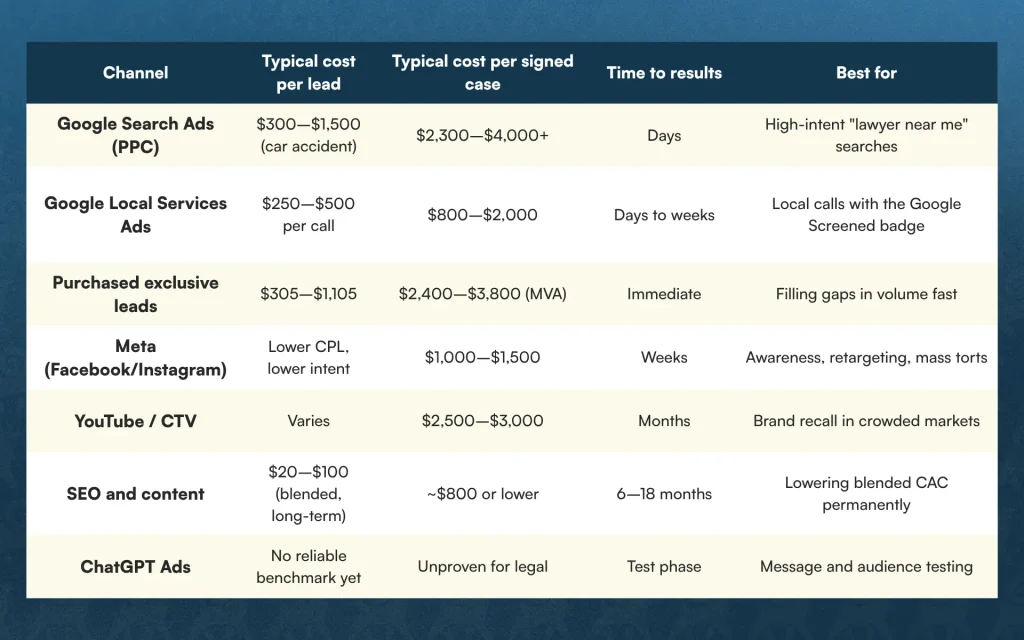
Why do blended numbers look so much lower? Firm-wide averages include referrals, repeat clients, and organic cases that cost little or nothing. That is why a firm's blended cost per case can sit under $500 while its paid search CAC is above $3,000. The two numbers answer different questions. Do not compare one with the other.
Why Personal Injury CAC Hit $4,000
No single cause pushed CAC up. Several pressures added up at once.
1. Click Costs Keep Climbing
Car accident and truck accident keywords are among the most expensive in Google Ads. Private equity–backed firms, national lead generators, and TV-heavy advertisers bid on the same terms, so a single click can cost more than $100 in major metros. If you bid on broad terms like "injury lawyer," you pay those prices for a lot of searches that never become cases.
Our guide to high-intent personal injury keywords shows where you can attract the better-converting searches.
2. AI Answers Took Space on the Results Page
AI Overviews now answer many informational injury questions before anyone clicks. Fewer organic clicks push more firms into paid search, which drives up auction prices. Firms that also show up inside AI answers rely less on paid clicks. That is the goal of AI SEO.
3. Intake Leaks Hide Inside CAC
Firms sometimes blame marketing for problems that start at intake. In Clio's secret-shopper research, 67% of law firms did not respond to emails from potential clients. Each paid lead that goes unanswered still counts in your cost per case, without a case to show for it.
4. Demand Is Not Growing Fast Enough to Absorb the Spend
NHTSA estimates that traffic crashes injured 2.42 million people in 2024, slightly fewer than in 2023. The pool of potential clients is flat, while the number of firms competing for them keeps rising. More money is chasing the same cases.
5. Accounts Built for Someone Else’s Benefit
We often audit accounts structured around an agency-owned landing page, or campaigns that mix every case type into one budget. When the landing page or the agency changes, performance drops and CAC jumps.
Real case: From $4,117 to $2,408 CAC
A personal injury firm came to Rankings.io with an average PPC CAC of $4,117 (Jan–Jul 2025). Its previous agency had built the account around a landing page that agency controlled.
What we changed:
- We rebuilt the main search campaign around the firm's own landing page
- We moved budget from broad "personal injury" terms to specific practice-area keywords
- We added Performance Max to win Google Maps and local 3-pack visibility
- We tested AI Max to grow a Spanish-language campaign that had struggled to get impressions
Result: CAC fell to $2,408 (Mar–Jul 2026), a 42% reduction, and search CPC dropped 15% year over year. The firm is now nearly doubling its paid search budget to enter a new metro. Read the full case study.
What Is a Personal Injury Case Worth? (The Other Side of CAC)
A $4,000 cost per case can produce profits or disaster. It depends on what you earn per case. Start with the industry baseline: The average auto bodily injury liability claim was $28,278 in 2024, according to the Insurance Information Institute.
| Injury severity | Typical settlement range | Fee at 33.3% | Fee at 40% | Max CAC at 3:1 return* |
| Minor (whiplash, sprains) | $3000–$25,000 | $1000–8,300 | $1200–$10,000 | $330–2,800 |
| Moderate (herniated disc, concussion) | $25000–$100,000 | $8300–33,300 | $10,000–$40,000 | $2,800–11,100 |
| Severe (surgery, permanent impairment) | $100000–$500,000 | $33300–166,700 | $40,000–$200,000 | $11,100–55,600 |
| Catastrophic (paralysis, wrongful death) | $500,000+ | $166,700+ | $200,000+ | $55,600+ |
*Max CAC at a 3:1 return = fee at 33.3% ÷ 3. Many firm owners use a 3:1 to 5:1 fee-to-CAC ratio as a floor, because case costs, staff time, and cases that never resolve all come out of the fee.
What this means: A $4,000 CAC is easy to justify for a truck accident or catastrophic injury practice. A firm that signs mostly minor soft-tissue cases cannot afford it. If your case mix is mostly minor injuries, cut your target CAC to match. Standard contingency fees are about 33% before a lawsuit is filed and 35%–40% once it is filed or goes to trial.
Google Ads vs. ChatGPT Ads: Cost Comparison for PI Firms
ChatGPT Ads are the newest paid channel firm owners ask us about. OpenAI began testing ads for logged-in U.S. adults on its Free and Go plans in early 2026, and 44% of U.S. adults have now used ChatGPT, according to Pew Research. That reach is real. Its track record for signing personal injury cases is not proven yet. Here is how the two compare:
| Factor | Google Ads | ChatGPT Ads |
| Maturity | 20+ years; deep legal benchmarks | Launched in 2026; still changing month to month |
| Pricing model | CPC auction (plus pay-per-lead for LSAs) | Started at about a $60 CPM with high minimums; self-serve CPC bidding added in spring 2026 |
| Typical PI click cost | $85–$210+ per click for car accident terms in major metros | Too early for a reliable legal benchmark |
| User intent | Explicit: "car accident lawyer near me" | Conversational: users ask about their situation, and ads appear below relevant answers |
| Geo-targeting | Precise radius and zip-code targeting | Less granular so far |
| Conversion tracking | Mature: call tracking, offline conversion import, CRM integration | Aggregated reporting; advertisers do not see chat data |
| Category restrictions | Legal services allowed; some states require disclaimers | OpenAI excludes sensitive topics; check eligibility for injury-related queries before you launch |
| Competition | Very high; CPCs reflect it | Low for now, which is the main opportunity |
| Best role in a PI budget | Primary signed-case engine | Test-and-learn channel (5%–10% of paid budget) |
When to Choose Google Ads
- You need signed cases this quarter and can measure cost per case by campaign.
- You target specific geographies (one metro, a list of counties or a radius around each office).
- You have intake that answers within minutes, 24/7. Paid search punishes slow follow-up.
- Your case mix supports a $2,000–$4,000 CAC (moderate injuries and above).
- You want Local Services Ads with pay-per-lead pricing and the Google Screened badge.
When to Test ChatGPT Ads
- You have a well optimized Google account and you want to find new demand, not replace it.
- You can invest in a test budget you can afford to lose while you learn.
- You want to test messaging fast: which pain points, fee explanations, and case types get engagement.
- You serve underserved audiences, such as Spanish-speaking clients, where competition is lighter.
- You want early-adopter insight before CPCs rise as more advertisers arrive.
Our Honest Take
ChatGPT Ads are a test channel right now, not a way to sign cases at scale. That still makes them worth testing. The questions you can answer with a small budget, such as which messages earn attention, which case types people bring up, and how prospects describe their injuries make your Google Ads, landing pages, and SEO content better. Fund the test, measure it honestly, and do not pull money from Google Ads that already produces signing cases.
How to Calculate Your Target Personal Injury Cost Per Case
Use this four-step formula to set a CAC ceiling based on your own numbers rather than industry averages:
- Find your average fee per case: average settlement × your contingency percentage. Example: $40,000 × 33.3% = $13,320.
- Subtract average case costs: filing fees, records, experts. Example: $13,320 − $1,500 = $11,820 net fee.
- Choose your target return: 3:1 is a common minimum for growth. 5:1 is healthy.
- Divide: $11,820 ÷ 3 = $3,940 maximum cost per signed case.
If your actual cost per case exceeds that ceiling, you have a problem with case mix, channel, or intake, not only with budget. The free calculator below runs this math with your numbers.
7 Ways to Lower Your Personal Injury CAC
- Fix intake before buying more traffic. Answer within 5 minutes, 24/7, and follow up by phone, text, and email. It is the cheapest CAC fix.
- Split campaigns by case type. Truck, car, motorcycle, and slip-and-fall cases have different values. Give each its own budget and CAC target.
- Cut broad keywords. Shift spend to specific, high-intent terms and add negative keywords every week.
- Own your landing pages and data. Never let an agency control the assets your account depends on.
- Import offline conversions. Feed signed cases, not just form fills, back into Google so bidding optimizes for retainers.
- Invest in personal injury SEO. Organic cases have no click cost, and they bring blended CAC down every month your rankings hold.
- Diversify channels. Use LSAs, retargeting, and content to reduce your reliance on one auction. Our list of personal injury marketing ideas covers lower-cost options.
Frequently Asked Questions Personal Injury Cost Per Case Benchmarks
What is a good cost per case for a personal injury firm?
A good personal injury cost per case is one that leaves at least a 3:1 return on your average net fee. For a firm averaging $12,000 in net fees, that means $4,000 or less. Firms that mostly sign minor soft-tissue cases should aim for $1,500 or less.
What is personal injury CAC?
Personal injury CAC (customer acquisition cost) is the fully loaded cost to sign one new client: all marketing spend, agency fees, and intake costs divided by total signed cases. It differs from cost per lead, which ignores whether the lead ever signs.
How much do personal injury lawyers pay per case?
Personal injury lawyers typically pay $800 to $4,000+ per signed case. Mature SEO sits at the low end, and Google Ads in competitive metros sits at the high end. Purchased exclusive car accident leads usually cost $2,400–$3,800 per signed retainer.
How much do most personal injury cases settle for?
Most personal injury cases settle for $3,000 to $100,000, depending on injury severity. The average auto bodily injury liability claim was $28,278 in 2024. Severe and catastrophic injuries can settle for $100,000 to several million dollars.
Should my firm advertise on ChatGPT?
Test ChatGPT Ads only after your Google Ads and intake perform well. Start with 5%–10% of your paid budget and treat it as research into messaging and audiences. Legal benchmarks do not exist yet, so judge results on signed cases, not clicks.