To read a law firm SEO report properly, skip traffic and rankings and go straight to three numbers: qualified calls and form fills by source, map pack position by target city, and signed cases attributed to organic search. Everything above those three lines is context. If the report cannot produce them, you are not reading a performance report, you are reading a status update.
Here is the uncomfortable part. Most law firm SEO reports are not dishonest. They are assembled from data sources with documented blind spots, by people who either do not know about those blind spots or would rather not bring them up on a monthly call.
Reading the report like a skeptic means knowing what the underlying tools can actually prove, and what they structurally cannot.
Key Takeaways
- Three numbers decide whether SEO is working: qualified inquiries by source, map pack position by city, and signed cases from organic. Read those first, every time.
- Google Search Console tables show a maximum of 1,000 rows, so any claim built on a full keyword list is already incomplete.
- An impression in Search Console means a link was seen or potentially seen. It is not proof anyone looked at you.
- Search Console's new generative AI report returns impressions only. No clicks, no position, no CTR. An agency showing you AI clicks from Search Console is showing you something that does not exist.
- Average position blends your brand name with your money terms, which is why it almost always looks better than reality.
- Branded versus non-branded split is the fastest credibility test in the entire report. Run it first if you only have five minutes.
What a Law Firm SEO Report Is Supposed To Answer
A report earns its place if it answers three questions in plain language. Not twelve questions. Three. Everything else in the document exists to support them.
- Are more of the right people finding us? Not more people. The right people, meaning prospects in our service area searching for the case types we actually want.
- Are those people contacting us? Calls and forms, attributed to organic search, filtered for quality rather than counted raw.
- Are those contacts becoming cases? Signed retainers, reconciled against the case management system, with a cost per signed case attached.
A report that answers all three is doing its job even when the news is bad. A report that answers none of them can still be forty pages long and full of green arrows. Length is not evidence.
If you want the measurement framework behind these questions, our guide to KPIs for law firms covers how to set the benchmarks before you judge the report against them.
The 6 Numbers Worth Reading First
Open the report and find these six rows. If any of them are missing, that absence is the most informative thing in the document.
| Metric | What you are checking | What a bad answer looks like |
| 1. Qualified calls and forms by source | Inquiries attributed specifically to organic search, with unqualified contacts stripped out | A single blended lead number with no source split, or raw form fills counted as leads |
| 2. Map pack position by target city | Where you sit in the local 3-pack for money terms in each city you want cases from | One citywide average, or a position with no stated measurement location |
| 3. Practice page clicks | Clicks landing on high value practice area and location pages, not the homepage or the blog | Total sessions, or blog traffic presented as if it were commercial progress |
| 4. Branded versus non-branded split | Whether growth is new demand or people who already knew your firm name | No split at all, which almost always hides brand-driven growth |
| 5. AI and assistant visibility | Whether your firm is being surfaced and cited in AI answers for local legal questions | A made-up AI traffic number, or silence on the topic entirely |
| 6. Signed cases and cost per signed case | Retainers traced back to organic, with the cost attached | Missing, or replaced with lead counts and a confident tone |
What Your Data Sources Literally Cannot Tell You
This is the section that changes how you read every report you receive from now on. Google documents the limits of its own reporting tools, publicly, and almost nobody reads it. None of what follows is a conspiracy. It is published behavior. But an agency that does not mention these limits is letting you believe the numbers are more solid than they are.
1. Search Console Shows a Maximum of 1,000 Rows
Google states it plainly: "Our tables can show a maximum of 1,000 rows, so some rows might be omitted" (Search Console Help). So when a report says your firm ranks for 4,300 keywords, that number did not come from the Search Console interface in any complete form. It came from a third party tool's estimate, or from an export that silently stopped at a thousand.
This matters less than it sounds for the keywords that pay your bills, because your money terms will be in the top thousand anyway. It matters a lot for the claim itself.
An agency presenting a total keyword count as a headline achievement is presenting a number it cannot fully verify, about keywords that mostly do not generate cases.
2. An Impression Means Seen or Potentially Seen
Google's definition of an impression is that a user "has seen (or potentially seen) a link to your site" (Search Console Help). The words in that parenthesis are doing a lot of work. An impression can be logged for a result sitting at position 9 that the searcher never scrolled to.
This is why impression growth is the most abused chart in legal SEO reporting. It is easy to grow, it is genuinely a leading indicator in some cases, and it proves nothing on its own. Impressions up, clicks flat, calls flat is not a good month.
It is a month where you became more visible to people who did not care.
3. Average Position Blends Your Brand Name With Your Money Terms
Average position is calculated from "the topmost position occupied by a link to your property or page in search results, averaged across all queries" (Search Console Help). Read that again with a law firm in mind.
Your firm ranks number one for your own firm name, your attorneys' names, and every misspelling of both. Those queries get averaged in with the competitive terms you actually hired an agency to win.
A reported average position of 4.2 can easily mean position 1 for sixty brand queries and position 40 for the twelve terms that produce cases.
4. The Numbers in the Table Will Never Add up to the Chart
Search Console removes queries that fewer than a few dozen users searched over a two to three month period, to protect privacy. Those anonymized queries are stripped from the tables but still counted in the chart totals (Google Search Central). So if you add up every row in the query table, you will not reach the total shown above it. That is expected behavior, not an error.
Why a skeptic cares: this gap is a convenient place for sloppy or motivated reporting to live. An agency can pull numbers from the chart when the chart looks better, and from the table when the table looks better, and both are technically from Search Console. Ask which view each figure came from.
5. Map Pack Position Depends on Where the Search Happened
Google says local results are based primarily on relevance, distance, and prominence, and that distance means how far each business is from the person searching (Google Business Profile Help). Distance is a ranking input, which means there is no such thing as your map pack position. There is only your position measured from a specific point.
A firm with one downtown office can rank first in the 3-pack for someone standing three blocks away and be invisible to someone in a suburb fifteen miles out. Both are true at the same time. A report showing a single map pack number for a metro is averaging away the only detail that matters, which is whether you show up in the neighborhoods your cases come from.
What a credible local report shows instead:
- A grid of measurement points across each target service area, not one city-level number.
- Position per point, so you can see the shape of your coverage and where it drops off.
- Movement over time at the same points, so the comparison is actually a comparison.
- Separate reporting per office location, because each one has its own radius of visibility.
Our comparison of local rank tracking tools covers how to verify this yourself, and Google Business Profile for lawyers covers the profile work that actually moves local position.
6. The AI Report Shows Impressions Only
This is the newest and most exploitable gap in legal SEO reporting. Google launched a generative AI performance report in Search Console and rolled it out to all sites worldwide on August 31, 2026. It covers AI Overviews and AI Mode. And it reports impressions only: no clicks, no average position, no click-through rate (Search Console Help).
So if your report contains a line like "AI search drove 312 visits this month," ask where that number came from. It did not come from Search Console's generative AI report, because that report does not have a clicks metric. It may have come from referral data in GA4, which is a legitimate but different and much narrower measurement. It may have come from a third party estimate. Or it may have come from nowhere in particular.
The report also excludes Search Labs experiments, applies the same 1,000 row limit as the main performance report, and only shows data for sites with enough impressions in AI features to clear the threshold (Search Console Help). Those are three more places where a confident number can quietly be an estimate.
How To Read a Law Firm AIO Report
A credible AI visibility report separates what is measured from what is sampled, and says which is which. Measured means Search Console impressions in AI features and GA4 referrals from AI assistants. Sampled means someone ran a list of prompts and recorded whether your firm appeared.
Both are useful. Presenting the second as the first is not.
What belongs in an honest AI visibility report
| Component | Source | What it actually proves |
| AI feature impressions | Search Console generative AI report | Your links were shown inside AI Overviews or AI Mode. Impressions only, no clicks available. |
| Referral sessions from AI assistants | GA4 traffic acquisition, filtered to assistant referrers | People actually arrived on your site from an AI tool. Real but undercounted, since many assistants strip referrer data. |
| Prompt visibility tracking | A defined prompt set, run on a schedule | Whether your firm is named or cited for the questions your clients ask. This is sampled, not census data, and should be labeled that way. |
| Citation source pages | Prompt tracking plus server logs | Which of your pages the models pull from, which tells you what to build more of. |
| Share of voice versus named competitors | Same prompt set, competitor firms tracked alongside | Whether you are gaining or losing ground in the answers themselves. |
Branded Versus Non-Branded: The Fastest Credibility Test You Can Run
If you only have five minutes with the report, spend them here. Branded search means people typing your firm name. Non-branded means people describing their problem. Only one of those is evidence that SEO is creating new demand.
Branded search grows for reasons that have nothing to do with your agency. A television campaign, a billboard, a referral surge, a verdict that made the local news, a sponsorship, even a competitor going out of business.
When branded and non-branded are reported as one number, all of that lands in the agency's column.
| Pattern in the report | What it probably means | What to ask |
| Non-branded clicks rising, branded flat | The work is genuinely producing new demand | Which pages and which queries? Can we do more of that? |
| Branded rising, non-branded flat | Something offline is working. SEO is coasting on it | What did we do that caused the non-branded line to stay flat? |
| Both rising at the same rate | Likely brand-driven, with SEO along for the ride | Show me the two lines separately for the last 12 months |
| No split in the report at all | The most common way weak performance gets hidden | Add the split permanently, starting with this month |
| Non-branded rising, calls flat | Traffic is arriving with the wrong intent | Which queries are driving it, and are those case-producing terms? |
One caution so you read this fairly. Branded search growth is not a bad thing, and good SEO does lift it over time, because people who found you through a practice area page later search for you by name. The problem is not branded growth. The problem is branded growth presented as proof of non-branded performance.
Report Red Flags Versus Honest Bad News
A bad month is not a red flag. A bad month with no explanation is. Legal SEO is slow and competitive, and any agency that never reports a decline is either very lucky or editing. The test is not whether the news is good. It is whether the reporting survives a follow-up question.
| Situation | Honest reporting | Red flag |
| Rankings dropped | Names the affected terms, connects it to a core update or a competitor move, states the plan | Drop is absent from the summary and only visible if you dig into an appendix |
| Metrics changed definition | Flags the change, restates prior months on the new basis | The definition quietly changed and the trend line magically improved |
| Date ranges | Same comparison window every month, stated on the chart | Windows shift between reports so nothing is comparable |
| A metric is unavailable | Says so, explains why, gives a date for the fix | That data is not available, repeated across several cycles |
| You ask a hard question | Gets a direct answer, or an honest I will find out | Gets reframed as a misunderstanding of how SEO works |
| Conversions | Calls and forms by source, with quality filtering explained | Raw form fills counted as leads, spam included |
| Guarantees | No guarantees, just a roadmap with dates | Promised rankings or promised lead volume |
On that last row, Google is unusually blunt: "No one can guarantee a #1 ranking on Google", and its guidance also warns to "be careful if a company is secretive or won't clearly explain what they intend to do" (Google Search Central). If your report comes with a guarantee attached, the guarantee is a sales instrument.
If several rows in the right-hand column look familiar, the broader pattern is worth reading about in red flags your law firm marketing agency isn't working.
10 Questions To Ask on Your Next Reporting Call
Ask these in order. The first four are about the data, the next three about the work, and the last three about the outcome. Watch which ones produce a direct answer.
- Which of these numbers came from the chart totals and which came from the table rows?
- Show me this same report filtered to exclude our firm name and our attorneys' names.
- What measurement points are the map pack positions taken from?
- Which AI numbers are measured and which are sampled from a prompt list?
- What specifically shipped last month, with dates, and what is scheduled for next month?
- Which pages did we build or improve, and how are they performing against the pages they replaced?
- What did you stop doing this month, and why?
- How many qualified inquiries came from organic, and how are you filtering out the unqualified ones?
- How many of those became signed cases, reconciled against our case management system?
- What is our cost per signed case from organic, and which direction has it moved over six months?
Question ten is the one that settles arguments. If the answer is unavailable after you have asked twice in writing, that is not a reporting gap, it is a measurement failure. Our breakdown of marketing ROI for attorneys and personal injury lead costs cover what good answers look like.
Rankings.io has worked exclusively with law firms for over a decade. We measure in signed cases and revenue rather than impressions, you own every account we report from, and engagements stay month to month.
See how our law firm SEO services and personal injury SEO are structured, or talk to our team about auditing your current reporting.
Frequently Asked Questions
What should a law firm SEO report include?
At minimum: qualified calls and form fills attributed to organic search, map pack position by target city with the measurement points stated, clicks to practice area and location pages, branded versus non-branded search split, AI feature visibility, and signed cases with a cost per signed case attached. Anything beyond that is supporting detail. If those six are missing, the report is describing activity rather than performance.
How often should my law firm receive an SEO report?
Monthly, delivered by a fixed date, with a live call to walk through it. Weekly reporting on organic search encourages reacting to noise, since meaningful ranking and case-flow changes play out over months. The fixed date matters more than the frequency. A report that arrives whenever the month looked good is not a reporting cadence.
Why do my Google Analytics and Search Console numbers never match?
They are measuring different things and labeling time differently. Search Console counts impressions and clicks on Google's side and labels data by California local time, while GA4 counts sessions on your site in your configured time zone. Search Console also strips anonymized queries from tables while keeping them in chart totals, and covers a representative sample of URLs rather than every one. Small gaps are normal. Large unexplained gaps are a question for your agency.
What is a law firm AIO report?
An AIO, or AI optimization, report covers your firm's visibility inside AI-generated answers rather than traditional blue links. A credible one separates measured data from sampled data: Search Console's generative AI report gives impressions in AI Overviews and AI Mode, GA4 shows referral sessions from assistants, and prompt tracking samples whether your firm is cited for specific questions. Any AI click or AI traffic figure sourced to Search Console is wrong, because that report has no clicks metric.
Can my agency see how many clicks came from AI Overviews?
Not from Search Console. The generative AI performance report returns impressions only, with no clicks, position or click-through rate. Clicks from AI assistants can sometimes be seen as referral traffic in GA4, but that undercounts, because many assistants do not pass referrer data. The honest answer to this question in 2026 is partial visibility, and any report claiming precision here is overstating what the tooling can do.
Is it a red flag if rankings went down this month?
No, not on its own. Rankings fluctuate with core updates, competitor activity and SERP layout changes. It becomes a red flag when the decline is not surfaced by the agency, when the cause is described only as Google changing something, when no impact is quantified, or when there is no dated plan to respond. Judge the explanation, not the direction of the arrow.
How do I check my real average position without the brand bias?
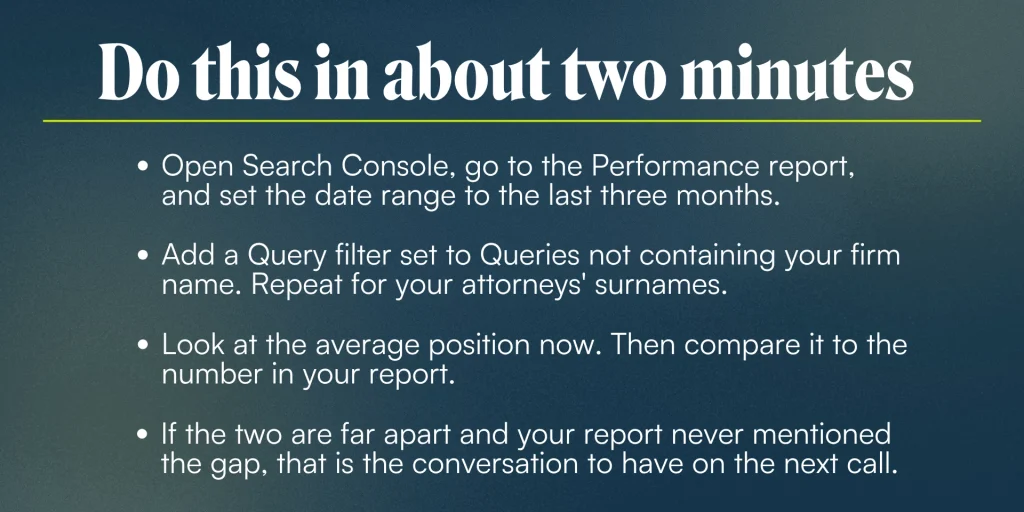
In Search Console, open the Performance report, set a three month date range, then add a Query filter set to Queries not containing your firm name, and repeat for your attorneys' surnames. The remaining average position is your non-branded position. It is almost always worse than the blended number, and the gap between the two tells you how much of your reported performance is really brand recognition.
Should I pay for an SEO report at all, or just use Google's free tools?
The tools are free and you should hold admin access to all of them regardless. What you are paying for is interpretation, reconciliation against your case management system, and the work itself. A report that only restates what Search Console already shows you is not adding anything. A report that tells you which five queries produced signed cases, what it cost to win them and what happens next is doing real work.