If you run Google Ads for your personal injury law firm, you already know clicks are expensive. Keywords like “car accident lawyer” routinely cost $150 or more per click. “Truck accident attorney” can push $300. In major metros, top personal injury terms regularly exceed $500 per click.
What most PI attorneys don't realize is that two firms bidding on the same keyword can pay wildly different amounts, and the difference has nothing to do with how much they bid. It has everything to do with their Google Ads Quality Score.
A firm with a Quality Score of 8 on a $150-per-click keyword pays about $94. A firm with a Quality Score of 3 pays $251 for that same click. That's $157 wasted on a single click.
At scale, that gap can mean tens of thousands of dollars per month either saved or squandered. This guide explains exactly how Quality Score works, why it hits personal injury lawyers harder than almost any other industry, and what you can do right now to bring your cost-per-click down without cutting your bids.
For a broader look across practice areas, see our guide on Google Ads Quality Score for Lawyers.
What Is Google Ads Quality Score and Why Does It Hit Lawyers Hardest?
Quality Score is Google's internal rating of how relevant and useful your ad experience is to the person who triggered it. It runs on a scale of 1 to 10. The higher your score, the less you pay per click and the better your ad placement, even if a competitor bids more than you do.
Google calculates Quality Score using three factors: your expected click-through rate (CTR), your ad relevance to the search query, and the quality of your landing page experience. We'll dig into each of these in detail below.
So why does this matter more for personal injury lawyers than for, say, a software company or an e-commerce brand?
Because of the base cost. When a software company has a low Quality Score, it might overpay by a few dollars per click. When a personal injury attorney has a low Quality Score on a high-value keyword, they overpay by hundreds of dollars per click. With a Quality Score of 1, Google can effectively increase your CPC by 400 percent. On a $150 keyword, that's $750 per click. On a $300 keyword, that's $1,200 for one click, from one person, who may not even call.
The legal industry also faces structural challenges that make Quality Score harder to achieve: intensely competitive keyword auctions, emotional ad copy that can depress CTR, and the near-universal tendency to send traffic to a generic homepage rather than a dedicated landing page. Understanding and fixing these issues is how elite PI firms separate themselves from competitors who quietly burn budget every day.
How Quality Score Directly Affects Your Cost-Per-Click
Google Ads uses an auction system to determine which ads appear and in what order. Ad Rank determines your position in that auction by multiplying your maximum bid by your Quality Score. The higher your Ad Rank, the better your placement and the less you actually pay per click.
Here's why that matters: You can have a lower bid than a competitor and still outrank them with a significantly higher Quality Score. Conversely, you can outbid every competitor in your market and still pay more per click than you should if your Quality Score is low.
The formula works like this: The CPC Google charges you is determined by the Ad Rank of the bidder below you divided by your Quality Score, plus one cent. In plain terms, a higher Quality Score reduces what you actually pay, regardless of what you bid.
The Quality Score CPC Multiplier Table
The table below shows how each Quality Score translates to a CPC discount or penalty, with examples based on a hypothetical $150 personal injury keyword:
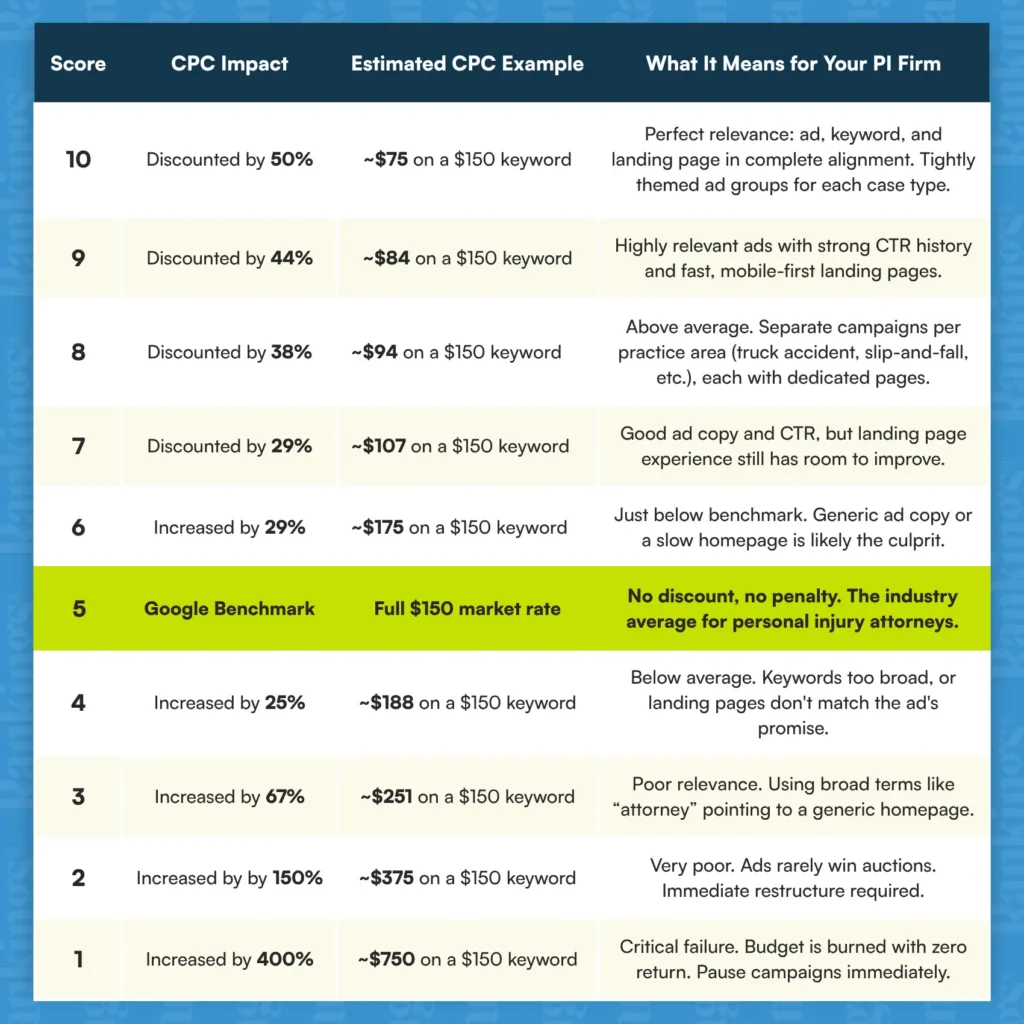
Note: We based CPC estimates above on published Quality Score discount/penalty data and a $150 base CPC example. Actual figures vary by market, keyword, and competition.
Real Example: What a PI Firm Pays at Score 3 vs. Score 8
Let's say a personal injury law firm in Chicago runs ads on “car accident lawyer chicago,” a keyword with a market CPC of $200.
Firm A has a Quality Score of 3. According to the multiplier data, they're paying a 67 percent premium. Their effective CPC is about $334.
Firm B has a Quality Score of 8. They're getting a 38 percent discount. Their effective CPC is approximately $124.
Both firms bid on the same keyword. Firm B gets better placement and pays $210 less per click. Over a month of running 500 clicks, Firm B saves approximately $105,000 compared to Firm A. That's not a rounding error. That's the entire difference between a profitable Google Ads campaign and one that hemorrhages money.
The 3 Factors Google Uses to Grade Your Personal Injury Ads
Google doesn't reveal the exact weights it assigns to each Quality Score factor, but it does tell you how your account performs on each one. Inside Google Ads, you'll see each keyword rated as “Above Average,” “Average,” or “Below Average” for all three components. Here's what each one means in the context of a personal injury law firm.
1. Expected Click-Through Rate (CTR)
Expected CTR measures how likely Google thinks users are to click your ad when it appears for a given keyword, based on your historical performance and how your ad compares to others in the same auction.
For personal injury attorneys, this is often the hardest component to improve because PI advertising has inherent CTR friction. Users searching for a personal injury lawyer are often in a stressful situation, scanning multiple ads quickly, and highly attuned to trust signals. Generic headline structures like “Experienced Personal Injury Attorney” do not create urgency or differentiation.
High-CTR ad copy for PI firms tends to:
- Lead with a result or social proof (“Over $500M Recovered for Injury Victims”)
- Speak directly to the situation (“Hurt in a Car Accident? We Can Help”)
- Eliminate friction around cost (“Free Consultation. No Fee Unless You Win”)
- Create geographic specificity (“Chicago Car Accident Lawyer — Available 24/7”)
Because your historical performance influences expected CTR, a new campaign starts with neutral data. Improving your CTR over time is one of the most durable investments you can make in your Quality Score.
2. Ad Relevance
Ad relevance measures how closely your ad copy matches the intent of the keyword that triggered it. Google looks for alignment between what someone searched for and what your ad says.
This is where most PI law firms lose points without realizing it. The common approach is to run a single campaign with broad keywords like “personal injury lawyer” or “accident attorney” and use one set of ads for all of them. To Google, an ad that says “Personal Injury Attorneys” responding to a search for “truck accident lawyer near me” is only loosely relevant.
The fix is tightly themed ad groups: separate ad groups for car accidents, truck accidents, slip-and-fall cases, motorcycle accidents, and any other major case type your firm handles. Each group uses keywords specific to that case type, and each ad directly speaks to that situation. When someone searches “truck accident attorney chicago,” they see an ad that says “Chicago Truck Accident Lawyer,” not a generic PI ad.
3. Landing Page Experience
Landing page experience is Google's assessment of what happens after someone clicks your ad. It evaluates page load speed, mobile usability, how closely the page content matches the ad's promise, and whether the page provides a clear, easy path for the visitor to take action.
PI law firms lose the most Quality Score points here, and the damage is almost always self-inflicted. The most common mistake is sending all ad traffic to the firm's homepage. A homepage should introduce your firm to visitors who may be exploring. A landing page should serve only one purpose: converting a visitor who already knows they need a lawyer into a consultation call or form submission.
Google penalizes pages with slow load times (over three seconds on mobile is a significant red flag), cluttered layouts with multiple competing calls to action, content that doesn't match the ad's message, and pages that are difficult to navigate on a smartphone.
A high-quality PI landing page for a specific case type should have a single clear headline matching the ad, a brief description of why the firm is the right choice, a prominent phone number or contact form above the fold, social proof such as verdicts or client reviews, and lightning-fast load time on mobile.
Why Personal Injury Lawyers Struggle With Quality Score More Than Other Industries
Quality Score optimization is hard for every advertiser, but personal injury law firms face a unique set of challenges that make it structurally more difficult to achieve high scores. Understanding these friction points is the first step to working around them.
Hyper-competitive keyword auctions depress baseline CTR.
When five to seven law firms all bid on the same high-value keyword, even a well-written ad will earn fewer clicks than it would in a less competitive market. Google's expected CTR benchmark is partly relative to other ads in the same auction, which means it grades PI attorneys on a steep curve.
Emotional subject matter makes ad copy difficult to calibrate.
Writing ad copy for someone who a car accident has just injured requires striking a balance between urgency and empathy. Copy that's too aggressive feels exploitative. Copy that's too soft doesn't convert. Copy that focuses on legal jargon rather than the client's situation misses the point entirely. Getting this balance right requires disciplined A/B testing, and most firms don't have a structured testing process in place.
Broad keyword strategies create systemic relevance gaps.
Many PI firms use a small number of broad-match keywords to try to capture as much traffic as possible. This strategy consistently produces low ad relevance scores because broad match keywords trigger ads for queries that are only tangentially related to the firm's actual services.
Generic homepages kill landing page scores.
Most PI firms send all paid traffic to their website's homepage. Homepages are not optimized for conversion. They're optimized for introducing the firm. This is perhaps the single most common and most fixable cause of low Quality Scores in personal injury marketing.
Slow, information-heavy websites hurt mobile performance.
Law firm websites tend to be content-rich, image-heavy, and built with desktop visitors in mind. Most people searching for a personal injury lawyer after an accident do so on their phones, often while still at the scene or in the hospital. A page that takes five seconds to load on a mobile connection loses clients and earns a “Below Average” landing page experience score from Google.
How to Audit Your Current Quality Score in Google Ads
Before you can improve your Quality Score, you need to know where you stand. Here's how to find your current scores and diagnose the specific problems dragging them down.
Step 1: Find Your Quality Score Columns
- Log in to Google Ads and navigate to your campaign.
- Click “Keywords” in the left-hand navigation.
- Click the column icon at the top right of the table.
- Under “Quality Score,” add: Quality Score, Landing Page Experience, Ad Relevance, and Expected CTR.
- Click Apply. You'll now see scores and component ratings for each keyword.
Step 2: Interpret What You're Seeing
Each component is rated as Above Average, Average, or Below Average. Here's how to read the results:
- If Expected CTR Is Below Average: Your ad copy isn't compelling enough relative to competitors, or your keyword-to-ad match is too loose.
- If Ad Relevance Is Below Average: Your ad groups are too broad, or your ad headlines don't include the keyword intent.
- If Landing Page Experience Is Below Average: Your page is slow, poorly matched to the ad, or not converting mobile visitors effectively.
Step 3: Prioritize by Keyword Value
Not all keywords are worth fixing. Sort your keywords by cost (total spend) and focus Quality Score improvements on the keywords costing you the most money. A 3-point improvement on a $200-per-click keyword delivers far more value than the same improvement on a $15-per-click keyword.
5 Ways to Improve Quality Score for Your Personal Injury Law Firm
1. Build Tightly Themed Ad Groups by Case Type
This is the single highest-impact structural change most PI firms can make. Instead of one ad group for all personal injury keywords, create separate ad groups for each major case type your firm handles: car accidents, truck accidents, motorcycle accidents, slip and fall, wrongful death, dog bites, and so on.
Each ad group should contain only keywords directly related to that case type, and each ad in the group should speak specifically to that situation. When your keyword, ad, and landing page all say the same thing, Google recognizes the alignment and rewards you with higher ad relevance scores.
As a starting point, aim for ad groups of five to fifteen tightly related keywords. If you find yourself grouping “car accident lawyer” and “truck accident attorney” into the same ad group because they feel similar, resist the urge. They represent different situations, different legal considerations, and different client mindsets.
2. Match Your Ad Headline Directly to the Search Intent
Your ad's headline, specifically Headline 1, should mirror the keyword as closely as possible while still reading naturally. If someone searches “motorcycle accident lawyer chicago,” your headline should say “Chicago Motorcycle Accident Lawyer” or something equally direct.
Beyond the first headline, the remaining headlines and descriptions allow you to address CTR. Test combinations that include:
- Your firm's primary social proof (“Over $1B Recovered for Clients”)
- Fee structure reassurance (“No Fee Unless You Win”)
- Availability signals (“Free Consultation — Available 24/7”)
- Urgency without pressure (“Time Limits May Apply to Your Claim”)
Use responsive search ads with at least eight to ten headline variations and four description variations. Google will test combinations and optimize toward the highest-performing versions over time.
3. Build Dedicated Landing Pages for Each Case Type
Every ad group should have its own landing page, not your homepage, not your general personal injury page. A dedicated landing page for car accident cases should open with a headline like “Car Accident Lawyer in [City] - Free Case Review” and contain nothing that distracts from the conversion.
The anatomy of a high-converting PI landing page:
- A clear, case-specific headline above the fold that matches the ad
- A single call to action — phone number, form, or both — visible without scrolling
- Three to five trust signals: notable verdicts, years in practice, bar memberships, client reviews
- A brief explanation of what happens when someone calls or submits the form
- No navigation menu — the only place the visitor should go is into your intake process
On the technical side, your landing page must load in under three seconds on a mobile connection. Use Google PageSpeed Insights to measure this. Compress images, minimize scripts, and use a content delivery network if your site isn't already on one.
4. Use Ad Extensions to Improve CTR Without Changing Bids
Ad extensions expand your ad's footprint in search results and give users more reasons to click without costing anything extra unless someone clicks an extension link.
For personal injury attorneys, the most impactful extensions are:
- Call extensions: Display your phone number directly in the ad. On mobile, users can call without ever visiting your site. This is especially powerful for PI ads, where many prospective clients prefer calling over submitting a form.
- Sitelink extensions: Add links to specific case-type pages, your verdicts page, or your client testimonials. Sitelinks give users multiple entry points and can improve overall CTR significantly.
- Callout extensions: Short, non-clickable phrases that add persuasive detail — “No Upfront Fees,” “Se Habla Espanol,” “30+ Years of Experience,” “Free Consultations.”
- Location extensions: Especially important for firms advertising locally. Showing your office address alongside the ad builds credibility and can improve CTR from users who prioritize proximity.
5. Pause Low-CTR Keywords Before They Drag Down Your Score
Most firms skip this step, and it costs them. A keyword with a consistently low CTR doesn’t just fail to help your Quality Score, it actively harms it. Google uses historical performance data when calculating expected CTR, so a keyword with a long history of low click rates becomes a liability.
The threshold to watch: If a keyword generates more than 200 impressions and has a CTR below 1 percent with no corresponding Quality Score improvement, consider pausing it. Either the keyword is too broad, the ad copy doesn't resonate with that specific query, or the intent doesn't match what you offer.
Before pausing, check whether the keyword might perform better in a more tightly themed ad group with more targeted copy. Sometimes the problem isn't the keyword — it's the mismatch between the keyword and the ad assigned to it.
What a Good Quality Score Looks Like for PI Lawyers (Benchmarks)
There is no single “good” Quality Score that applies universally, but here is a realistic framework for personal injury attorneys in competitive markets:
- Scores of 7–10 are exceptional for PI keywords. If you consistently hit these scores on your highest-value keywords, your campaigns are likely among the most efficient in your market.
- Scores of 5–6 are average. You're paying market rate or a modest premium. There's room to improve, but the situation isn't urgent.
- Scores of 3–4 are a warning sign. You're paying significantly more per click than competitors with better-optimized accounts. This range should trigger an immediate audit.
- Scores of 1–2 are a crisis. PPC is consuming your budget at a rate two to five times higher than necessary. Pause, restructure, and relaunch campaigns in this range before you spend another dollar.
Industry data suggests the average Quality Score across Google Ads accounts is approximately 5, the Google benchmark. Personal injury law firms tend to cluster slightly below this average due to the structural challenges described earlier. Reaching a consistent average of 6 or 7 across your primary keywords puts you meaningfully ahead of most competitors.
Quality Score vs. Ad Rank: The Difference That Matters for Your Budget
These two terms are related but not identical, and understanding the distinction helps clarify why Quality Score improvements deliver compounding returns.
Ad Rank is the formula Google uses in each individual auction to determine where your ad appears and how much you pay. It calculates your rate using your maximum bid, your Quality Score, the expected impact of your extensions, and the auction-time context of the search. Ad Rank changes with every single auction. It is dynamic.
Quality Score is the underlying performance rating that feeds into Ad Rank. Google updates it periodically based on your historical performance data and is the factor most within your control. While you cannot directly control what your competitors bid, and you have limited influence over the auction-time context factors, you have complete control over your ad copy, your landing page, and your keyword organization — all of which drive Quality Score.
The compounding dynamic works like this: As your Quality Score improves, your Ad Rank improves even at the same bid level. Higher Ad Rank means better placement, which means more impressions in the top positions, which typically means higher CTR, which further improves your expected CTR component of Quality Score. Improvement in one area reinforces the others.
This is why treating Quality Score optimization as a one-time project misses the point. The PI firms that maintain the lowest cost-per-click over time are the ones that treat it as ongoing infrastructure, continuously testing ad copy, monitoring landing page performance, refining keyword structure, and acting quickly when any component dips Below Average.
Frequently Asked Questions
How long does it take to see Quality Score improvements after making changes?
Google updates Quality Score as new performance data accumulates. Minor improvements can appear within a few days if a keyword has high impression volume. For lower-volume keywords, it may take two to four weeks to see meaningful changes reflected in the score.
Does Quality Score affect my organic search rankings?
No. Quality Score is a Google Ads metric and has no influence on your organic SEO rankings. The two systems operate completely independently. However, the same landing page improvements that raise your Quality Score (faster page speed, clearer content, better mobile experience) also tend to support better organic rankings indirectly.
Can I have a high Quality Score with a low bid?
Yes. Quality Score and your bid are separate inputs into Ad Rank. A firm with a Quality Score of 9 and a modest bid can outrank a firm with a Quality Score of 4 and a much higher bid. This makes Quality Score optimization one of the highest-ROI investments in paid search. It delivers better placement while reducing what you pay per click.
Why is my Quality Score showing as a dash instead of a number?
A dash typically indicates that Google does not yet have enough data on that keyword to calculate a reliable Quality Score. This happens with new keywords or very low-volume terms. Continue running the keyword to accumulate impression and click data, and the score will populate over time.
Should I pause keywords with a Quality Score of 1 or 2?
In most cases, yes, at minimum, you should pause them while you diagnose the problem and restructure the relevant ad group. Running keywords with scores of 1 or 2 is equivalent to paying a 150 to 400 percent surcharge on every click. The exception would be a highly strategic keyword where you're willing to absorb the cost premium while working to improve the score, but this should be a deliberate choice, not a passive one.
Is a Quality Score of 5 considered bad for a personal injury attorney?
A score of 5 is the Google benchmark. It means you're paying market rate, with no discount and no penalty. It is not bad, but it is also not competitive. In an industry where keywords cost $150 to $500 per click, the difference between a 5 and a 7 or 8 can easily represent $50 to $100 in savings per click. For high-volume campaigns, that translates to significant monthly savings.
The Bottom Line
Google Ads Quality Score is one of the most leveraged variables in personal injury law firm marketing. In an industry where a single signed case can result in $50,000 to $500,000 in fee revenue, the difference between a Score of 3 and a Score of 8 on your primary keywords is not a minor operational detail, it is a fundamental competitive advantage.
The mechanics are clear: Improve your ad relevance through tightly themed ad groups, improve your expected CTR through disciplined copy testing, and improve your landing page experience through dedicated, fast, conversion-focused pages for each case type. Do those three things consistently, and your cost-per-click will fall while your ad placement improves.
Rankings.io works with personal injury law firms. If your Google Ads campaigns are spending budget without delivering consistent, qualified cases, or if you suspect your Quality Scores are costing you more than you realize, we can audit your account and show you exactly where the leaks are.