Legal advertising is among the most expensive categories in Google Ads: full stop. Family law, criminal defense, immigration, estate planning, employment law: Every practice area competes in a paid search environment where a single click from a prospective client can cost anywhere from $30 to well over $200.
Most law firms treat that cost as a fixed reality of the market. It isn't. Two attorneys in the same city, bidding on the same keyword, can pay dramatically different amounts per click, and the gap has nothing to do with who bids higher. It comes down to a number between 1 and 10 that most lawyers have never looked at: their Google Ads Quality Score.
A firm with a Quality Score of 8 on a $100 keyword pays roughly $62. A firm with a Quality Score of 3 on that same keyword pays roughly $167. Same keyword. Same city. Same auction. One firm pays 2.7 times more per click than the other and loses placement on top of it.
This guide explains how Quality Score works, what drives it up or down in legal advertising, and the specific steps any law firm can take to bring their cost-per-click down without reducing their bids.
What Is Google Ads Quality Score?
Google assigns a Quality Score of 1 to 10 to each keyword in your Google Ads account. It represents Google's assessment of how relevant and useful your ad experience is compared to other advertisers targeting the same keyword.
The score consists of three components: your expected click-through rate (how likely users are to click your ad when it appears), your ad relevance (how closely your ad copy matches the intent behind the search query), and your landing page experience (how useful, fast, and relevant your page is after someone clicks).
Each component is rated as Above Average, Average, or Below Average in your Google Ads account. The combination of these ratings determines your overall Quality Score, which then directly influences two things that matter enormously to any law firm running paid search: how much you pay per click and where your ad appears on the page.
A high Quality Score signals to Google that your ads are genuinely useful to the people searching. Google rewards that with lower costs and better placement — even if competitors bid more than you. A low Quality Score signals poor relevance, and Google charges a premium for it.
How Quality Score Affects What Your Law Firm Pays Per Click
Google Ads uses an auction system. Every time a user conducts a search that matches one of your keywords, an auction occurs in milliseconds. Ad Rank determines your position in that auction by multiplying your maximum bid by your Quality Score and factoring in your expected ad extension impact.
To see how this plays out in a high-stakes practice area, read our guide on Google Ads Quality Score for Personal Injury Lawyers.
The important implication: Your bid and Quality Score are interchangeable levers. You can achieve the same Ad Rank by bidding more or by improving your Quality Score. The difference is that improving your Quality Score also reduces the cost per click Google charges you, while increasing your bid only increases it.
Here is how the Quality Score multiplier translates to real CPC impact across all ten score levels:
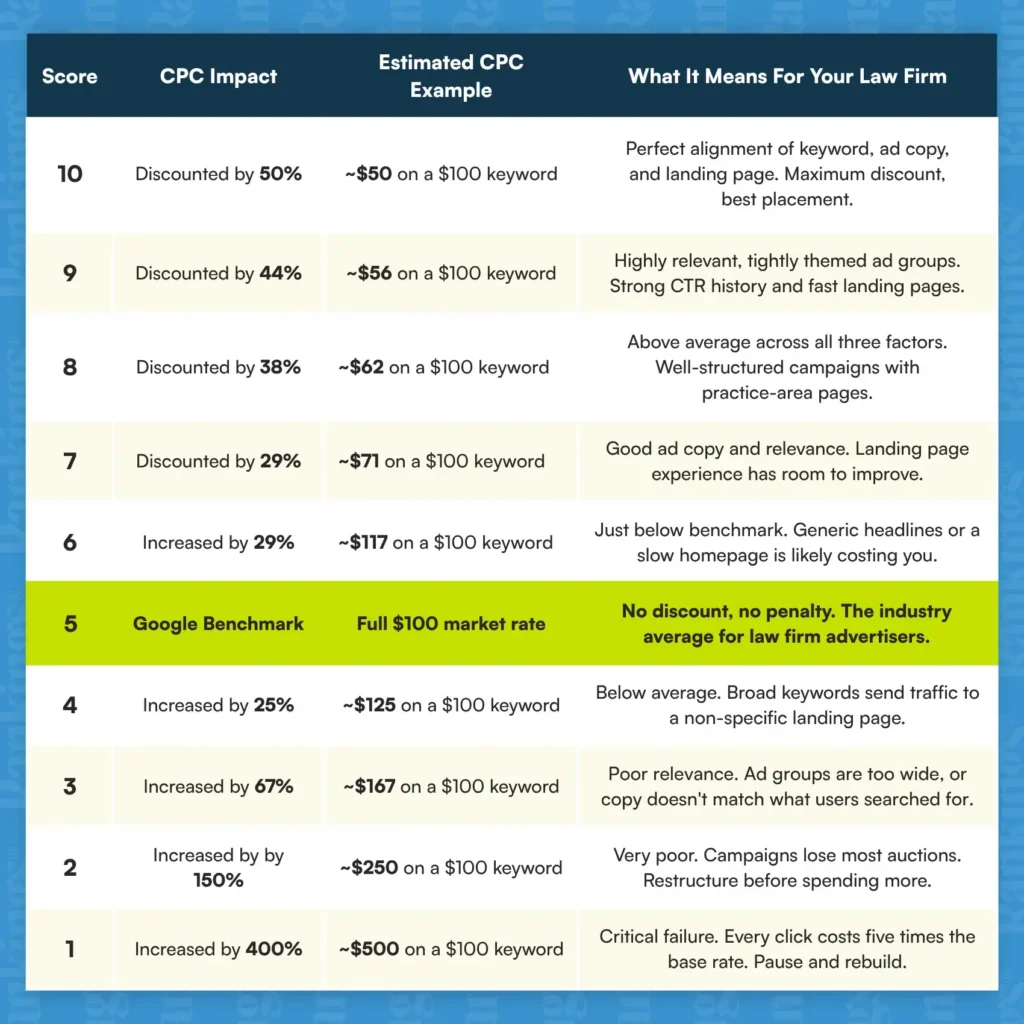
We base CPC examples above on a $100 base keyword rate. Legal CPCs vary widely by practice area and market. Family law keywords average $6–$30. Immigration law keywords range from $10–$50. Criminal defense can reach $80–$150 in competitive markets. The multiplier effect applies at every price point.
The 3 Components Google Uses to Calculate Your Score
Expected Click-Through Rate
Expected CTR measures how likely Google predicts users are to click your ad when it appears for a given keyword. Google bases it on your ad's historical click performance and adjusts for factors like your position in the results.
For law firms, the specificity and emotional resonance of your ad copy heavily influences CTR. An ad that reads "Experienced Family Law Attorney" in a market full of similar ads earns a predictably low CTR. An ad that reads "Divorce Lawyer in [City] — Protecting Your Interests Since 2002. Free Consultation" gives users a clear reason to click and differentiates the firm from generic competitors.
CTR also varies meaningfully by practice area. Criminal defense ads tend to earn higher CTRs because the emotional urgency of the situation drives action. Estate planning ads face lower average CTRs because many users are still in research mode and not yet ready to contact an attorney.
Ad Relevance
Ad relevance measures how closely the language and intent of your ad matches the keyword that triggered it. Google looks for meaningful alignment between what a user searched for and what your ad says in response.
The most common relevance problem in law firm Google Ads accounts is using a small number of broad ad groups to cover a wide range of keywords. A criminal defense attorney running one ad group for "DUI lawyer," "assault attorney," "federal defense lawyer," and "drug charge attorney" will almost certainly earn a Below Average ad relevance score on most of those keywords. Each of those queries represents a different situation, a different level of urgency, and a different user mindset. A generic criminal defense ad doesn’t speak directly to any of them.
The fix is tightly themed ad groups: one set of ads for DUI, another for assault charges, another for drug offenses. When your ad's headline directly addresses what the user searched for, ad relevance improves.
Landing Page Experience
Landing page experience is Google's evaluation of what happens after the click. It considers page load speed (especially on mobile), how closely the page content matches the ad's message, ease of navigation, and whether the page provides a clear next step for the visitor.
This is consistently the weakest component in law firm Google Ads accounts. The near-universal default is to send all ad traffic to the firm's homepage or general practice area page. A homepage should introduce the firm to an unfamiliar visitor. A landing page should do one thing: convert a visitor who already knows they need legal help into a consultation inquiry.
When someone clicks an ad for “immigration lawyer free consultation,” they should land on a page that says exactly that, not a homepage about the firm's full range of services. The mismatch simultaneously costs the firm points on landing-page relevance and conversion rate.
Why Legal Advertising Scores Below Average (and What to Do About It)
Law firms tend to score below the Google benchmark of 5 on Quality Score. The reasons are structural, not unique to any individual firm.
1. Broad keyword strategies create relevance gaps at scale.
Many law firms use broad match or broad match modified keywords to capture as much search volume as possible. This reliably generates impressions from queries that are only loosely related to the ad, which depresses both CTR and ad relevance across the account.
2. Homepages are the wrong destination for paid traffic.
Law firm homepages are typically designed for organic visitors who are exploring the firm's capabilities. They contain multiple practice areas, attorney bios, and links to dozens of other pages. A paid search visitor who clicked on a specific ad for a specific legal problem is not in exploration mode. They want immediate confirmation that this firm handles their situation and a frictionless path to contact. A homepage fails both tests.
3. Mobile performance is often an afterthought.
Most people conduct legal queries on mobile devices, often at high-stress moments—after an accident, following an arrest, during a custody dispute. Law firm websites are frequently slow on mobile, with large images, heavy scripts, and layouts that don’t suit a five-inch screen. Google's landing page experience score reflects this, and so does your conversion rate.
4. Ad copy testing is rarely systematic.
Most law firms write a set of ads when a campaign launches and never revisit them. Without ongoing A/B testing, the law firm will never know whether the ad copy has earned the CTR it could. Meanwhile, stagnant copy that accumulates a history of low CTR drags down the expected CTR component of Quality Score over time.
4 High-Impact Fixes Any Law Firm Can Implement
1. Restructure Into Practice-Area Ad Groups
Reorganize your campaigns so that each distinct legal service has its own tightly focused ad group. Family law firms should have separate groups for divorce, child custody, spousal support, and adoption. Criminal defense firms should separate DUI, drug charges, assault, and federal cases. Immigration attorneys should separate visas, green cards, deportation defense, and citizenship.
Each group uses only keywords directly related to that specific service. Each ad speaks directly to that specific situation. The result is higher ad relevance scores across the account and stronger CTR because users see ads that match exactly what they searched for.
2. Build Dedicated Landing Pages for Each Service
Create a separate landing page for each major ad group, not a full website page, but a conversion-focused page with a single purpose: turn the visit into a consultation request. The page should open with a headline that matches the ad, include a prominent phone number or short contact form above the fold, and contain enough social proof (case results, client testimonials, bar memberships, years in practice) to establish credibility immediately.
Remove the navigation menu. On a landing page, the only direction a visitor should be able to go is toward contacting your firm. Every other link is an exit.
On the technical side, the page must load in under three seconds on a mobile connection. Test this with Google PageSpeed Insights before running traffic to it. Compress images, minimize third-party scripts, and prioritize above-the-fold load time.
3. Write Ad Copy That Earns the Click
Your ad headlines, especially the first headline, should directly reflect the keyword the ad group targets. Beyond relevance, the remaining headlines and descriptions carry your conversion argument.
For legal advertising, the most effective elements tend to be:
- A fee structure that removes hesitation: "Free Consultation," "No Fees Unless You Win”
- A trust signal specific to the practice area: "Board Certified Family Law Specialist," "500+ DUI Cases Defended”
- Availability reassurance: "Available 24/7," "Same-Day Appointments”
- Geographic specificity: "[City] Immigration Lawyer," "Serving [County] for 20+ Years”
Use responsive search ads with at least eight headline variations. Google will test combinations automatically and favor the highest-performing ones, which, with time, feeds better CTR data back into your Quality Score.
4. Monitor and Pause Underperforming Keywords
Add the Quality Score columns to your keywords view in Google Ads: Quality Score, Expected CTR, Ad Relevance, and Landing Page Experience. Review them monthly. Any keyword showing Below Average on two or more components actively harms your account's performance and costs you a significant CPC premium.
For keywords with fewer than 100 impressions, withhold judgment. There isn't enough data yet. For keywords with significant impression volume and persistent Below Average ratings, either restructure the ad group around them or pause them. A keyword you pause stops hurting you. A keyword you leave running at a Quality Score of 2 or 3 charges you 67 to 150 percent above market rate on every click.
Quality Score Benchmarks for Law Firms
Here is a realistic framework for interpreting your scores in a legal advertising context:
- 7 to 10: Excellent. You're receiving meaningful CPC discounts and competitive ad placement. Your account structure, copy, and landing pages work in alignment.
- 5 to 6: Average. You're at or just above market rate. There is room to improve, and doing so will deliver measurable cost savings, but the situation isn't urgent.
- 3 to 4: Below average. You're paying a 25 to 67 percent premium on clicks. Audit your ad groups, copy, and landing pages.
- 1 to 2: Critical. Your campaigns are significantly inefficient. Pausing and rebuilding the affected ad groups will almost always cost less than continuing to run them.
The average Quality Score across Google Ads accounts is approximately 5. Law firms as a category tend to cluster between 4 and 6. Reaching a consistent average of 7 or above puts your firm in the top tier of legal advertisers, paying less per click, appearing higher in results, and generating more leads per dollar of ad spend.
Frequently Asked Questions
Does Quality Score affect my organic rankings?
No. Quality Score is a Google Ads metric only and has no influence on your organic search rankings. The two systems operate independently. That said, the improvements that raise Quality Score (faster pages, clearer content, better mobile experience) often support stronger organic performance as well.
How quickly will my Quality Score change after I make improvements?
Google updates Quality Score as new performance data accumulates. High-volume keywords can show changes within a few days. Lower-volume keywords may take two to four weeks to reflect meaningful improvements.
Can a high Quality Score offset a lower bid?
Yes. This is one of the most important dynamics in paid search. A firm with a Quality Score of 8 and a modest bid can outrank a competitor with a Quality Score of 4 and a much higher bid. Quality Score and bid are both inputs into Ad Rank, and they are interchangeable. Improving your Quality Score is functionally equivalent to increasing your bid but it also reduces your cost per click rather than increasing it.
Which practice areas have the highest average CPCs?
Legal keywords are consistently among the most expensive in Google Ads. Mesothelioma and mass tort keywords frequently top the list nationally, sometimes exceeding $500 per click. Personal injury, criminal defense, and DUI keywords in major markets often range from $80 to $200. Family law, immigration, and estate planning keywords tend to cost less, typically $10 to $60, but still far above most other industries. At every price point, Quality Score improvements deliver proportional savings.
Should I pause campaigns with low Quality Scores rather than fixing them?
It depends on the campaign's overall performance. If a campaign generates signed cases at an acceptable cost despite low Quality Scores, restructuring it may get the same cases for less money. If a campaign does not generate cases and has low Quality Scores, pausing it and rebuilding from scratch is usually faster than trying to repair a poorly structured account. In either case, continuing to run campaigns at Quality Scores of 1 or 2 without addressing the underlying problems is difficult to justify.
The Bottom Line
Quality Score is not a vanity metric. For law firms spending thousands of dollars per month on Google Ads, it is the single most controllable variable in determining what each click actually costs. The mechanics are not complicated: Tighter ad group structure improves relevance, better ad copy improves CTR, and dedicated landing pages improve conversion and page experience scores. Each improvement compounds the others.
Rankings.io works exclusively with law firms. If your Google Ads campaigns generate impressions without generating cases, or if you suspect your Quality Scores are quietly inflating your cost per lead, we can audit your account and show you exactly where the inefficiency lives.