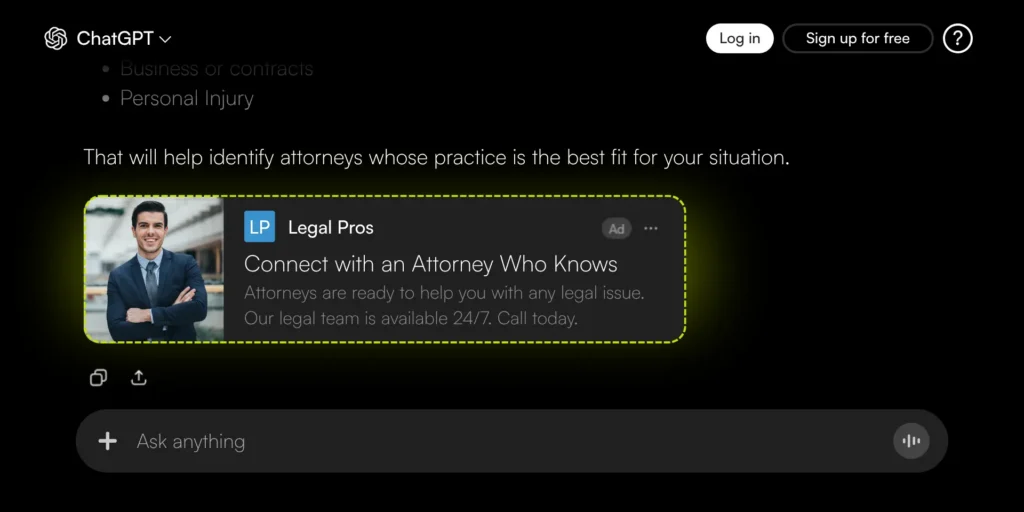
Lawyers can take out ChatGPT ads that appear in a clearly labeled box below responses when a conversation signals legal intent.
OpenAI's ad policy currently prohibits ads that offer legal services, so law firms advertise compliantly by promoting educational content through the OpenAI Ads Manager, while building organic AI visibility to get recommended inside the answers themselves.
Key Takeaways
- OpenAI opened self-serve advertising in ChatGPT in May 2026, with CPC bidding and no minimum spend, but its policy blocks ads for legal representation, advice, and case reviews across every practice area.
- ChatGPT allows legal education and media ads. Free guides, webinars, checklists, and video content can run. "Free consultation" and "hire us" offers cannot.
- Build campaigns in the OpenAI Ads Manager (ads.openai.com) using audience descriptions and context hints instead of keyword bidding. Targeting is conversational, not query-based.
- Ads appear only to Free and ChatGPT Go users in live markets (U.S., Canada, Australia, New Zealand, and the U.K. as of mid-2026). Paid subscribers never see them.
- Native reporting is thin, so firms need dedicated landing pages, UTM tagging, and ChatGPT-specific tracking numbers to attribute signed cases.
- The bigger long-term win is when ChatGPT organically recommends you. Paid and organic AI visibility work best as one system.
What Are ChatGPT Ads for Lawyers?
ChatGPT displays sponsored placements beneath ChatGPT's answers when a conversation matches an advertiser's targeting criteria.
For law firms, they represent the first opportunity to put paid messaging in front of people at the exact moment they describe a legal problem to an AI, a moment of intent that no search engine has ever captured this directly.
How We Got Here: The 2026 Rollout Timeline
The platform moved from announcement to open access in under five months.
OpenAI announced its advertising plans on January 16, 2026, alongside the launch of ChatGPT Go, an $8/month mid-tier subscription. Live testing began in the U.S. on February 9 for logged-in adult users on the Free and Go tiers.
By mid-April, ads had expanded to Canada, Australia, and New Zealand, and in May 2026 OpenAI opened a self-serve Ads Manager that any business can use: CPC bidding, no minimum spend, no agency requirement. The U.K. followed, with Mexico, Brazil, Japan, and South Korea announced as the next wave.
That pace matters for law firms.
Every previous ad platform (Google Ads, Facebook, TikTok) followed the same arc: Early adopters bought attention cheap, the market caught on, and costs climbed. Legal is consistently among the most expensive verticals on every mature platform. ChatGPT is at the beginning of that curve right now.
How the Ads Actually Appear
ChatGPT ads don't interrupt the AI's answer. They appear as a distinct block at the bottom of the organic response, clearly labeled "Sponsored" and visually separated with their own styling. OpenAI has explicitly stated that ads never influence the substance of the answer itself, and that it does not sell user conversation data to advertisers.
Each placement includes a headline, a short description, and a link, closer to a native search ad than a social feed unit. The critical difference is what triggers it: not a keyword, but the context of the conversation.
Why This Matters for Law Firms
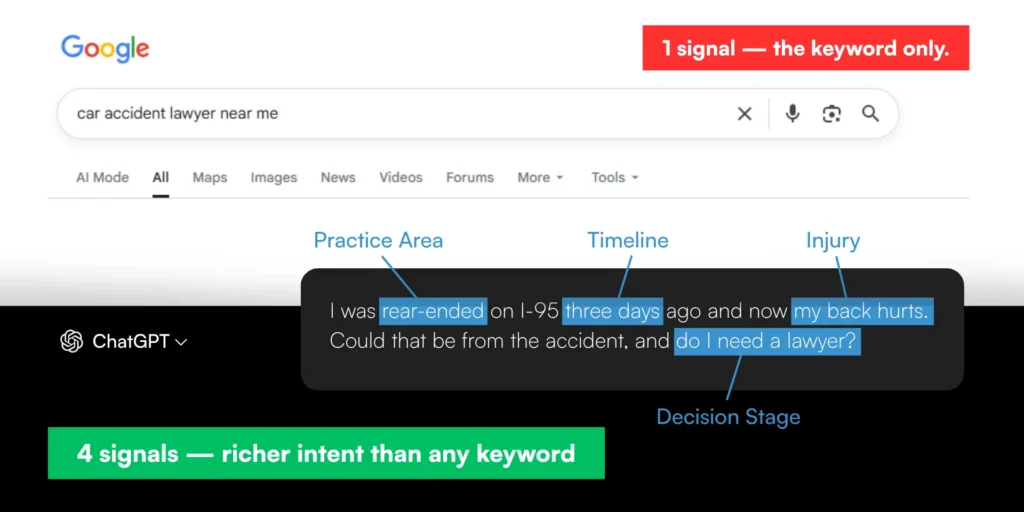
People don't type keywords into ChatGPT, they describe situations. Instead of "car accident lawyer near me," a potential client writes: "I was rear-ended on I-95 three days ago and now my back hurts. Could that be from the accident, and do I need a lawyer?" That single message contains the practice area, the injury, the timeline, and the decision stage, all richer intent data than any Google query has ever carried.

This applies across practice areas. Family law prospects describe custody situations. Criminal defense prospects describe arrests. Estate planning prospects describe family circumstances. In every one of those conversations, a potential client articulates their exact legal need in plain language, and ChatGPT's contextual targeting matches ads to precisely that.
We covered why this conversational shift changes paid strategy in our guide to AI advertising for law firms.
Two constraints matter before you spend a dollar, though.
First, ads only reach Free and ChatGPT Go users. Paid subscribers on Plus, Pro, Business, and Enterprise never see them, so ads alone can't cover your full market.
Second, and far more importantly: OpenAI doesn't allow legal services ads at all.
How to Get Legal Ads Approved in ChatGPT
Approval comes down to one distinction: ChatGPT allows education, not representation. OpenAI's official ad policy prohibits ads for legal advice, representation, or legal services, whether offered to individuals or businesses, and specifically names immigration, personal injury, legal claims, and document preparation. The restriction covers essentially every campaign law firms run on Google and Meta today.
What ChatGPT Rejects
If the ad or its landing page offers to represent someone or review their case, ChatGPT will reject it. That includes the entire standard legal PPC playbook:
- "Injured in a car accident? Speak to a lawyer today."
- "Free case evaluation" or "free consultation" offers
- "Get the compensation you deserve"
- "Immigration consultation available now"
- Any click that lands on an intake form or "book a call" page
What Gets Approved
The same policy carves out one lane: ChatGPT allows ads for general legal education or media when lawyers offer no legal services. That exception is the entire approval playbook.
Compliant campaigns look like:
- "Free guide: what to do in the first 48 hours after a car accident" → downloadable PDF
- "Watch: how injury settlements actually work" → YouTube explainer
- "The 5 mistakes that can hurt a custody case" → educational checklist
- A legal podcast, book, or plain-English video series → media property
The test OpenAI applies is substance, not phrasing. If your "free guide" page is a thinly disguised intake funnel—a two-paragraph PDF gated behind a case-evaluation form—expect ChatGPT to pull the ad. You need to offer reall education.
As a YMYL category, everyone holds legal content to a high trust bar, and the same E-E-A-T principles that govern your Google rankings should govern what you put behind an AI ad: real authorship, real expertise, genuinely useful content.
The April 2026 Placement Change (and What It Doesn't Mean)
One nuance trips up a lot of law firms.
In April 2026, OpenAI stopped categorically blocking ads from appearing around legal-topic conversations. Some marketers read that as the legal ad ban loosening. It wasn't. It was a placement change. Other advertisers' ads can now show inside legal-related chats, not just legal ads.
Law firms still cannot advertise legal services. The distinction matters because it means ChatGPT will monetize its audience while locking legal advertisers are out of direct offers, which makes the education lane more valuable, not less.
How to Run ChatGPT Ads as a Law Firm (Step by Step)
A compliant first campaign takes about an hour to build and roughly $1,000/month to learn from. Here's the full process:
Step 1: Create Your Account at the OpenAI Ads Manager
Go to ads.openai.com and set up a business account. The platform is self-serve with no minimum spend and no approval gate to get in. The review happens at the ad level, not the account level.
Use your firm's primary domain and business details. Mismatched or vague business information invites extra scrutiny in ad review.
Step 2: Choose Your Educational Asset Before You Build Anything
This is where most firms get it backwards.
Don't write an ad and then scramble for a landing page. Pick the asset first. Audit what you already have: your most-viewed blog post, your best-performing YouTube video, a guide your intake team wishes every client had read.
If you produce content for social already, you can repackage much of it. The same assets driving your AI-powered social media strategy make natural ad destinations.
Step 3: Structure Your Campaign by Intent Stage, Not Just Practice Area
Create separate ad groups for early-stage conversations ("what should I do after an accident") and late-stage ones ("how do settlement negotiations work").
Each stage gets its own asset and creative. One catch-all campaign per practice area wastes the platform's biggest advantage: knowing where the prospect is in their decision.
Step 4: Set Your Audience and Context Hints
There's no keyword bidding. Instead, you describe your ideal audience, your geography, and, through context hints, the kinds of conversations where your ad belongs.
Be specific: "adults in Georgia discussing recent car accidents, injuries after collisions, or insurance claim problems" will match better than "people who need a personal injury lawyer." Think in situations, not search terms.
Step 5: Write Education-First Creative
Lead with the resource and what the reader will learn, not with your firm. "Free 12-page guide: how injury claims actually get valued" is compliant and compelling.
"Top-rated injury attorneys: download our guide" drifts toward a services offer and risks rejection. Keep firm branding present but secondary.
Specific, concrete trust signals ("written by a trial attorney with 15 years of verdicts") outperform generic authority claims.
Step 6: Send the Click to a Compliant Destination
The landing page can't offer legal services, but it can absolutely build your audience: an email opt-in for the download, a YouTube subscription, an Instagram follow.
The conversion to client happens off-platform, later, through your nurture sequence. This two-step structure isn't a compromise. It's how the channel works.
Step 7: Build Your Own Tracking Layer
Native reporting in the Ads Manager is thin, and there's no keyword-level data because there are no keywords. Compensate with a dedicated landing page per campaign (never your homepage), UTM parameters on every URL, a ChatGPT-specific tracking phone number, and a "how did you hear about us?" field in intake.
Without this layer you'll never connect ad spend to signed cases—and signed cases, not clicks, are the only metric that matters.
Step 8: Launch Small, Review Weekly, Iterate Fast
Start with two or three ad variants per group. Kill what gets rejected or doesn't click, and document why. You're building a playbook nobody else has yet. The platform is weeks old. Your test data is a genuine competitive asset.
5 Strategies for Running ChatGPT Ads for Lawyers
1. Lead With Education, Convert Off-Platform
Your ad's job is attention and list-building, not intake.
Firms that accept this structure [ad → free resource → email nurture → consultation] buildcompounding audiences while competitors keep submitting rejected "free consultation" ads.
Every download is a contact you own regardless of what OpenAI's policies do next.
2. Match the Offer to the Conversation Stage
Someone describing a fresh accident needs a "what to do right now" checklist. Someone asking how long settlements take is weeks into their problem and closer to hiring.
Someone asking whether they can afford a lawyer needs a fee-structure explainer. Build distinct assets for each stage and let context targeting do what it's built for.
This is the single biggest structural advantage over keyword platforms. Use it.
3. Pair Ads With Organic AI Visibility
The bigger prize isn't the sponsored box. It's being the firm ChatGPT names in the organic answer above it. You earn this placement through reviews across multiple platforms, consistent citations, press mentions, and content structured for AI extraction. That’ss exactly how to get your law firm cited by AI.
And because AI assistants pull heavily from traditional search indexes, strong SEO for lawyers fundamentals remain the foundation of AI citations.
Run both tracks: ads for immediate reach, organic authority for the recommendation itself.
4. Review Placements and Refine Context Hints Weekly
Contextual targeting drifts in ways keyword targeting doesn't.
If your injury campaign starts serving in business-contract or landlord-tenant conversations, that's budget burning on the wrong intent and you can fix it through tighter context hints and category exclusions.
Make placement review a standing weekly task, especially in the first 90 days while the platform's matching keeps maturing.
5. Diversify Across AI Platforms. Don’t Build on One Gatekeeper
ChatGPT's ad rules have already shifted multiple times in 2026, and they'll shift again. Treat it as one channel in a portfolio. Build presence in Google AI Overviews, learn how to rank on Perplexity, and understand how Claude handles legal queries. Each assistant weighs sources differently, and firms visible across all of them insulate themselves from any single policy change.
ChatGPT Ads vs. Google Ads vs. LSAs for Law Firms
| ChatGPT Ads | Google Ads | Local Services Ads | |
| Legal services allowed | No — education/media only | Yes | Yes |
| Targeting | Conversation context + audience hints | Keywords + audience signals | Location + practice area |
| Typical cost | Low CPCs (early-stage auction) | $50–$500+ per click in legal | Pay-per-lead, varies by market |
| Intent signal | Full situation described in plain language | Keyword only | High — direct service search |
| Audience reached | Free + Go tier users only | Everyone searching | Everyone searching locally |
| Reporting maturity | Minimal — build your own tracking | Mature | Moderate |
| Best role in 2026 | Cheap top-of-funnel + learning data | Direct response workhorse | Bottom-of-funnel local capture |
The takeaway: ChatGPT ads don't replace anything yet. They're a low-cost top-of-funnel layer and a learning investment in a channel that's about to matter enormously while Google and LSAs keep carrying direct response.
What's Coming Next for ChatGPT Advertising
The platform is adding infrastructure fast.
In June 2026, OpenAI published new Ad Tools Terms covering two capabilities familiar from Meta and Google: audience tools for uploading first-party customer data to build custom and lookalike audiences, and creative tools for AI-generated ad assets. OpenAI had not confirmed either as fully live in the Ads Manager as of this writing, but the legal groundwork signals where this is heading: a mature ads ecosystem, not an experiment.
For law firms, the practical implication is simple: the email lists and audiences you build through education campaigns today become the seed data for custom-audience targeting tomorrow. Firms starting now aren't just buying cheap clicks, they're building the first-party assets the next phase of the platform will run on.
Watch for changes to the legal services restriction too. If OpenAI ever opens a verified path for legal advertisers the way Google did with LSA screening, the firms with existing accounts, quality scores, and platform history will be first through the door.
Final Thoughts
You can't buy legal clients directly on ChatGPT today. The platform bans representation ads, and nothing suggests that changes soon.
But ChatGPT doesn’t ban visibility.
The firms winning this channel right now are running compliant education campaigns while CPCs are low, capturing audiences into email lists and content ecosystems they own, and simultaneously building the organic authority that gets them named in ChatGPT's actual answers.
Treat ads as one input into a system you control: content, reviews, citations, and cross-platform AI visibility that no single policy update can switch off. The platform will mature, the restrictions will evolve, and the auction will get expensive.
The head start is available now, while most of your competitors are still asking whether ChatGPT ads exist.
Frequently Asked Questions About ChatGPT Ads for Law Firms
Can lawyers advertise on ChatGPT?
Not for legal services. OpenAI's ad policy prohibits ads offering legal advice, representation, or case reviews, including immigration, personal injury, and document preparation. Law firms can advertise legal education and media — free guides, webinars, podcasts, and video content — as long as they offer no services in the ad or on the landing page.
How much do ChatGPT ads cost for law firms?
ChatGPT ads use CPC bidding with no minimum spend through the OpenAI Ads Manager. Early campaigns have cost less than Google Ads, where competitive legal keywords routinely exceed $100 per click. Costs will rise as more advertisers enter the auction, which is makes early testing cost-advantaged.
How do I create ChatGPT ads for my law firm?
Create an account at ads.openai.com, choose an educational asset, build campaigns segmented by intent stage, define your audience and context hints, write education-first creatives, and link to a compliant resource page with an email capture. ChatGPT will reject ads offering legal services in review.
Who sees ads in ChatGPT?
Only logged-in adult users on the Free and ChatGPT Go tiers see ads, in markets where advertising is live — the U.S., Canada, Australia, New Zealand, and the U.K. as of mid-2026. Plus, Pro, Business, and Enterprise subscribers see no ads.
Do ChatGPT ads affect the AI's answers?
No. Ads appear in a separate box labeled "Sponsored" below the organic response and don't change what ChatGPT says. Buying ads does not make ChatGPT recommend your firm in its answers. That requires organic AI visibility work like reviews, citations, and structured content.
How does ChatGPT ad targeting work without keywords?
ChatGPT matches ads to the context of the conversation rather than to typed keywords. Advertisers describe their target audience, geography, and relevant conversation topics through context hints, and the platform serves ads when a chat matches those signals.
Are ChatGPT ads worth it for law firms in 2026?
For most firms, yes — as a low-cost learning investment, not a replacement for Google Ads or LSAs. Early CPCs are cheap, competition is minimal, and the audience data and platform history firms build now will compound as the ads ecosystem matures.