Download the full case study
Get the PDF version. No email required.
Results that speak for themselves
Key Stats & Results

Confirmed signed personal injury cases from ChatGPT

Early adoption of AI SEO strategies ahead of competitors
Behind the transformation
How a Personal Injury Law Firm Leveraged AI SEO to Win in AI Search
As AI-powered discovery transforms how injured people find legal representation, an established Midwest personal injury law firm partnered with Rankings.io to become visible and trusted inside platforms like ChatGPT, Gemini, and Perplexity.

“The biggest benefit of working with Rankings.io is that they want you to succeed and can give you the tools to succeed. They know who we are as a firm, what kind of work we do, what kind of clients we’re looking for, and they devise a plan tailored for us to achieve our goals.”
Ilya Frangos, Partner
Galine, Frye, Fitting & Frangos
FROM CHALLENGES TO SUCCESS

The Challenge
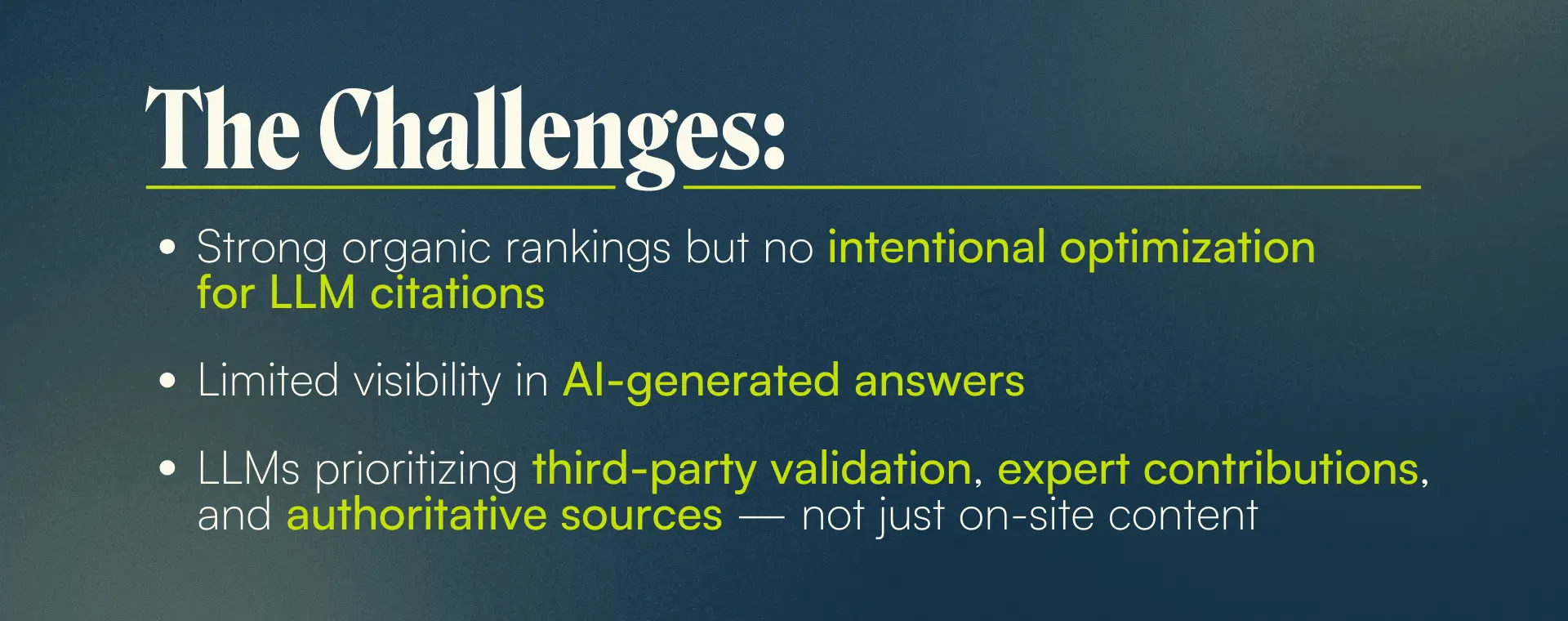
This firm already had:
- Strong traditional SEO performance
- High organic rankings in competitive personal injury markets
But they recognized a major shift in client behavior.
Potential clients were no longer relying only on Google’s blue links.
Instead, they asked questions inside legal Q&A platforms that feed LLMs, including:
- ChatGPT
- Perplexity
- Gemini

How We Did It: The Strategy
Rankings.io deployed a hybrid SEO + AI Search Optimization framework built specifically for personal injury firms.
1. AI Search Visibility Across LLMs
We focused on increasing visibility across major AI platforms and conversational search environments like:
Monitoring LLM Sessions in GA4
We can’t monitor or make decisions about things we can’t or don’t track.
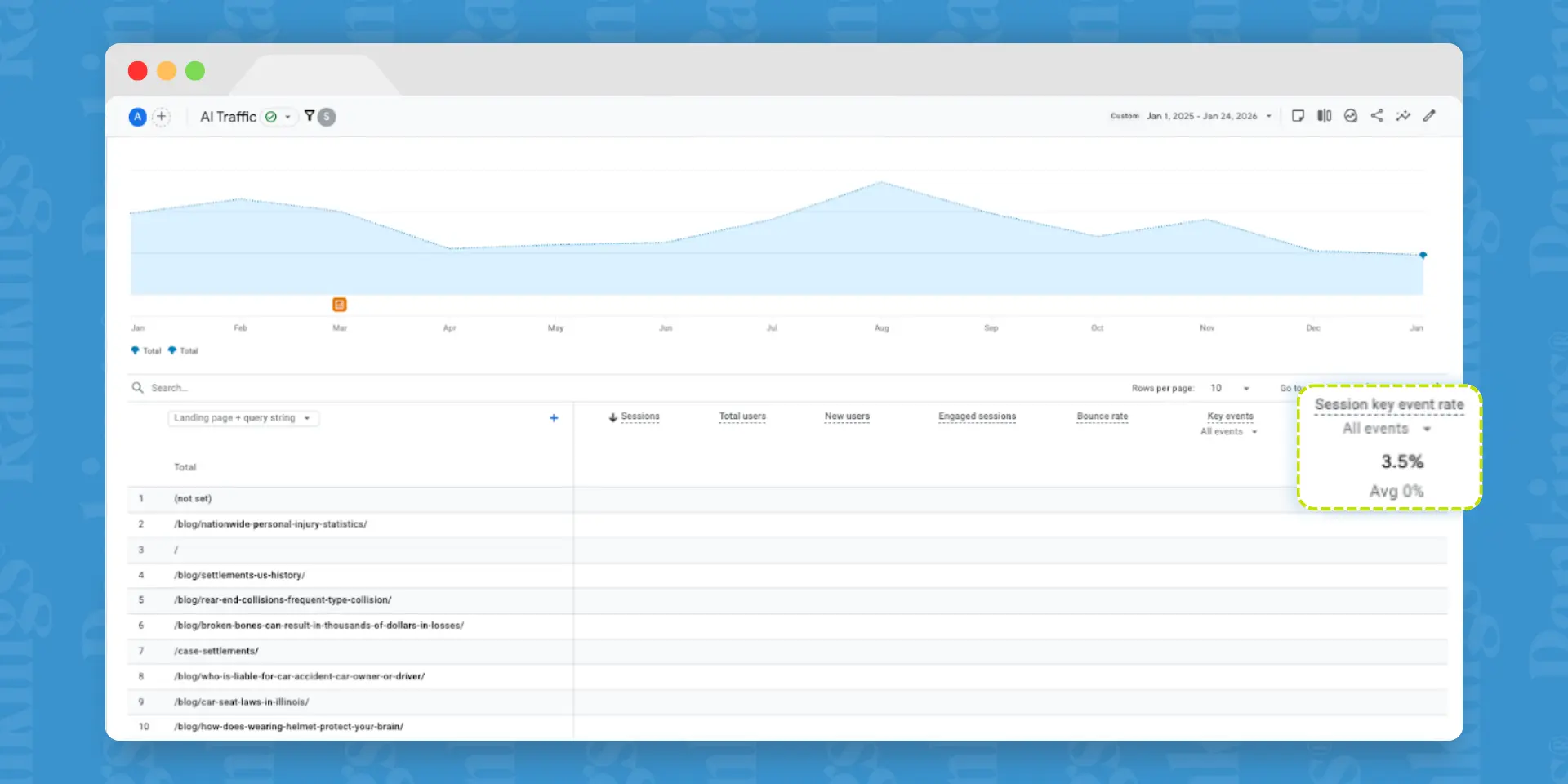
Leveraging custom reports in Google Analytics 4, we saw and reported on which LLMs not only drove traffic, but which ones actually created leads. This gave us clarity on these sources to improve in other areas.
Identifying Top-Performing Landing Pages in These LLMs
With custom reporting, we could review which content and URLs these LLMs consistently cited. From there, we could review that content and emulate the structure in other areas of the website to increase the likelihood of LLMs citing it for more topics.
Ensuring Content Clarity, Authority, & Citation-Worthiness
Providing clear content on topics the firm is well-versed in makes it easier and faster for bots to find the answers they need when summarizing queries from multiple sources. We ensured that the content was not only topically relevant but also clear and concise. This helped improve visibility, increase authority, and improve our citation-worthiness.
2. Legal Directory Optimization (High-Impact AI Signal)
One of the highest-impact initiatives was legal directory optimization and consistency. Recent industry research found the importance of consistency in niche-specific off-site signals. Now, this has always been a cornerstone of traditional local SEO, but it’s even more important with LLMs. AI confidence levels in the brand drop substantially when they find incomplete or contradictory information.
Rankings.io guided a consistent expert contribution strategy:
Answer 2–3 legal questions per week on authoritative legal Q&A platforms.
They actively participated on:
These platforms are:
- Frequently crawled
- Heavily cited in AI answers
- Trusted by LLMs as expert sources
As a result:
- The attorney’s answers appeared prominently in legal Q&A ecosystems
- LLMs repeatedly associated the attorney and firm with authoritative legal explanations
- AI tools increasingly surfaced the firm as a trusted source
3. Conversational Content Alignment
The firm’s blog and practice area pages already performed well in organic search.
We enhanced them for AI citation by ensuring:
- Clear, direct answers to common injury questions
- Plain-language explanations aligned with how users ask questions in ChatGPT
- Strong internal linking to reinforce topical authority
Several blog posts and informational pages became frequent landing pages for AI-driven sessions.
4. LLMs.txt
Industry debate questions whether these files are referenced or used, and Google even recently shared that it does not endorse them. As with all new things in SEO, and now AI SEO, do your own testing and monitoring to see how things respond. That is exactly what we did here.
We implemented LLM accessibility best practices, including llm.txt files via Yoast to:
- Clear crawl signals for AI systems
- Explicitly permit LLM consumption
- Align with emerging AI SEO best practices
In parallel, we reinforced the firm’s entity signals across both search and LLM ecosystems. This included structuring content to clearly define the firm’s practice areas, geographic relevance, and authority, leveraging authoritative legal directories and platforms, and strengthening off-site validation through relevant backlinks.
These efforts helped clarify the firm’s identity and its relationships to related legal entities: providing consistent, corroborated signals that support how LLMs interpret, trust, and surface brands in generative responses, while allowing us to evaluate the combined impact alongside LLM accessibility and content initiatives.
We tested this alongside directory and content initiatives to measure the combined impact.

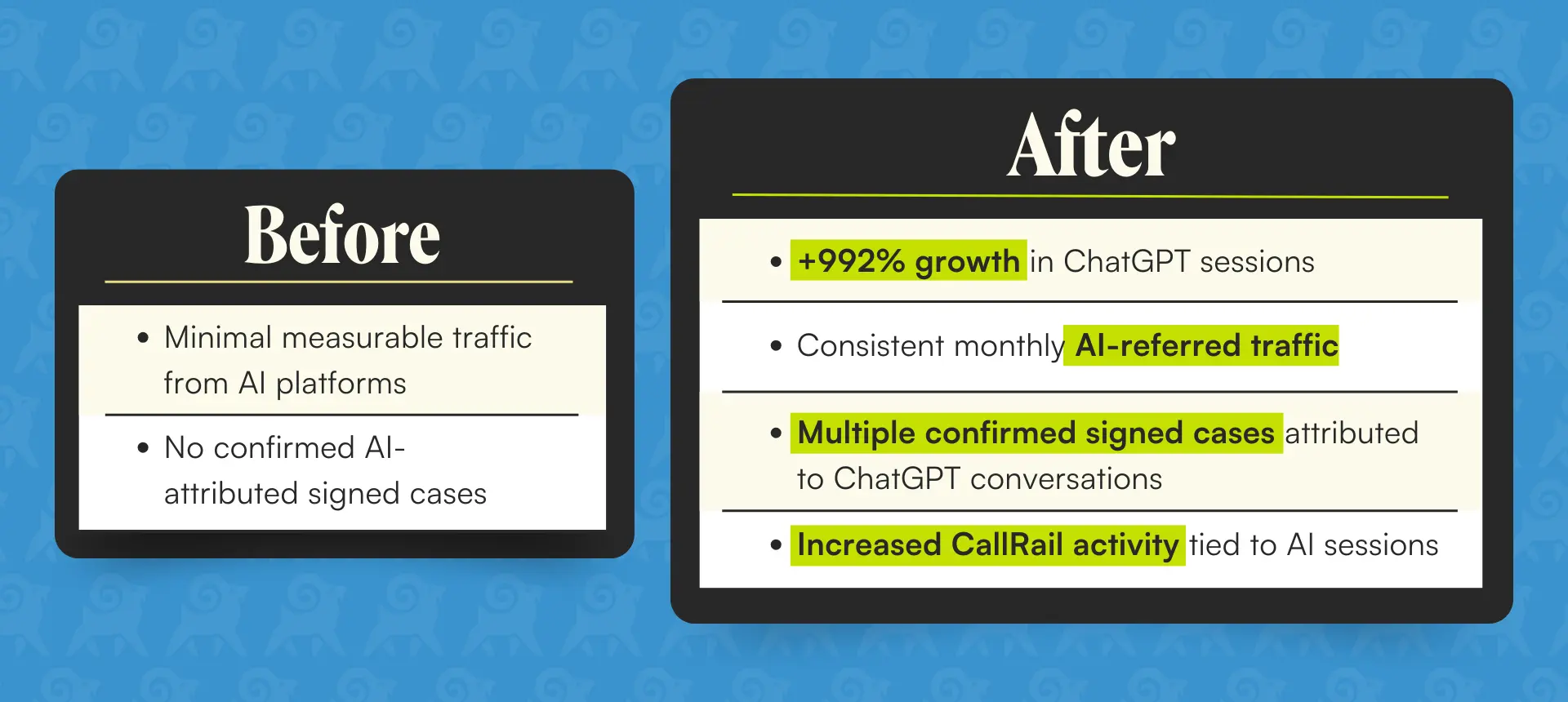
Before & After: AI Traffic Growth
Key Wins
-
- Confirmed signed personal injury cases from ChatGPT
- ChatGPT emerged as the #1 AI traffic source
- Avvo and legal directory answers surfaced in AI responses
- Increased authority signals across LLMs
- Early adoption of AI SEO strategies ahead of competitors
Ready to Grow Your Firm?
This case study shows what happens when a personal injury firm aligns traditional SEO with AI search optimization.
At Rankings.io, we specialize exclusively in SEO for lawyers, with dedicated expertise in personal injury marketing.
Our AI SEO services position your firm for both today's Google searches and tomorrow's AI-powered discovery.
"The biggest benefit of working with Rankings.io is that they want you to succeed and can give you the tools to succeed. They know who we are as a firm, what kind of work we do, what kind of clients we’re looking for, and they devise a plan tailored for us to achieve our goals."
Ilya Frangos, Partner
Galine, Frye, Fitting & Frangos