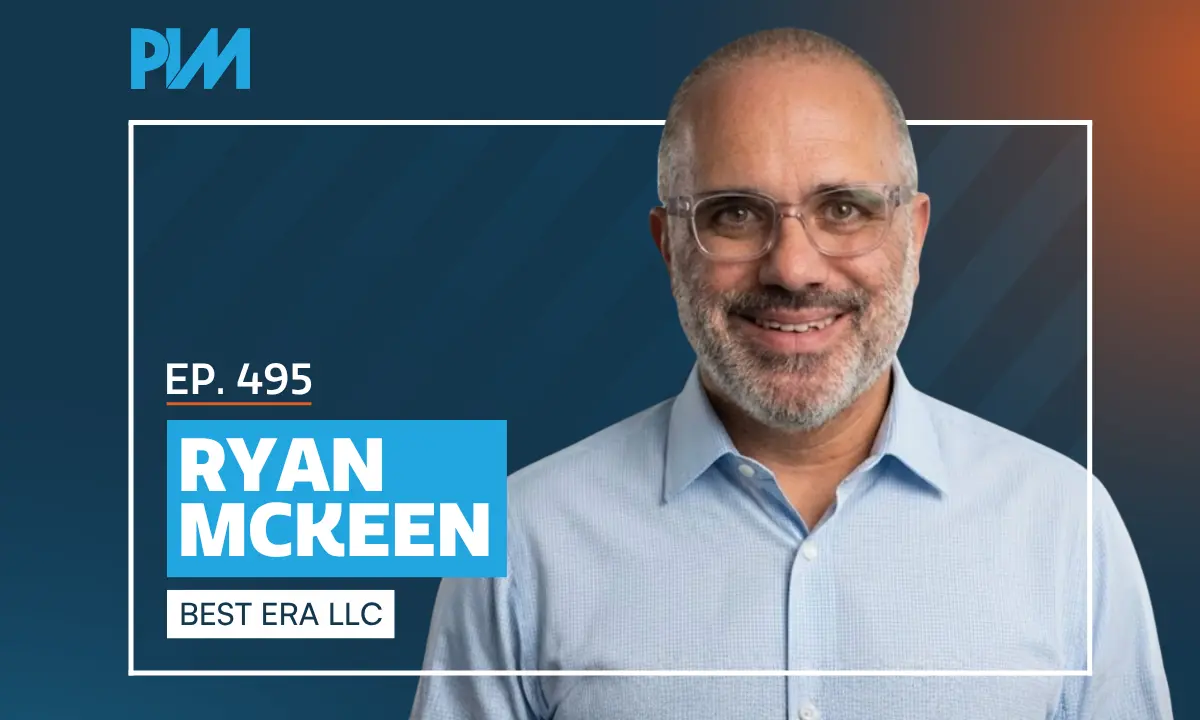
Ryan McKeen:
Creating more spam, both in marketing and in your practice, doesn't move the needle for you.
Chris Dreyer:
Technology is evolving faster than ever, but adopting every shiny tool without a clear strategy is a trap.
Ryan McKeen:
Legal tech has been focused so much on the how, but I think the question more is really why and what matters.
Chris Dreyer:
Scaling a powerhouse firm today doesn't require 100 complex software solutions; it requires radical operational clarity and a framework built purely for execution.
After building a three-time Inc. 5000 trial firm in Connecticut and securing over $100 million jury verdict, today's guest stepped out to help other attorneys achieve the exact same level of scale. As the co-founder of Best Era, Ryan McKeen helps law firm owners eliminate operational confusion, master their core metrics, and scale with purpose.
Today, we cover cutting through the fierce overwhelm of emerging legal tech and AI spam, implementing the way a simplified execution-focused operating framework designed specifically for law firms, and how establishing a massive BHAG, that's a Big Hairy Audacious Goal, creates absolute clarity to what to say yes to and no to in your business. This is Personal Injury Mastermind. I'm Chris Dreyer, founder and CEO of Rankings.io, a legal marketing agency for elite law firms specializing in personal injury. Let's get into it.
What does the fierce overwhelm of now look like when you walk into a firm today?
Ryan McKeen:
Yeah, there's a lot of confusion and there's a lot of struggle because, really, law firms are pretty boring businesses, and I would say up until this time have operated in very similar sorts of ways. And you can say, "Okay, when I started," I've been a lawyer for 20 years, "When I started, there were paper files and filing cabinets." Gradually that goes into the cloud, we'll say, and Dropbox and Box and things like that. And then it progresses into case management. But all of that is sort of very incremental change. And then a case management platform adds an e-signature component.
And okay, so it made that component of it easier. But now what you have are fundamental shifts in how to practice law, how to manage a law firm, how to market a law firm, how to grow a law firm, and you also have no shortage of people willing to sell you AI products or AI things to help you accomplish that.
And so I think it is an incredibly confusing time for folks out there to try to sort through, I think, all the noise in the space and do things that are actually valuable to them, to their firms, and their communities, as opposed to just, look, probably, Chris, on the time we're recording this podcast, I could go into Claude and I could say, "I want a thousand-page website, no mistakes," and somehow it will spin up some crap. But the question isn't, can I do that? It's, should I do it? Why do I want this? What matters? Does it matter? And the answer I think is creating more spam, both in marketing and in your practice, doesn't move the needle for you.
Chris Dreyer:
Yeah, there's a space for all of it. And one of the things, a lot of people look at it to reduce head count, but at least from my purview, it's more to enhance capabilities and it's more of a tool. I think a lot of these big tech companies that are doing these extreme layoffs are using it as an excuse for maybe poor hiring decisions and what have you. And even the token costs can end up being more costly than the labor itself. So there's a lot. There's this, in my opinion, this big bubble going on.
They do have extreme advantages. There's some great companies, EvenUp and other AI companies. I think I haven't spoken with Second Chair yet. I think they're really exciting what they're doing on depos, and there's a lot of emerging tech to help. It's just at what point do you introduce that to your firm?
Ryan McKeen:
Right. And what is the point? What are you trying to build? What matters? And what becomes valuable when that becomes so commoditized, whether I'm a 20-year lawyer or a first-year lawyer can plug in a bunch of stuff to AI, get a depo outline, ask the same questions, get the same feedback? What is actually valuable? What are clients paying for?
There are these much bigger questions than how. And I feel like legal tech has been focused so much on the how. Okay, you build this, you connect this, you grab this tool, you create this Zap, you hire this vendor, and you have become more efficient.
But I think the question more is really why and what matters because the how cost is getting reduced to near zero. It's not zero. There are token costs and there are software costs, but if you are somebody just starting out, if you are a young lawyer out there listening to this, if you have access to Claude and we'll say the $100 a month plan and maybe Google Drive or Microsoft One Suite, you have access to some of the most powerful tools on earth to build with.
And yes, you can get nicer and you could get more specific, but that is commoditized at this point. And what value are you adding? Where are you stepping in? What is currency in this era? And I actually think of it, Chris, as a post-AI era. I think it's happened so fast, the question is now what? It's like electricity.
Chris Dreyer:
AI and legal tech have made cranking out work easier than ever. Anyone can press a button, generate a deposition outline, or spin up a thousand pages of content in seconds, but churning out high-volume noise isn't a growth strategy. When execution gets commoditized, the how stops moving the needle. The real competitive advantage comes from stepping back and getting brutally clear on the why. That's exactly why Ryan built a streamlined operating framework to cut through the noise, and it's called The Way.
Ryan McKeen:
When I grew a firm, one of the books that I got from one of my mentors, Lee Rosen, was Traction. And I got the book in 2015, and it just kind of sat there. And then I read it, and then I tried to implement it.
And the success of my firm really became doing a BHAG, which was setting out to be one of the top trial firms in Connecticut. And I sat out to say, "Well, what did the top trial firms have?: They have a $10 million verdict. And so I said, "Well, in 10 years, I want to have a $10 million jury verdict." We got $100 million verdict in five years, so that changed the calculus, but trying to implement EOS was very important.
And so this was when it was one of us, two of us, three of us, and there was a constant sort of struggle with it, but there was value, and we ended up hiring an EOS implementer, and it worked very well and really helped us stably grow the firm.
But as I started to work with firms, I would give them a copy of the book Traction, and they'd just look at me like, "What? 10 years? Hairy audacious goal? I don't have director-level people to form a leadership team." And so we, with our very first clients, started writing down a system for ourselves to help these clients do it. And so it's sort of like a dumbed down version of EOS.
And it was like, okay, instead of a 10-year goal, let's set a five-year goal. Instead of calling it a vision, let's call it a destination. Instead of 90-minute level 10 meetings, they're going to be 30-minute level 10 meetings. So we tried to distill it into some core functionality. Instead of getting your directors on board, we're like, "Hey, it could just be you as a solo, or if you are in a firm of eight people, who are your ride or dies? Who are your one or two people who are so bought in? There's your leadership team, and we'll figure out the rest as we go along. And here are some basic metrics to do."
And so I think the book's like 47 pages. It's so small, which is convenient for us to mail, but it really tries to simplify things to combat that sort of fierce overwhelm because even getting on an imperfect operating system is better than having no operating system.
Chris Dreyer:
I couldn't agree more. And look, we kind of went the same route with Traction. I was in Vistage, I read the book, then I read the accompanying books, and we wanted to self-implement. We got it. It was all broken, and maybe we got it 65% there, then we hired an implementer and really had a lot more success. And I do think that some of the things... I don't know how anyone could set a 10-year today just because of the speed of tech and change, and especially in the PI space and everything that's emerging.
And then also just like you, it's like in the beginning when I first started to implement it, I had maybe a director or two. So I remember having a conversation with my chair, and they were wanting my presidents to be an integrator to all functions, and that's just not how we operate.
And even today, it's not how we operate at close to 200 people. Being transparent, it's like I'm revenue, so I'm the front end and he's retention. I bring in the clients of the business and he keeps them.
Now, we work hand-in-hand and I do participate in client service to some degree in strategy, but that's just how we divided it. It wasn't like he was a part all function. So I think, to your point, I think a simplified version is a big opportunity for most businesses.
Ryan McKeen:
Yeah. And that's really what we sought out to do. So I really think my early clients in consulting who were very vulnerable and were like, "Yeah, no, this isn't for us." And it forced us, I think, to build something that our clients needed and could use. And so yeah, I mean, we wrote it literally so if you're out there and you've got a firm of five people or 20 people or 10 people, or you're just a solo, you don't even need us to do it. That's the goal of that book.
Chris Dreyer:
I would love to talk about the BHAG for a bit. And I'm trying to get deeper in the value chain for my abilities as a podcast host, not being a lawyer. You got 20-plus years of trial experience. You teach trial advocacy at Yale Law School, and you've had that nine-figure result and you've tried a ton of cases. When you set that goal, what were some of the early things that you did to try to pursue excellence, to improve your abilities as a litigator?
Ryan McKeen:
So the first thing was it made it very clear what to say yes and no to. And by that, I mean it was like I'm doing Keenan Trial Institute down in Atlanta. They're doing a workshop on this. Yes, I'm investing the money and going. And this is when I didn't have much money.
Okay, somebody's calling me and they want to sue their neighbor over the misplacement of a fence. No, I'm not taking that because that doesn't get me closer to my goal. And it's literally that simple of a prism. And if you compound those things over and over as to what you're saying yes to, what you're saying no to, how you're spending your energy, where you're investing your time and money, that's when it really begins to compound.
I think that so much of success is being intentional. And I think that so many lawyers struggle with that. They struggle with imagining a world that they want to live in. Nobody asks them, "What is it that you want to do?" It's more, "Here's what you're doing," or you get put into a box as to what it is that you want to do.
And look, you can have a good career that way, you can be successful that way, and maybe that makes you happy. But for people out there who that doesn't resonate with, that is what a BHAG helps you do because it says, "This is not where I am. Look, I'm trying $40,000 car accident cases and losing," or, "I'm taking a slip and fall and losing," or, "I'm getting a $30,000 verdict." And it feels really awkward to say, "I'm going to be a top trial firm in my jurisdiction," but I'm going to submit to you that the only way to get there is to write it down, to be intentional, and to understand sort of the yes/no decision prism and say yes to things that you should be saying yes to to get you there.
Chris Dreyer:
It gives you that milestone, something to keep you on the path, as opposed to we all have these shiny-object syndromes. I have at least 10 other business ideas written on a notepad that I try to avoid, and I have successfully for many years. So that's fantastic. So you start becoming the result, I guess, by doing the thing, getting the education, trying the cases, looking for the opportunities. That's fantastic.
Ryan McKeen:
Yeah. And it becomes a thing where it's like, okay, I need to put in the financial structure to carry us to that verdict, to be able to fund the case, to be able to have the payroll. I need to be able to not just hire any paralegal; I need to be able to hire a paralegal with good litigation experience. I don't just need any case management software; I want software that is specific to a PI practice. All of these things, those are the small decisions that become clear when you have that north star.
Chris Dreyer:
Having a massive goal isn't just about motivation, it's an operational filter. When Ryan set out to land a $10 million jury verdict, it dictated every single choice in his practice, from case selection criteria to hiring senior litigation paralegals. That relentless focus transformed a modest firm into a powerhouse that landed $100 million verdict in five years.
But for attorneys launching their own shop from scratch, the immediate hurdle isn't landing eight-figure verdicts; it's surviving the initial cash-flow crunch and solving the very first business problem that all new firms face.
Ryan McKeen:
First of all, I would say, look, your first problem is finding clients, and that is the first problem that you can solve. So if you are out there and you have no clients and you have no way of getting clients and you're employed, I would start figuring out exactly how to get clients and to build sustainable systems.
Look, it's going to be very slow. GaryVee says everybody starts at zero, and we do. If you get that one client, treat them like gold. Give it your all. You don't need a million clients to start. If you've got one client, serve them really, really well.
Also use it to get better at your craft. Use it to fundamentally go to the CLEs, do the things, learn from people who are doing it better, make mistakes, but get better. And then let people know what you do, and then ask people who are your clients to refer you more clients and to build sort of slowly, and just understand, I think, more than anything, because, look, there are lines of credit, there are hiring... We're only on for 20 minutes. There's a whole host of things, but I really do think it starts with how can you add value to those that are coming in contact with you and how can you get more people to come in contact with you? And the rest of it can sort of take care of itself.
But I think a mistake I see for a lot of folks, especially in PI, is the patience aspect of it. They can look at some of these people who are flying around on jets or doing these things, but what they don't see is the toil that it took to build those firms. What they don't see is the losses that happen in the courtrooms. What they don't see is all the stuff that all of us experience.
Chris Dreyer:
I couldn't agree more. And also just your comment of treating them like gold makes me think of an early conversation that James and I had on the pod talking about cost to acquire a case. It's like one case would turn into three because he didn't have a ton of cases, so he would give it everything he got. And before he knew it, he'd get a bunch of referrals, and it was the lowest cost acquisition he ever had. And I think anyone has the ability to do that, to treat people well and to expand upon their center of influence and their sphere of influence. I think that's great advice.
So talk to me about Best Era. What does Best Era do? Who's the best fit for our audience? Here's the open platform. What do you guys do? Who in the audience would be the best fit to work with?
Ryan McKeen:
So I grew a larger team, and my goal with Best Era, my vision, my destination as we call it in the way parlance of five years is to help 15,000 lawyers with a team of under 10 people. So I don't want to grow into a massive coaching company or anything like that.
We really view ourselves as almost two companies. One is an educational company where we provide community. We do ask me anything. It's like we're having today a VP of a legal tech company in engineering coming in, talking to our community about AI. That's $1.39 a day for our community, and we try to provide a lot of value.
And interestingly, there are two referrals a day. We've got 400 lawyers in that generates. We do a lot of teaching, so we put on events. I'm doing how to build a law firm, call it a Revolutionary Era event. We riff on Taylor Swift because my co-founder Brittany's a big Taylor Swift fan, so everything's an era. So we have our Revolutionary Era, we've got our AI era event down in Charleston. So we like to put on events.
And then really what we do at a much higher level is individual consulting with law firms. And so we tackle, either on a subscription basis or a project basis, their biggest opportunities. So some of it could be helping them with marketing. We do paralegal training in personal injury space. We do operational things for law firms. We were just working with a firm building out their systems and with the goal of building an AI feedback loop on all of their systems and making their systems living where they work. So that's a really, really fun project. We train trainers at law firms, and we get to work very closely with clients.
So all of our team and our Best Era team came from the firm. We all did the thing that we now do, and we are all involved in delivery. So when I grew the firm, I got detached from delivery, and with Best Era being intentional about it, I get into the nitty-gritty with my clients, and I love it.
Chris Dreyer:
Fantastic. Ryan, this has been amazing. What's the best way to get in touch?
Ryan McKeen:
LinkedIn DM. If you are spam, I might respond, "Hey, are you interested in PI leads?" I might say, "What's your insight?" And I always respond like, "I've really leaned into my OnlyFans account." I don't have an OnlyFans account, but if you're a real person and you send me a DM, that is fantastic. I will respond. I try to believe in giving value and helping wherever I can help, even if it's not you hiring me in any which way.
Chris Dreyer:
Fantastic. Ryan, thanks for coming on the show.
Ryan McKeen:
Thanks for having me, Chris.
Chris Dreyer:
Ryan McKeen proved that building a standout law firm isn't just about chasing every new app or flooding the market with automated noise. It comes down to simplifying your operating system, maintaining total focus on your core objective, and treating every single client opportunity like gold. When you cut out operational friction and execute with absolute intentionality, compounding growth follows.
I'm Chris Dreyer. Thanks for listening to Personal Injury Mastermind. See you next time.