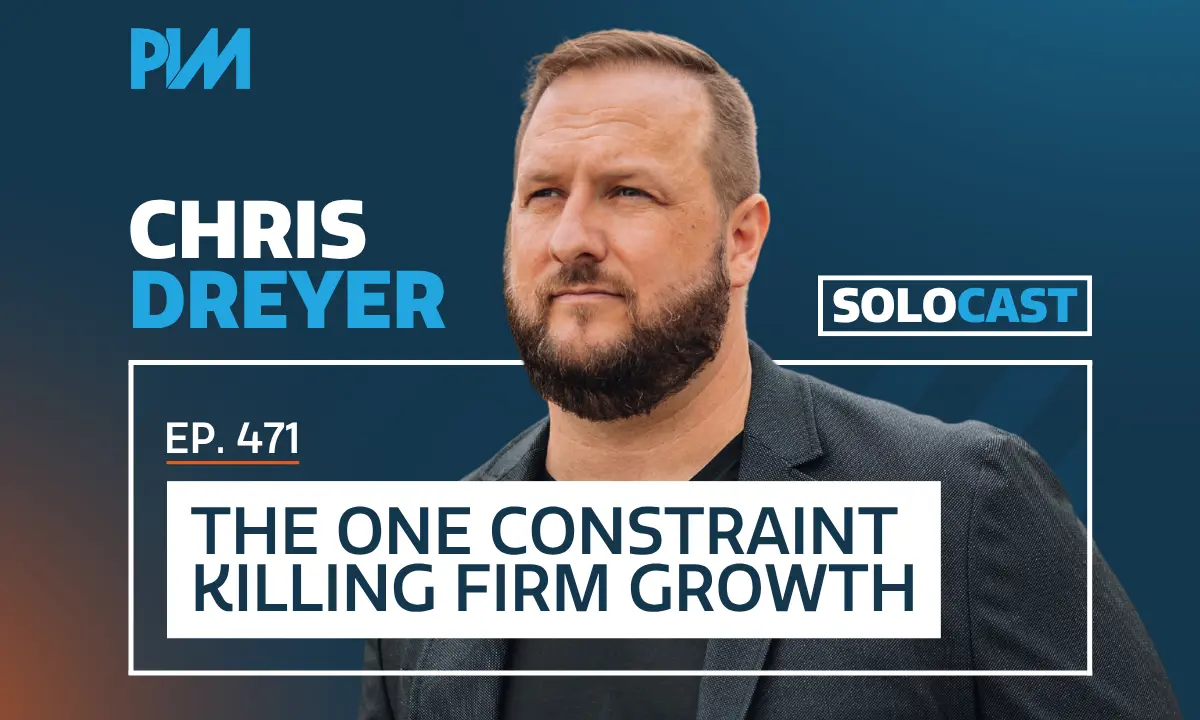
Chris Dreyer:
There's a book that I go to regularly, it's called The Goal. Its whole argument is that any system, a factory, a firm, anything has exactly one constraint holding it back at a time. One. Once you fix it, a new one takes its place. And for most law firms I look at, one of the first constraints they encounter isn't a strategy or a marketing budget, it's talent. And the single biggest predictor of a firm's success comes down to a question most owners don't ask enough, "Do I actually have the right people on my team?" This is Personal Injury Mastermind, I'm Chris Dreyer, founder and CEO of Rankings.io, the elite performance marketing agency for personal injury law firms. Today, we're talking about the one thing that has set the ceiling on every business I've ever seen, including my own. Talent. We're going to talk about how to find it, how to hire it, and how to keep it. Let's get into it.
How important is talent if you're trying to grow your firm? It's everything. The standards that you set in regards to the quality that someone produces, their work ethic, their values, do they match yours? Do they align with yours? The reality is when a business owner starts, you need a generalist in most positions, because you don't have enough dedicated work to an individual craft. You need them to be able to multitask. And you may think that this individual's an A because you have no means of comparison. As you grow, what happens is you start to get specialized functions within your organization where, and I'll use it from a marketing standpoint, maybe you have, for us as an example, instead of just an SEO specialist, a generalist. Maybe you have an on-page SEO specialist, maybe you have a technical SEO specialist, a link builder, a local SEO.
There's a lot of subdisciplines within this area and it lends itself to focus. And what happens is those individuals that you thought were A is because there wasn't any comparisons, what you've soon realized is they were Bs, and then it constantly is evolving. This even happens with leadership. There's a lot of different principles, there's the Peter Principle, all these things. But what happens is people have to constantly evolve and improve their skillset. It's not a set it and forget it.
A lot of people will say, "Hire slowly, fire fast." I don't live by that mantra because even with personality assessments, the best reading of a resume, now you've got ChatGPT running sidecar in the interviews, basically coaching them up on what to say on the interview. The reality is you need to hire pretty fast, pretty quick, get them doing the application, and then also fire fast. That's the reality. It's so expensive to do the latter, and I think people that go this ... They've read it in a book. I don't know if it was Lencioni or top graders or what have, that's a dated method of running an organization. You need to hire fast when they meet your criteria because you're guessing. You have no idea. And then when they do the application of the work, are they learning? Do they take feedback well? If they don't, they go.
Let's say you have an organization and the front end, the marketing, you're getting more leads, you have a good system, your leads are increasing but you're stalling. A business operator's constantly going to have different constraints at their organization that are inhibiting their goal, their growth. So, let's say that you're getting the leads and your leads are growing. What are some of the other potential constraints? The next constraint very easily in the value chain could be intake, could be your sales. You run a sales organization, all marketing is is leverage sales. Sales, can you close the leads that come into you? If your wanted conversion rate isn't 90 plus percent, that is your constraint. You don't need to spend more on marketing, you need to fix sales. Let's continue in the value chain. Let's say that you're getting more leads, you're closing at an effective rate, but your deal size, your fees are not good.
They're decreasing, and then maybe you need to work up the cases more, improve your demands. Look, I'm not a lawyer, but it would be on the fee side. Maybe it's the types of cases that you're taking. Maybe you need to file more lawsuits and go to court and actually get full value.
So, you find a constraint. The next question is, who do you bring on to fix it? And here's where most owners slip. They hire for a title they read in the book instead of a bottleneck they actually have sitting in front of them. Your first hire isn't a rule, it's whatever you can't do yourself yet.
Let's say you're thinking about your early hires. And this is where when coaches and mentors are like, "Your first hire should be this. It should be the integrator." It should be someone that compliments what you do, that has a skill set that you don't have a lot of times. And I'll explain this. I am a digital marketer. I know how to generate business, I know how to do marketing. My first hire, it could be another marketer because I can take my craft and train that individual and maybe I'm referring cases. That is one option.
Or a different option, the yin and the yang could be I'm the great marketer, someone else could be the great attorney and do the legal casework. If you're getting the leads, again, think of this as in constraints. You as the owner, what constraint do you solve? Do you solve sales? Maybe you need marketing, maybe you need legal work. You, the owner, do you solve marketing? Maybe you need intake, maybe you need legal. Maybe you're a great lawyer. Maybe you need marketing and intake. Those are how you need to think about this. Think about you have one main constraint at all times. It's going to change, but there's one, there's not multiple, there's one main constraint you need to solve. That's who the next hire should be. There's a lot of different ways to staff a personal injury law firm and case managers are one that is a point of contention or debate.
What I will tell you is the biggest law firms do both pre-litigation and litigation. The biggest advertisers typically will have case managers because it's a leveraged position where they're more focused. Remember what I said at the beginning, you're going to hire a lawyer that does everything and then you shrink down. Well, case manager will handle the client service typically. They'll handle the medical communicating with the client, making sure they're getting treatment, maybe collecting all that information. I'm not a lawyer, that's generally how I think of this position. The reason it's a challenging hire is because they need to have EQ. They need to be great communicators. Everything is marketing, and if you have great communicators that are really good with customer service, you can get reviews. So, that's important. They need to be organized, they need to be able to take a high volume of cases.
Typically, you'll want these individuals to be bilingual, handle more case types. You also get in these scenarios where there's shortages of case managers or there's shortages of lawyers. There's shortages of case managers because not everyone likes to do client service. And that's why when you look at people that are in hospitality or have waited tables, that's why you hear those types of comments is because they've learned, they've had a lot of client service experience. But you also need to look at this from a supply and demand. There's not as many lawyers, everybody's competing for the lawyers. And it's just a position that doesn't require a bar card typically.
So that's why they're hard to hire, it's a challenging position anytime you're dealing with people. But for most organizations, it's a necessity. I'm going to give you the counter. If you are a litigating practice and that is your bread and butter, and you are through and through lawyer and you're taking a low volume of cases, you're taking these complex cases, these catastrophic cases, and maybe you worked at another firm and you were a trial lawyer and now you have pipeline just because you are great in the courtroom.
You may not need a case manager, because your cases are going to trial, baby. You need a litigation paralegal, you're going to be very involved with the cases that you talk to. You're going to be at their house, you're going to learn all about them because it helps you in the courtroom. It helps you convey what they lost, how their life changed. That's a different scenario where if it's a low volume of cases you may not need a case manager.
Structure tells you which seats to fill, it doesn't tell you who to put them in. And the best people for those seats usually already have a job, sometimes with the firm across town. This raises two uncomfortable questions. Where is it fair to go get talent? And how do you know if it's the right talent when you find it?
So, the question is, what are your thoughts about hiring from the competition? That's a loaded question. First of all, there's other scenarios where what if a firm wants to change their attorney to yours? Same scenario. Like what do you do? Here's the way that I look at it. I am all about the golden rule. Treat people how you want to be treated. So, I have some competitors that have done some shady shit. I'm not going to call out what they've done, I've got the notepad.
I've got the, if you're a nerd, the Dwarven Book of Grudges, I've got that. So if that occurs, it's open season, baby. I'm going to take your best people, because, if they are actually competitive, because not only does it make me better, it weakens you. Having said that, when you choose a niche, when you choose personal injury, when you choose a geography, you choose to congregate in that area. And I don't want to walk around and bump into a ton of enemies. So, it's not open season on everyone, but it is open season on people that mistreat you, and that's the way that I look at it. I think it's the golden rule. And yeah, there's a lot of advantages, institutional knowledge if they're in the same industry. There's also a lot of disadvantages. We have our competitors that will frequently hire people we've terminated. Awesome. Thumbs up.
It's different if someone's on the court, they're playing and they're taken from the playing field than someone that was on the bench. Before I talk about hiring trial lawyers and just my thoughts on it having never hired a trial lawyer, I'm going to give you my opinions on it. I just want to talk about one thing that I used to think was silly. I remember when I was in Vistage, we had Cameron Herold speak and he was talking about values. And I love Cameron. Super intelligent, great business mind. And I used to kind of roll my eyes. And we originally started EOS and you go through this core values episode and I'm like, "Okay, whatever." And what I've come to learn and understand is over the years, values are everything. Even the irritants, the things that bother me, it's because they share different values. I'll give you an example. Our core values, play to win. I want somebody that's competitive. I want people that don't like to lose.
If you're playing monopoly, I don't care what it is. I want somebody that wants to win monopoly. You're playing darts at the bar. And I want to see those type of people that succeed. They overcome adversity, they go the extra mile. That's important to me. Maybe it's not important to everybody, but it's important to me. Maybe you got the casual gamers and different businesses and that's fine. Second core value is speed. I want people to move quickly. You turn back the clock to my original question about the hire slow, fire ... I don't believe in that. I think you move with speed. I think it's an advantage. Good, fast, or cheap? Fast. The Hermozi's Value Equation, how do you make something better? It's faster. The next one is excellence. I want people to care about their craft, I want people to improve, I want to do quality work.
Could I create a business that's beneficial? Could anyone create a business that races to the bottom and is the Walmart of their industry? There's nothing wrong with that if you design it with an intentionality to do that, that is not me. And the next one's grit. It is, I want people that can endure and do the thing for a long period of time. Those are my values. Everyone's values are going to be a little bit different and you need to surround yourself with those types of people. So when you're hiring, think about do they fit your values? Because you can train the skills, you can train the tactics. Now, back to your original question on hiring trial lawyers. There's a couple methods that you can do, and I'll talk about the advantages of each. If you are a more seasoned firm and you have a method of incubation and training in developing trial lawyers, the advantages are you can get them on the run-up before they themselves have value.
You can get a phenomenal trial attorney for not a lot of money, because what are they gaining? They're gaining the experience, they're getting the opportunity to develop a reputation, and that's one advantage is you can nurture them yourselves. Now, they're going to be green, they're going to make mistakes, but they're trained in your method. That is the up or out, you go up or you go out. Another method is you go recruit these top trial lawyers that have proven themselves in the courtroom. The issue with that is a lot of times it's going to take a big salary, maybe a name partnership, maybe equity or phantom equity, or some type of bonus program. That's the trade-off. It's their experience and time and their reputation versus ramping yourself. There's pros and cons in all of it, let me give you a couple examples.
Let's just say I'm a new firm trying to make a name for myself, I don't have very many employees. I'm going after the seasoned vet. I want someone that has got the big numbers, that can advise me as a younger operator who I need to be surrounding myself with. Again, you may think they're an A, and in the future they may be a B, but they're an A for you right now. If I'm a more seasoned firm and let's say my skillset set, maybe I'm a Brian Panish, baby. I'm the best in the trial. You send me to court, I know how to nurture talent. You look for those individuals that share the same values. Using Brian Panish, he's very competitive, he played football, he's an orator, he's a lecturer, he has all these opportunities to nurture younger talent. That would be an opportunity for like a Panish-ey Ravipudi.
So, it really depends upon what type of firm you are, where you are in your history, the up or out, nurture yourself or just go into hire the seasoned vet. But I'll tell you, you don't want the guy that's cruising Indeed, he's got this trial. Why are they not on the court? The best trial attorneys are working for someone else. There's a lot of ways to be attractive as an employer. One thing is your compensation, but it could be like your impact on community. It could be your location is a big one. Do you offer a remote working environment? Maybe that's important. Maybe it's the practice type. If you want to do complex litigation but the firm is designed to just get auto cases, and maybe that's not what you want to do. Maybe you love every case is a blank canvas and rolling up the sleeves and learning the medicine, learning the different product liability, manufacturing issues.
There's a lot of scenarios that can attract top talent to you. Maybe you're on a winning team and they see the upward trajectory, and they want to jump on that rocket ship. There's a lot of ways to draw in and be that magnet to talent.
Attracting great people is only half the job. The other half, the half that actually compounds, is giving them a reason to stay and setting them up to win. For me, that comes down to the one rule I was raised on and one expensive lesson about what happens when you hire the perfect person but fail to support them.
Everything's the golden rule for me. It's how I was raised. Treat people with respect, say thank you, have manners. I'm not saying that I don't deviate and have my own issues, like we're all flawed as humans. When I started rankings, I wanted to create an environment where people wanted to stay and they were given opportunities. And I've really taken that serious, and I'll give you an example. Early on, we could not afford health insurance for our employees. And we had a $300 stipend, I think, for the monthly stipend. I think we started with that, which some organizations don't even do that. And a few years in, we decided to give health insurance. And we were pitched by all the big companies, the Insperitys, the what have you. And they would pitch the plans and they would say, "Oh, well, this one, you should do 80% and have your employees put 20% skin in the game because they won't value it if you do 100%."
And they would give you these options and they would do the cost benefit analysis and all those things, and I would just look at that and I'd be like, "If I'm choosing the health insurance plan, I want the best health insurance plan. And I want all of my employees to have the best health insurance plan." It's not I have a $500 deductible and they all have $6,000 deductibles. So, that's the way I've looked at our benefits, because I want to create an environment where people thrive, they're happy, they're supported. And we frequently do these surveys for our employees, and I know most organizations' surveys are like an afterthought joke, but we read the feedback and it's like, what do people want? We implemented a gym membership, now we've got some plans for that. Now we've got some credits for childcare, I believe.
We went from PTO to unlimited time off and we have all the holidays blocked. And from the very first few years, we took off from Christmas all the way to January 1st. We've done that every year. And I think that if you want to create an environment where people want to stay, it's the golden rule. Now, I'll tell you the counter is when I see someone not treating other employees right and there are issues with this person's been not nice to this ... That is the quickest exit path. I don't care who you are, because everyone here's got a family, we want to have fun. We don't want to dread coming to work, we don't want to have to worry about X individual.
And let me promise you, that is the quickest exit. That is how we eliminate that. So, we try to get rid of the toxic employees, but I really just think it comes down to just treating people with respect and wanting people to be happy. We've got a kudos channel where I love to see people celebrated. There's different break room channels on Slack where people share their interests. We even have a credit for employee members that, because we're remote, but if they travel to meet another employee member we give them credit for lunch and travel. Yeah, we've got birthday, we've got a rolling anniversary. Every year you're here, you get a 100 bucks, year two's 200, 300, it keeps going. So, I love seeing what other organizations are trying to do and to set a very inviting, warm culture.
I want to celebrate people that come to our organization. I'm more about celebrating the people that come and less the big party when they leave. That's been a weird dichotomy. I would rather celebrate the people that come in. We're not perfect, it's harder with remote. Transparently, there's the benefit of remote is talent across the world. The downside is some of that personal belly-to-belly conversations that you have that's harder to do digitally, but we're really intentional about trying to make an environment where people want to stay. We look at our Glassdoor readings. We don't ask anyone to go leave Glassdoor ratings, it's like a go-go. We're not trying to manipulate people, but we do see those, we do reply to those. We try to take any feedback that we can get. There was a book called Hug Your Haters by Jay Baer, and basically his main takeaway is negative feedback is feedback and you need to learn from that.
So that's why we send the net promoter scores out, we send employee net promoter scores out, and we want to learn, we want to grow. At the end of the day, no matter what we do there will be some individuals that won't like our direction or think they have a better solution. I recently had one that complained about our health insurance. And I'm like, "Are you kidding me?" It's 100% paid and we have. I just don't know what else I could do. I really don't know what else I could do. But that's just natural, I think that's in everything. That's in comedy. Some people are going to love it, some people are going to hate it, and ultimately you can just do your best to try to create an environment that's welcoming where people want to work.
Let me talk about a hiring mistake that I've done. And look, we all hire, we look at the resumes, they interview well, and we've got those scenarios. But there's another scenario that's equally important that I don't think people talk about enough is if you under-capitalize a new department or new function at a company and you don't give them enough support, you create an island of one or two. It can be really troublesome. I'll give you an example, this is me being transparent here is at one time we were considering traditional media. Look, we're working with personal injury attorneys, you guys spend a lot on TV and billboards and radio. And I'm like, "Okay, let me try to bring traditional media in-house." But I was under capitalized. I hired a great leader that really knew the craft, but I didn't hire enough support roles. So, I still think this individual's fantastic, but because I didn't give them the team and the ability to succeed, that was a learning mistake.
So, now I really think about how do I properly capitalize and support a department when we're going to move into another function? And if I'm a personal injury attorney I'm thinking like, "Hey, maybe I want to start doing premises liability cases." Well, it's not just one lawyer probably. You probably need to support them with paralegal, case manager, maybe two lawyers, maybe resources and training. A lot more on the front end, a method of acquiring those cases. A lot more goes into it than just, "Oh, I want premises liability cases. Let me hire the one lawyer." Now, there's the dip. There's the Seth Godin dip where you can have pain, pain, pain, pain, pain and grow out of it once you finally do get the support. I would say that's one of the biggest learning lessons I've had over my career is you could have a great person, but if you don't give them the tools to succeed that could be an issue itself.
If you take just one core truth away from this, let it be this. Your firm will never outgrow the quality of your team. Marketing fills the top of the funnel, but your people are the funnel. Every ceiling I've ever hit in business turned out to be a hiring problem, a values problem or a support problem wearing a different disguise. So, diagnose your real constraint before you spend another dollar. Hire for values because you can train the skill. And when you find the right person, give them everything they actually need to win. And look, if you want a marketing partner that takes growth as seriously as you take your team, head on over to Rankings.io. We're the elite performance marketing agency for personal injury law firms. We operate on one principle, proof over promises. So visit Rankings.io to get your complimentary growth audit and see the proof for yourself. I'm Chris Dreyer, and I'll see you next time on Personal Injury Mastermind.