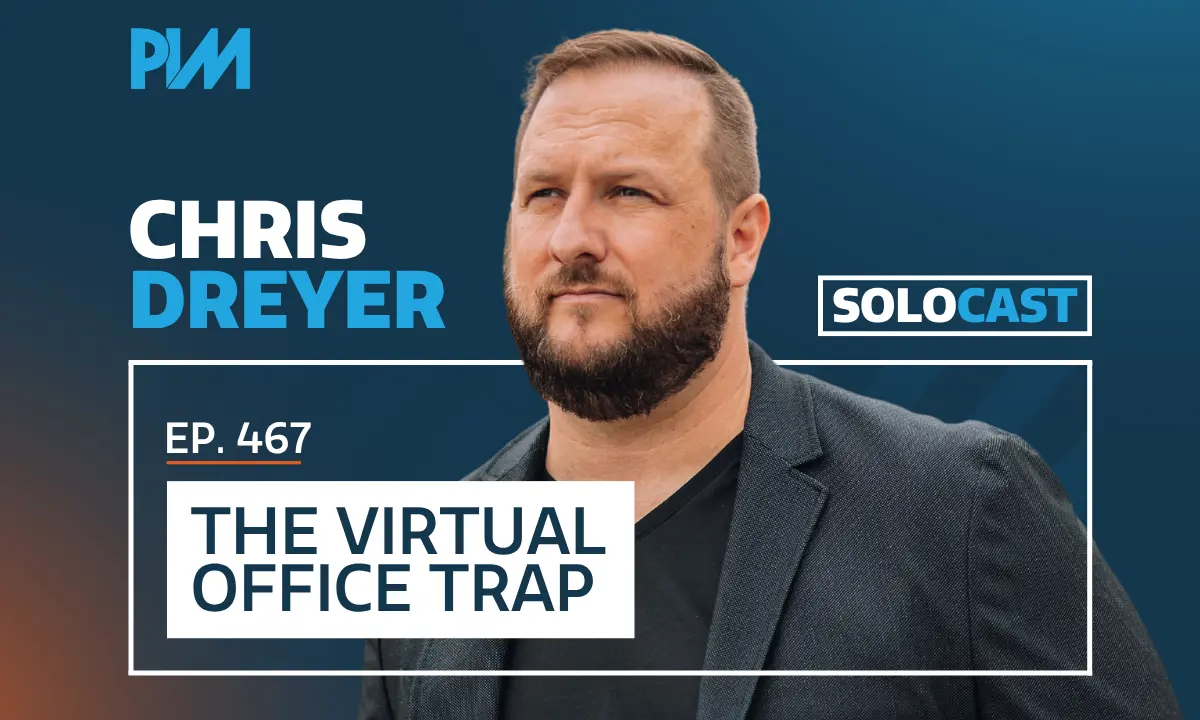
Chris Dreyer:
Business is booming. You've got leads coming in and you're producing results for your clients. Now you're ready to expand your footprint, but open a new physical office, take serious cash. So you look for a shortcut. The cheapest one, a virtual office.
While it sounds like a good idea on paper, there's real risk. The shortcut can quietly burn down the one thing your entire firm's visibility depends on, and you won't even know it's happening until it's too late.
This is Personal Injury Mastermind. I'm Chris Dreyer, founder and CEO of Rankings.io, the elite performance marketing agency for personal injury law firms. Today, we're talking about how to expand the right way, what a virtual office really costs you, the hidden signal that decides whether your firm even shows up, and where your second office should actually go. Let's get into it.
So, your law firm, you're thinking about expanding, and personal injury is so capital intensive, no matter what channel you're looking at, whether it's Google Ads, a minimum 20, 30K, whether it's radio, a hundred, 200K, TV, 200 to 400K. And I know there's exceptions and you can start small and build, and individual billboards that's not programmatic, 5K-plus, programmatic being 1500.
And you're thinking about expanding. And the first thing that goes through your head is, "Hey, let me get a virtual office." When I think of virtual, I think of in the cloud. Let's just say satellite office. I think cheaper, lower cost. You're not buying the building, maybe you're renting a commercial space. The thing is, according to Google's guidelines, you have to be there. You have to have an employee there during the business hours that you're advertising. So if you say 24/7, you're supposed to have someone there.
Now, I know many of you are like, "Oh, I've got that and I've never been dinged." That's because you're not big enough. That's just the reality because I promise you, the largest PI firms will send their investigators to your office, record a video, and turn it into Google. I promise you that. I know this. I've been a part of this. I haven't recommended it. Let me back up. I haven't recommended it, but I know they're telling me they're doing this.
Okay, so let me be clear. You may have slipped under the radar, but the biggest players will do this. So you got to have someone staff there. Here's the deal. I think the easiest expansion opportunity, especially with scale economies, you're thinking about seven powers is to look at Regus.
In the past, it was a no-no. They actually flagged and named these virtual offices and Regus was the example, but they've removed that. It abides by their assuming you have signage, your own individual suite with a desk, where somebody's at that is all above board because that's how most attorneys operate, so they had to change their program.
I think it's a good way to scale because Regus has many offices all over the country in the best real estate, the best locations. And I think that's a good option. So when you're thinking about expanding, make sure you're capitalized. If you want to decrease your costs, think about Regus, and maybe some of these other lower cost areas, but just keep in mind that you got to have someone there, whether it's an intake specialist, a lawyer, a secretary, someone's got to be there during the hours that it's stated.
I think there's this assumption that, "I'll just open an office and start to get business there," and because, "Hey, my current headquarters is working," I think a lot of people, especially when they go to a different state, they really undervalue and underappreciate how much compounding works in your headquarter location. You may have grew up there, and had a sphere of influence. You've done grassroots very naturally. You know the best locations in your head. When you're moving to a different state. You don't really know what the best areas are unless you visit it frequently or have some inside information.
You underestimate the amount of reviews that's required to break out and get visibility. So I would say really do your market analysis, and whatever your budget you think is going to be, I would add about 20% on top of that because it's going to take a little bit more than what you're planning on. So, if you're thinking, "Hey, I'm going to allocate this amount of expense, and this, at least 20 to 50% more to really break through and get some visibility."
Let me talk about some ramifications that you may not be thinking about if you don't do this correctly. When you open another office and it's not staffed or it's breaking any Google guidelines and your listing gets suspended, your trust rating on your Google Business profile decreases. So that means anytime your primary profile gets a review, or you need to change a phone number, or there's a public edit, or there's any minor change, it is now scrutinized. Those reviews that used to stick in the past may start to get filtered more frequently, because your rating. When you have a very high rating, the reviews stick. You can make a phone number change and it just changes naturally. You could change your hours because you've accrued all this trust.
The moment you open the second virtual office, the third, that you can lose all credibility. I can tell you an example. I'm not going to name the firm that I worked with, but we worked with a firm that was expanding for numerous cities in an individual state. And, they weren't staffed, they weren't in the best locations. And here's what happened.
First, all the profiles got suspended. So they had to go through the process of getting all of the utility bills, the DBAs. That was the first thing. So you had to get a whole bunch of paperwork. This was not a quick process no matter how quickly we tried to fix it. Posting to Google Forms, posting to X, and all the support channels, ultimately, they have to have the paperwork and they have to prove that they're abiding by the Google guidelines.
The second thing is this firm, I'm not going to name this firm, they got approved. So they already had this ding on the trust rating. And then they got a bunch of suspicious activity on the reviews. So, there was a person that reported them. Well, their reviews started being filtered, so they lost a ton of reviews. And you know how much effort goes into the reviews. Got all that fixed.
And then they had a third. So three strikes, you're out. The reviews wouldn't even post to most locations. Google just chose to not post any review, because that's what happened to the rating. And once you get to that point, there's no getting out. Three strikes, you are out. Your best bet is to start a new firm name, file a new DBA, a new email, and start over. The trust rating's everything.
I had another situation where a firm, I'm not going to disclose this firm either, was using TaskRabbit to hire people to do the onsite verifications. So with TaskRabbit, they would constantly get new emails added to their profile. Well, Google saw that and flagged it as unnatural, and that became an issue.
So there is a rating even associated with your email. If there's an untrusted individual email and it gets added to the GBP, that's an issue.
And I'll go a step further. Even as the agency owner and us doing everything properly, we segment all of our GBPs because we need to protect our rating, and we can't be associated. So anytime, I know it'll be really easy to just throw them on a, one account, but we have to go the extra step and segment these because we have to protect our rating. I'm saying most attorneys, look, they're doing the right thing and they got one location, but those that are very aggressive, you got to be very careful because it can blow back even on the agents.
Here's the deal. Google doesn't tell you if your rating drops. There's no public rating. It's all internal. It's algorithmically. They're using artificial intelligence and they're coding to determine what reviews should stick, what locations are trustworthy. They're not going to tell you.
In Google Search Console, if you have a manual penalty, it'll pop up. You'll be told. Google Business Profile, they do not.
So what are the signals? The first signal is if you make any modification to your profile and it gets automatically suspended, uh-uh-uh, you go to open a second location and you immediately get suspended. Another sign. Your reviews start going away and you're like, "I don't know why my reviews won't stick." Hey Bubba, you might be breaking a guideline that you otherwise though you're okay and maybe you slipped under the radar, but you hit a certain threshold and now the game has changed.
So it's very hard to fix this. Again, three strikes, you're out. I've seen it. You got to be very careful. Abide by the guidelines, get reviews naturally, have someone staffed at the location, good proper signage, utility bills on hand with the exact name of the business on the Google Maps. So if you're adding accident injury lawyer, that needs to be on utility bills, the DBA, the signage, everything. It needs to be consistent because it needs to be your actual business name.
Let's take it a different step. Let's say you do have some capital accrued, you've got the trust, you're doing the things right, and you want to open your second location. So yes, get a Regus, but put a body there. Have a strategy to get reviews. Do you have marketing being deployed in the market that you're advertising in? Have you shifted over your DMA on your traditional marketing, your digital marketing? You got to have some pipeline creation in order to justify it.
And I think to me, it's just too risky. You don't want to risk the golden goose of your headquarter by just crossing the line and trying to cut corners. With all that said, there's a huge advantage to open in multiple offices. The two main ranking factors for local maps and LSA are proximity, is distance.
And not only that, in Yelp, you're constrained to a 20-mile radius for ads. And that's only going to shrink. That's only going to shrink due to competition and saturation.
So there's a huge advantage. And also for convenience, you think someone wants to drive an hour when they can drive 15 minutes to see their firm? No, there's huge advantages to opening offices.
What I'm saying is, there's a couple main things that people talk about. I've heard this on John Morgan on the Breakfast Club podcast recently. The biggest issue that most, they're under-capitalized. You cannot have marketing initiatives. You will not be successful. The biggest rule to break is being under-capitalist. I don't care what it is. SEO, Google Ads, open an office, traditional media, radio. If you don't have the capital, the proper capital allocation to deploy for a certain initiative, you shouldn't do it. You should double down on what's working until you do have the capital. Otherwise, you're just wasting money. You're lighting it on fire.
Let's talk about the first office that you should open, your second office, right? The first expansion-based office. So you got your headquarter and you want to open your first additional office. Where should you be considering? My very strong recommendation is in the same city, assuming the city isn't super small, Elkville, Illinois. Assuming it has at least a hundred thousand in population, it should be in the exact same city. The reason is, because your advertising is already working there. You probably have hired individuals that already live in that location and maybe it's closer to some of those individuals' subdivisions, in their houses for their travel time to work. And you can see for certain things like local maps, you can see your share of local voice start to deplete at certain points. Those are the points where you want to start to consider another location.
It's the same thing for local services ads. In certain markets like Houston, for example, it's gigantic, absolutely second office in the same location, in the same city. In highly dense areas, you should think about where the population's just really dense. You should think about a second. New York, Arizona, and the desert, right? Everybody's all on top of each other in the valley. Those are some of the locations you need to think about, in the same city, five to 10 miles away.
I'm not trying to scare anyone on the whole expanding to a second location. And it sounds very doomer, because there's huge significant advantages because of the proximity, the convenience, the conversions, the Yelp ads, all the things. There's a lot of advantages to opening another office, but I would highly recommend that you consult with someone on this. We've had numerous scenarios where a client of ours is completely dominating in their main market. They grow too big. They don't fit their office space, and they want to get another building that's two or three miles away, and they lose all their rankings, all their visibility, because two to three miles away, that could be a different city.
So for example, I'll tell you, St. Louis, there's a St. Louis address and there's a Clayton, Missouri address. Clayton is nearly on top of St. Louis. That's where the more affluent go. But if your office moves from St. Louis to Clayton, you're going to lose all your downtown visibility for St. Louis. I've seen it. I've seen it in Georgia. There's a lot of little cities, suburbs all around Georgia. There's certain markets you got to be very, very careful with. So you want to look at your share of local voice.
You want to look at population density. You may think that, oh, there's no competition up in this area. I'm still in the same city. No one lives there, right? You're going to get less cases. It's just the reality. Consult with someone, have them do some market intelligence, some market analysis before you just go not renew the lease and you go open another one, you just think it's going to be okay.
So if there's one thing to take away from all this, it's that your trust rating is the golden goose, invisible, fragile, and once it's gone, it's gone for good.
Expanding is absolutely worth it, but only if you're capitalized enough to do it right, because the moment you cut corners to save a little money, you'll put the entire market you already own at risk.
For some people, hoping and guessing is a strategy. For everyone else, there's real value in talking with someone who's been through the grind, and can run the marketing analysis before you sign a lease. So if you're fighting a suspension, watching your reviews disappear, or weighing a second office in a new city, don't leave it to chance. Head it over to Rankings.io. We're the elite performance marketing agency for personal injury law firms. Let us run the numbers before you make a move.
I'm Chris Dreyer. We'll see you next time on Personal Injury Mastermind.