Austin Kurtz:
I'd say that we're two, and a half years old, and I say we have a brand that's a five-year brand. It's as if we've been in business for five years, but our firm is a 15-year firm.
Chris Dreyer:
The personal entry market is more competitive than ever. The old guard is getting nervous. While other firms are throwing up walls, and panicking about new players in their territory, today's guests are inviting the competition to hang out with them.
Austin Kurtz:
Everyone's like, "Don't let them in here. Block them." It's all this thought. And Brian, and I are like, "Hey, when are you guys coming? You want to play golf? Let's go get coffee."
Chris Dreyer:
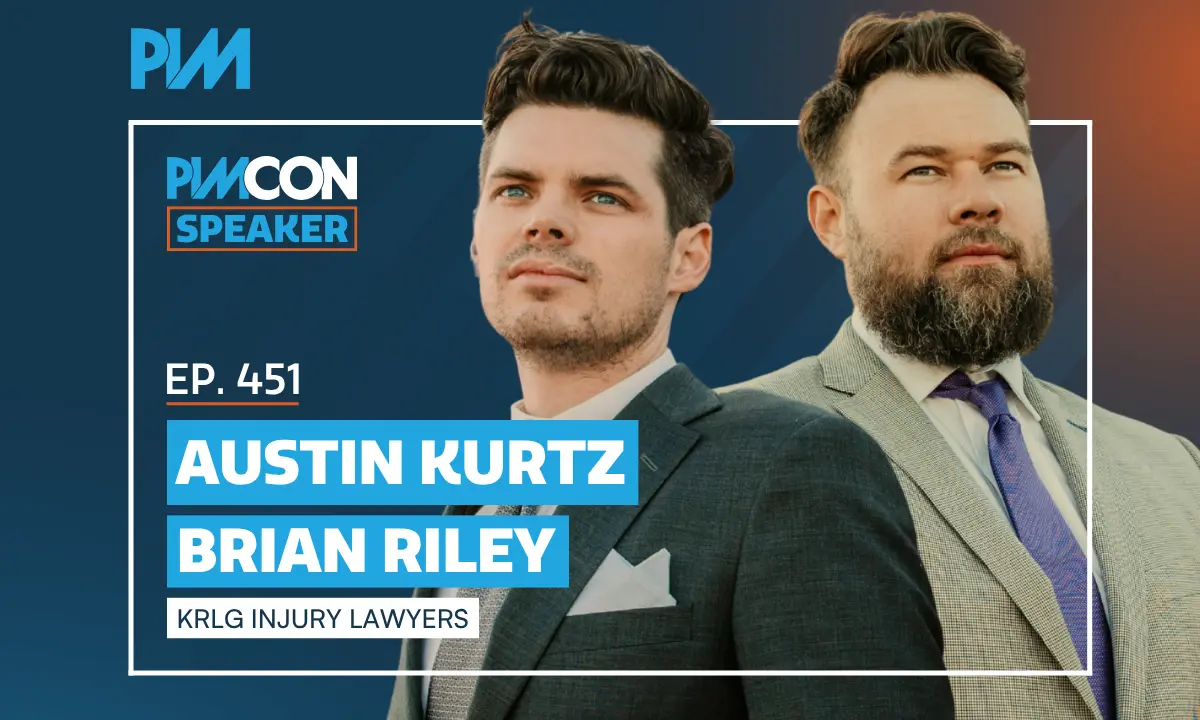
Austin Kurtz, and Brian Riley aren't your typical PI attorneys. In just two, and a half years, their young firm has experienced rocket ship growth by doing exactly what the traditional crowd won't. If you want to know how to outmaneuver the old guard, and scale a massive market presence on your own terms, then you'll definitely want to stick around for this one. This is Personal Injury Mastermind. I'm Chris Dreyer, founder, and CEO of Rankings.io, the elite performance marketing agency for personal injury law firms. Today we're talking with Austin Kurtz, and Brian Riley from KRLG Injury Attorneys in Arizona. We're talking off the wall Gorilla Marketing, turning industry bottlenecks into powerful referral engines, and how they build a 15-year firm in a fraction of the time. Plus, I'm very excited to announce Brian, and Austin will be bringing their larger than life approach to PIMCON Stage as feature speakers.
They promise it's going to be a highlight, so you'll definitely want to get your tickets at PIMCON.org to join us in Scottsdale in October. All right, let's get into it. Hey guys, I'm really excited. I got two guests today. I got Brian Riley, and Austin Kurtz back on the show. Welcome back.
Austin Kurtz:
Thanks for having us. Stoked to be here.
Chris Dreyer:
Man, you guys have just been crushing it. I was looking back at the last interview, and it was like you guys had 10Xed your caseload the first year, and now two, and a half years in, you're like 10 plus attorneys. I don't know how many you have, 50 plus staff. Give me a current win. Give me something going on current. What's a win that comes to mind? I'll start with Brian.
Brian Riley:
Well, yeah, I mean, we are starting to turn the law firm from frat house to legit law firm. Probably last time when we were together, it might've just been me, and Austin, maybe one, or two other attorneys. And now we've got 12 attorneys, two ABOTA attorneys just joined us in the last couple months.
Chris Dreyer:
I don't know what that means. What's ABOTA?
Austin Kurtz:
American Board of Trial Advocate.
Chris Dreyer:
Okay.
Brian Riley:
Thanks, Austin. But it's a pretty prestigious group. I think you have to do a certain amount of trials in order to become qualified. And so we've got a lot more experience that just recently joined us, and is super helpful for us to train our younger attorneys as well as me, and Austin. I still consider us younger generation attorneys. So, we've got that going on, which is awesome. Team's growing. We moved into a new office in October. We've expanded out of that. We're currently breaking a wall down to add another three, or 4,000 square feet. So, a lot of good things, a lot of things happening, a lot of chaos, a lot of emails coming through that I can't seem to keep up with.
Chris Dreyer:
Let's go. That's awesome though. Austin, what about you? Anything to add like current?
Austin Kurtz:
Yeah, I think for wins for us, I think it's a two growth. So, it has been a rocket ship, which we're ecstatic about, but because the success of the firm has gone so quick, I'd say that we're two, and a half years old, and I say we have a brand that's like a five-year brand. It's as if we've been in business for five years, but our firm is like a 15-year firm. It's really going at that rate. And so trying to get the brand to catch where the firm's at has been a big initiative this year. And so we did a high end commercial with OpenJar, shout out at OpenJar, and we are now deploying it in tons of fun ways. We just signed a deal with the movie theaters that this summer all the movie theaters in our area are going to be playing it every single time a movie goes at the start, which is a super fun, weird, totally on brand, funky thing.
That's really exciting. And so continuing to find ways to hit the market where other people aren't is really exciting, and like now doing it at a rate. We have a little bit more money to spend to hit them in different ways that's really fun.
Chris Dreyer:
The movie theater, I think I brought this up a long time ago, and I've never heard anybody pull the trigger on it. I always thought like, look, everybody loves the Super Bowl because people watch the commercials. We go to the movie theater, you don't have your phone out, or else they're like, it's like weird, and it's like you got to watch the commercials. So, I think that's genius. I think that's great. That's awesome.
Austin Kurtz:
Yeah. If it hits how we want, they'll go in there, they'll watch a movie, and then they'll leave. And two, anyone listening from Arizona, sorry you've already done it, and I got to lock down 900 different ways, but if you're out of state, I encourage you to do it.
Chris Dreyer:
Then you guys got Best in the Valley third time?
Austin Kurtz:
Yep, threepeat.
Brian Riley:
Yep. So, three years in a row for both of the lawyer categories, best law firm, and then best personal injury law firm. So, super excited about that. It's a lot of work every year kind of rallying the community to get to vote every single day for 30 days, but we've been really thankful to grow, in my opinion, a real community of true followers that actually support us, understand how important it is for us to try to win that every single year, and to be able to do it for the third year in a row is amazing.
Chris Dreyer:
Yeah, that's insane. That's great. Social proof, community, kind of taking it back to this growth. I know you got the new initiatives, the TV you just cut, that's exciting. We'll talk more about that. Austin, and Brian are executing something brilliant here. They're zigging while everyone else is zagging. While other firms are pouring cash into standard TV spots, they are capturing a completely captive audience on the big screen, and they back it up with powerful grassroots branding, and absolute powerhouse operational engine. Let's dive into how this young firm has structured their pre-lit litigation departments, and how that structure is helping to fuel their growth. From what I see, there's not a ton of like through, and through lawyers that really take cases all the way. I don't remember if Brian, it was your episode, or Austin. I think Austin, you did at the time you were kind of overseeing pre-lit, and then Brian, I think you were overseeing the lit department attorneys. Do you think that's like one of the big factors of like drawing in these cases, and having the growth so early on?
Austin Kurtz:
Yeah. I mean, I think we were inverse of that. I think Brian was running pre-lit, and I was running lit. Brian's an amazing litigator, but there's nobody better at pre-litigation than Brian. Brian has a strategy. He's trained our team. Our team has grown so much under watching. I mean, most of our attorneys have had periods where they've sat in our office. That's how we used to train people. It's like, "Hey, we're going to be on the phones. You sit your ass right there, and you watch how we do it." And they've sat in my office, they've sat in Brian's office, and I think that they've grown so quickly because of that. We do referrals. We have our own marketing, we have our own branding, we're good at that, but we do referrals openly. We tell people, "Send us your cases." You don't want to do pre-litigation, send us your cases.
You only want the lit side? Okay. Oh, you only want to do big litigation. Send us a small lit. Oh, you only want to do small lit, and you want someone to do the big lit. Send us a big lit. We do everything, and we're built to do everything. And so absolutely huge part of our growth is being able to handle those cases from start to finish any which way.
Chris Dreyer:
We talked before the show, Rafi with Fortress, I think he sold 20%. I don't know the exact percentage. So, he's expanding, I guess, into Colorado, and other markets, and then you've got another big firm potentially could announce. I won't let the cat out of the bag yet until maybe that's public, but have you found... I mean, you guys are in the center of it all. The PE cat, the money coming in, I guess that creates kind of an opportunity too of like all these people wanting to pile in money. It's like, well, who are we going to send cases to? And you guys are built for referrals. That seems like a really good strategy.
Brian Riley:
Yeah. I mean, I think Austin, and I are, we're not afraid to ask for referral business either, and we do it in a way that's respectful. We never do it in a way that's, "Hey, we can work your cases better than you can, or anything like that." But we understand that with some of these bigger firms, they're just receiving so many brand new cases every single day, and that's great. That's great for their business, and their company. But if they need help, or when they get stuck, we definitely want to be the first group of attorneys that they think of when they need someone to help push a case to the finish line, or if maybe it's one of those things where it's like, "Look, we are just getting overloaded right now. We can trust you guys. You do a great job. Here's a batch of pre-lit cases, work a good referral agreement out. We know you're going to treat the clients right. We have similar systems, similar communication standards, different things like that."
I think that's sort of how we try to appeal to some of the bigger firms. And especially with private equity, we haven't really had any real conversations with some of this new stuff going on, but I expect them to have high expectations, and to be forecasting on their cases in certain ways where you sign a hundred cases, the fall off rate needs to be within 15%, and the average case value needs to be X, and Y. And if the attorneys for those firms are not able to achieve those goals, we want to be the first people to come in, and sort of be ready to say, "Hey, well, if they can't do it, we can, or we can try." So, I think that's kind of our angle.
Chris Dreyer:
But talk to me about the strategy, right? I can't think of the team you guys sponsor the grassroots initiative.
Austin Kurtz:
We got the Valley Suns.
Chris Dreyer:
Yeah.
Austin Kurtz:
There you go. That's the Valley Suns mascot. We got the Valley Suns. I mean, we're all grassroots. I'm actually laughing because I don't notice these, but we did Bobblehead with the Valley Suns this year, which was cool, and a fun thing. And so we do weird stuff. I think our whole strategy right now is we can't compete with going twofold. There's tons of money coming in here, and on the Arizona Listserv, if you want to sit there, and read, everyone's like, "Don't let them in here, block them." It's all this thought. And Brian, and I are like, "Hey, when are you guys coming? You want to play golf? Let's go get coffee." We have just accepted that the world is changing, and we're either going to fight it, or you're going to work with it. I think that we are welcoming.
Anyone who wants to come in Arizona, and figure it out like, "Hey, Rising Tide, I'm all about it. Give me a call. Give Brian a call. We'll give you whatever we can. We'll tell you who the great guys to work with, tough ones to work with. We'll say everything we can. We'll be very open about it." For growing, I think we just stick hyper grassroots. We had a real conversation about going more traditional means, and maybe eventually we will go traditional, but Brian, myself, and Mackenzie who runs our marketing had a sit down at the end of last year, and we said, "Look, we're going to start deploying capital, and we can deploy it the same way everyone else does, or we can deploy it through us." And it's really exhausting that a lot of the brand is like, Brian, and I are good at drinking beers, that's tiring, but we're good at drinking beers so we're going to keep drinking beers, and it's going to work, and it does work.
And so it's a lot of us, but anyone who knows us knows it's not BS, right? It's just authentic. It's not like we're putting on some sort of show to walk in these conferences, and then you walk away, and you're like, "Oh, Brian Riley's such a jerk." That's not it.
Chris Dreyer:
Well, I've never heard that.
Austin Kurtz:
We've always said the firm's two dudes hanging out, and we really are just like two dudes hanging out. We just happen to be good at practicing law, and have had been really blessed to get referrals, and continue growing it, and people want to come back, and we're really interested in giving the highest level of service. So, I think doing things like deploying the commercial in weird ways, continuing to grow social, grassroot initiatives that are different. We did Country Thunder, which is a big concert out here, total flop, but we're willing to learn on like what's good, and what's bad.
We have some stuff this summer that's going to have some content come around it, but it's going to be really funky, and different, which this won't come out before the ad comes out, but for our Best of the Valley ad. So, we won the third time Best of Valley, and we're like, "Okay, in that magazine, how do you deploy an ad that makes people actually read it?" And so what we're doing is we have a Where's Wolfie. Our mascot is a Wolf. And so we did a two page ad that is like an old Where's Waldo, but it's a Where's Wolfie. And it will say KRLG, three time winners, find Wolfie, scan us on Instagram, DM us where it is, and be entered into contest, win $1,000.
So, now people are actively getting into the funnel, and the ad actually makes sense. People are resonating, "Oh, these guys won Best of Valley. This is the Best of the Valley issue." Instead, we could just put our two faces on it, and people are like, "Yep, next page, next page." So, I think just continuing to be weird. I don't know how else to describe it. B, am I missing anything?
Brian Riley:
No, that's right. I mean, that's definitely on the marketing front when it comes to growing, and getting more cases through our SEO efforts, and those different efforts. I mean, the firm's definitely built on referrals from a lot of other lawyers, but we are doing our best to get some traffic directly to us through our Instagram, our various social media platforms, Google. And those are super important because those cases are people that sought us directly. So, we obviously, I mean, every single case is important, but for the ones that come to us directly, obviously there's no referral fee. It's a little bit more profitable. And then on the other end, when it comes to growing the firm, we're only two, and a half years in. So, we've got a lot of attorneys, we've got a lot of cases, we're starting to move more cases into litigation, more cases in litigation are starting to mature.
Those cases are requiring experts so it's like higher cost to higher nut to run your caseload every single month, but then at the same time, we have higher expectations for the results that we're seeking, and I can see that directly in Austin's caseload. He definitely runs our bigger, and larger litigation cases, and it's awesome to see so many mediations set, and big seven figure results happening every single month. And then for me, I'm also doing a lot of litigation, but more kind of being the...
Austin Kurtz:
Enforcer.
Brian Riley:
Yeah, kind of being the battering ram for our pre-lit lawyers when those insurance companies don't meet deadlines, lawsuits are getting filed within 24 hours, and cases are getting flipped into lit quickly, and we're making sure they understand the deadlines mean something. So, like this year's been great. It's been a lot of strategically trying to find ways to get clients to us directly, and then also building the value in our cases by doing good litigation work.
Chris Dreyer:
Yeah, that's great. That's great. I kind of wanted to expand on just the cases, and things like that. There's so much competition on auto, and then it's like I know the Waymos were like driving, and like they all went to that one subdivision. I've seen some of the stuff on social media, then they pulled them from the interstate, so they're having all kinds of issues. And I just saw something, I think Steve Muir posted something on his social about the people moving into Arizona. It's like top four, or top five. Have you thought about weird case types like construction defect? It's not really PI, but it's kind of adjacent, or like maybe some of these other cases just because of how many people's coming in.
Austin Kurtz:
Yeah. I mean, I think we do a little bit of products. We'll take a products case of the injuries there, but like the reality is, and med mal, but like in order to do a med mal case, or a products case, you just have to have such catastrophic injuries because they're just so expensive to litigate, and we find those, and we do them, and they're just a different... Production in a car accident case outside of your injury records, I don't know how many pages they produce, like 200 to 500 in an average case, like production in a products case is tens of thousands of pages, and you can rely on the AI to like read it, and pull it out, and do traditional doc review. But I'm a little old school. I read those things page by page. I just have to. It's so funny how much advice we've gotten since starting this firm by people that like shouldn't be giving advice including like the advice pieces we've gotten are like, "You guys are never going to work as partners.
Partners never work. Partnerships always fail." And I'm like, "You haven't found a partner that stakes." But like the other advice was like tons of people have been like, "When are you guys going to expand out of Arizona?" And I'm like, "Dude, I just want to figure out Arizona. We don't need the world. We like our world. We're very comfortable with what we're doing. We want to grow organically, and normally." And so to answer your question, yeah dude, if someone comes to us, and they're like, "I have a boatload of construction defect cases, and they're going to go, and Brian, and I can talk about it, and be like, all right, we can figure out a way to build this, we would do it for sure." But we're so focused on doing what we do really well that like, I mean, we're licensed in, I don't know, eight states, or something across the firm, but really we pretty much only take Arizona because outside of a few cases, we're good at Arizona.
Someone comes, and asks me a question about Arizona, I know what we're doing, I know where the pitfalls are, and the more you expand that, the more dangerous it becomes to just like, now our product isn't that we're just the best at what we do, it's now our product is like, we're good at getting cases. And so I think trying to stick in our lane a little bit is a pressure, but like the growth of business is always there.
Brian Riley:
Yeah. And just to kind of tack onto that, too, I mean, we do have, I got one sexual assault case right now. We've certainly expanded when it comes to premises liability cases, I mean, there's not many attorneys that actually like doing those cases, but we love them. I love premises liability cases. Normally there's almost no insurance coverage that you have to worry about. So, it's just about finding liability, and then fighting for value. A lot of times it takes litigation, but that's fine. So, I see us definitely becoming, probably having a department at some point that focuses on premises liability, and those types of cases. And then the other way that we're also doing our best, and this is one of those things where Austin is hitting the nail on the head when it comes to staying in our lane. We're starting to get more Spanish-speaking clients, which is awesome.
And we've hired a Spanish-speaking attorney who can, in my opinion, truly serve those clients. So, for the cases that we have in litigation with Spanish-speaking clients, we have a Spanish-speaking attorney, and usually myself, or Austin also on that case, and then also in pre-litigation. So, just making sure that our standard of service, our level of service is at a certain market all times is super important. And I think if you get too big, and too many states too quickly, at least for us, and our system, which we think is pretty good, we just think the level of service probably comes down a little bit. And when you're doing a lot of work for like referral partners, they expect that level of service to be super high. We want to keep that consistent.
Chris Dreyer:
Scaling a local firm requires leaning directly into operational headaches your competitors run away from. For Austin, and Brian, that meant attacking a bottleneck that routinely stalls minor settlement cases for months, conservatorship cases. Here's Brian on how they transform a major industry friction point into a massive referral play.
Brian Riley:
There's a lot of law firms coming in, a lot of money coming in, and conservatorship cases is something that becomes a huge bottleneck for a lot of law firms when it comes to helping get those cases through the line. There's not a lot of lawyers that really know how to run a conservatorship. So, we've actually set up our own conservatorships department within our firm with one attorney, one team, handles all the conservatorships, and we're starting to look at possibly kind of advertising that service on like a fee based, or like a flat fee rate for other lawyers who just don't have the manpower to get it done. We've got the system ready to go so we can potentially help out in that way.
Chris Dreyer:
Brian, talk to me like I'm a six-year-old. What is a conservatorship?
Brian Riley:
My bad. My bad. When somebody under 18 years old has a personal injury settlement, and it's over $10,000, or more in Arizona at least, it all has to go through the courts. So, a judge has to approve, and then the money has to be put into a restricted account, or some type of investment fund for when the minor turns 18, they get all the money, and that basically safeguards from the parents going out, and buying a new vehicle. So, it's crazy because like people want to help the whole family when they're in an accident, and then like that conservatorship issue pops up, and it's like people, lawyers are like, "It takes over a year to get that done." We want to try to spend that, speed that up as much as we possibly can.
Chris Dreyer:
Really smart, really smart. And I'm excited. Both of you guys are speaking at PIMCON. So, that's October 4th through 6th this year in Scottsdale, Arizona at the Phoenician. Give us a preview Austin, like your segment, maybe a preview. I know you don't want to spoil it because you guys are going to do something out of the box, but a preview of that.
Austin Kurtz:
Yeah. So, I think we're going to do Gorilla Marketing, and just kind of on what our strategy is, and how we've grown through Gorilla. And I think that we've gone to PIMCON both years. Is this the third year? This is the third year. Yeah, we've gone both years. We've been wildly impressed how people have presented, and what they've done. But I think that sometimes when you're there, you hear different sizes of firms, and you're like, "Oh, that's great. This is how you dominate a presence if you have this kind of budget." And I think that ours is going to be completely opposite. Look, anyone can compete. If you're in a world, and you're saying, "I'd love to start a firm, or I'd love to grow my small firm. How can I do this with a budget that makes sense? How can I be competitive with the big guys while being a small guy?" Our whole presentation's going to go to that.
It will attract eyes. We're going to be funky, and do everything we do is off the wall. This is going to be 100% on brand, and continue to be off the wall. It'll be a highlight.
Chris Dreyer:
Let's go. That's going to be a lot of fun. So, kind of super excited, continue to see you guys there. For our audience listening that has questions about the pod, they want to send you a case in Arizona because you guys know how to handle those cases, get max value. Brian, what's the best way to get in touch with you? And then Austin, what's the best way to get in touch with you?
Brian Riley:
Yeah, no. So, my cell phone number, 520-977-2025, text me, call me. Email Brian, that's B-R-I-A-N @krlg.com Austin's email's the same, austin@krlg.com. Those are the easiest ways to reach us. You can also find us on Instagram at KRLG. It'll pop up. You'll find it.
Austin Kurtz:
We're still in a battle for the actual username, but that's a different story.
Brian Riley:
That's a different story. We got a lot of stories to tell. Yeah, those are the best ways to reach us, and we can either handle it directly with you, set up a referral relationship. If it's a one-off case, do you connect with our intake team? We're definitely, we've got a lot of people with eyes on at all times. So, any way that you contact us, you'll get a quick response.
Chris Dreyer:
Amazing. Gentlemen, thank you for coming on the show.
Brian Riley:
Appreciate it.
Chris Dreyer:
Huge thanks to Brian, and Austin for pulling back the curtain today. If you want to see exactly how they deploy these off-the-wall Gorilla Marketing strategies with a budget that actually makes sense, you do not want to miss their presentation. They're bringing their larger than life approach to PIMCON stage as featured speakers this October in Scottsdale, Arizona at the Phoenician. Spaces are filling up fast, so secure your spot right now at PIMCON.org. I'm Chris Dreyer. Thanks for listening to Personal Injury Mastermind. I'll see you in Arizona.