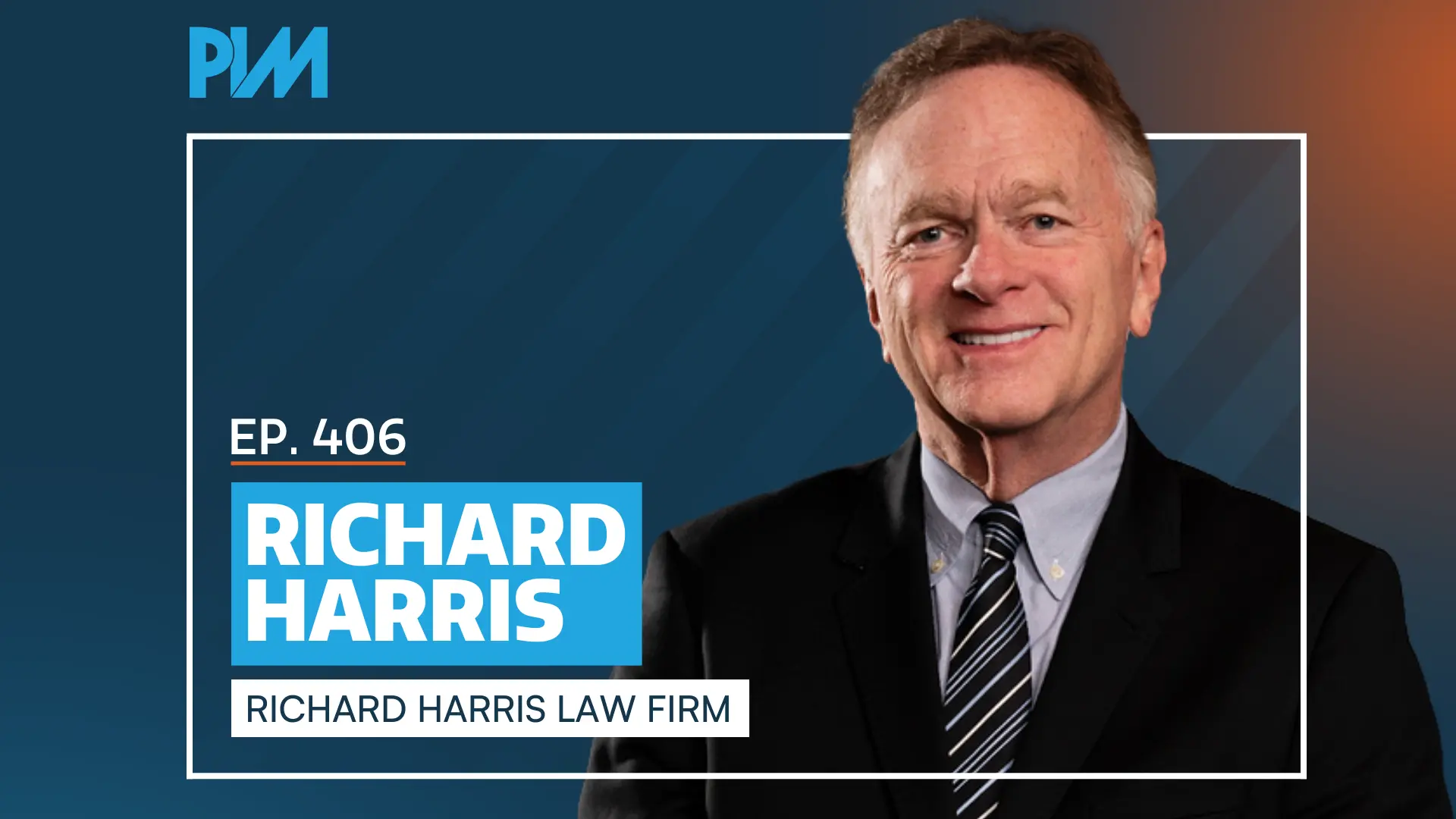
Chris Dreyer:
Richard Harris is an absolute legend in Nevada. He built his practice the old-fashioned way through relentless litigation and taking incredible care of his clients.
Richard Harris:
That served us well for 25 years. We also did good work and we litigated. And so we got referrals from other lawyers and judges and insurance adjusters and had some record setting verdicts and settlements in the '90s.
Chris Dreyer:
But even a powerhouse like Richard Harris found himself needing to start over. In the early 2000s, his original firm dissolved and he had to rebuild alongside his son, Josh.
Richard Harris:
It was the best thing that ever happened because I was 25 years into my practice. Josh is out of law school and together he and I rebuilt it. He had his young, youthful style and so it's a good collaboration.
Chris Dreyer:
Josh brought a completely new perspective. It was old school colliding with new school. The grit to outwork the competition when everyone else goes home, combined with aggressive marketing and relentless KPI tracking. When you mix those two worlds together...
Richard Harris:
When you have both, that's like lightning in a bottle.
Chris Dreyer:
This is Personal Injury Mastermind. I'm Chris Dreyer, founder and CEO of Rankings.io, the elite performance marketing agency for personal injury law firms. Before the massive ad budgets and 500 cases a month, Richard Harris actively looked down on advertising. Today, we're unpacking his strategy to build $100 million empire. You'll learn how to lay an unshakable referral bedrock, why you must dominate your local market, and the exact light bulb moment that changed his mind on growth forever. Let's get into it.
Richard Harris:
Even though it was legal, I was part of that generation that thought if a lawyer advertised, they must not be a very good lawyer. And I believed that for a long time and built my firm the old-fashioned way by word of mouth. And so that served us well for 25 years. We also did good work and we litigated. And so we got referrals from other lawyers and judges and insurance adjusters and had some record setting verdicts and settlements in the '90s leading into the 2000s when the firm disintegrated.
And so around the same time when the firm broke up in '03, my son Josh was in law school and he joined me in '05 to rebuild the firm. And so that was sort of what happened. We decided to sprinkle a little marketing into a really solid client service oriented referral-based practice. And when you have both, that's like lightning in a bottle. When you can actually have a good firm with solid policies, procedures, systems, and then you start sprinkling marketing and advertising, then you've really got a great, big, successful firm. And so that's what's happened to my firm the last 20 years.
Chris Dreyer:
Geez, from a client service perspective, I mean, you got one location that's 3,100 plus reviews, may have more than that with a high rating. And I got to imagine too, when you didn't have the volume of cases early on when you weren't advertising, you were, "Hey, let me get maximum value and give extreme attention to this." And then those results ended up being marketing.
Richard Harris:
Yeah, so that's really true. I remember sitting in my conference room in about '07, '08, and there was this young couple, husband and wife, they'd been involved in a very serious accident and they were coming from a TV lawyer. They wanted to terminate the services with this TV lawyer and come to me. And it was a really big case. And I remember sitting there talking with this couple saying, "How on earth do you, as a bright young couple, end up with this lawyer who is not a very good lawyer with a case like this?" And she said to me, "Well, he had the best ads. We assumed he was the best lawyer." And all of a sudden, a light bulb went off in my head and then suddenly I go, "Okay, I'm going to lose this unless I start adding marketing and advertising." So that's kind of what happened is literally that case.
I know that for years in the early days of advertising, 10 or 15 years ago, I would say, "Oh, I'm happy with my 150 cases a month because we just don't have any people out here in Nevada." It's just Las Vegas and the rest is sagebrush and jackrabbits. And so I never believed that you could get more cases than your typical 100, 150. I just figured the population wouldn't support it because of the number of lawyers that were already here and advertising and we pushed the envelope, more and more money being spent on advertising and we haven't hit the saturation point yet.
Chris Dreyer:
So that was one of my future questions, but you led me right to it. You've got a thriving practice and you went the, I'll say the inch wide mile deep and stayed in Nevada as opposed to expanding your total addressable market. Have you thought about going to California, going to these other markets?
Richard Harris:
I have seen other lawyers make the mistake because of their desire to grow, maybe their ego. They want multiple offices in multiple states. There's an old saying, "He who chases two rabbits catches neither." So I don't feel that we have dominated, conquered Nevada yet, although we continue to grow every year. I don't believe we've reached the saturation point. And maybe once we've done that, I might explore other markets. We already practice in Utah, Arizona, California, just because we have other lawyers that are admitted there and we get overflow cases that come in. So we already do have quite a few cases in those other states, although we don't actively market anywhere else but Nevada. But I just don't feel that that's what I want to do. Maybe my son, Josh, when I'm not around, might do that. And we have dabbled in lead gen plays in Colorado. It works. I did Law Tigers in California. It works, but I just feel that focusing on Nevada in Nevada is the best play for us.
Chris Dreyer:
Thank you for sharing that. I got to say, when I think of dominating a market, I think of you in Nevada and I think of Newlin over in Orlando. I know he sold his practice and I'm not sure whether it's the fortress or whatever happened there, but I look at the media spend, 20 million in Orlando on TV buy. It's like, well, clearly if he's spending that much, then it's going to support it. I don't know what the signal would be to show just complete diminishing returns. I guess if the CAC just completely, the cost acquired case just blew out and wasn't sustainable, I don't know.
Richard Harris:
Yeah. Well, those are all the considerations, aren't they? I used to be proud of the lack of money spent on marketing. I used to brag about, "I'm less than 10% of gross revenue," and now we're a hefty 20% of revenue, and we're approaching $100 million law firm. So that's a significant amount of marketing dollars spent for 3.2 million people in Nevada, but that's just like Newlin's play in Orlando. I didn't believe that we could do it until we started spending the money and the cases came and now we're approaching 500 cases a month, and I never would have believed that would happen in Nevada.
Chris Dreyer:
One of the things I've always thought about Vegas and Orlando is they facilitate a nationwide strategy because you get so many travelers and as opposed to other markets that maybe aren't as visited from a tourist perspective. So I've always thought that that was an interesting component of maybe these two markets in particular.
Richard Harris:
You're exactly right. We have approaching 40, 50 million tourists a year that come to Las Vegas. Some of them get hurt. They go home, they hire their local lawyer and they come to us either through referral or the ones who don't hire a lawyer or getting on the internet. And so years ago, we made a play to become Nevada's lawyer, the go-to lawyer. And we're in Trial Lawyer Magazines, we're on LISTSERVs in other states, trying to be helpful to people who have had cases here. And we get hundreds and hundreds of cases from lawyers out of state every year because of that focus that we made years ago.
Chris Dreyer:
When the cash starts flowing, firms that spread themselves too thin across multiple states can run into trouble. But focusing solely on Nevada, Richard was able to continue to increase his ad spend without diminishing returns. But once you start dominating a market, those massive cases start rolling in, you run into completely different problems. You can spend millions to make the phone ring, but if your intake isn't solid, all those expensive leads are just going to leak right out of the bottom of the bucket. You've been doing this a while. What are the fundamentals to you today for advertising from a PI firm?
Richard Harris:
Well, the fundamentals are word of mouth referrals, that's the fundamentals. Because when you think about it, everyone in practice has sort of a radius of influence, whether they advertise or not. They have their 1,000 or 2,000 people that they know. And if they're available to those friends and family and associates, all the marketing and advertising in the world has no effect on those people whatsoever. They already know a lawyer, they know how to get a lawyer, and they can watch TV or drive down the freeway and all these billboards and all of it flies over their head like mattress commercials. You know how many mattress commercials there are on TV? So none of it means anything to somebody who already has access to a lawyer. So I remember those days and actually long for those days when it was just me and my little staff and the people that called me, knew me or they knew somebody that knew me and I could attribute every case to somebody who... For years it was like that.
I knew every single case and where it came from. And so there were people advertising and it didn't affect me. I think having a practice like that, a core practice that's based upon referrals, client service and so forth, that's where you have to start. That's the fundamental. And then when you branch out and begin to mass market, then the risk is you're going to lose that quality. You're going to lose that client service. You're going to lose that ability to get maximum value on a case. And so then it becomes just feeding the monster, sort of the hamster wheel of feeding the marketing dollars so you can have more cases because you're not really getting those cases by word of mouth and doing a good job, which feeds on itself.
So the fundamental is to do a good job and to have your systems and processes perfect so that when these people call and these people are calling you, you don't want to lose those people. An 80% conversion rate is not good enough. A 90% conversion rate is not good enough. You want to be able to capture everyone that wants you as long as you want them. And so I think a lot of law firms make the mistake of throwing marketing dollars out there and then not having a solid way of doing things and stuff slips through the cracks.
Chris Dreyer:
Let's talk about that leaky bucket, the wanted conversion rates, a practice your size. Are you a Salesforce Solidify? Are you a lead docu Filevine? Talk to me about your tech stack. Talk to me about your intake.
Richard Harris:
We're Litify. We wanted to be a Salesforce-based CRM just because of the kind of saw what was happening years ago when we committed to that, that there's going to be add-ons and plugins and eventually AI stuff. And I have no problem with Filevine. I know the owners, that's a Vegas product, Ryan and Nate, but it's a closed system. And so we opted for Salesforce so we could plug and play. And so as far as the tech stack is concerned, we have Speed AI, if you're familiar with that, monitoring our intake processes. We have Foundation AI, which scans and distributes our documents. We have also EvenUp, we use both as far as processing cases and MedChrons and things like that. We actually have an AI receptionist. We're one of the first firms to actually have the guts to do that. And it's not perfect, but it's pretty good. We call her Casey. We named her after a difficult staff member that used to work for us.
Chris Dreyer:
Love it.
Richard Harris:
So Casey speaks 150 languages and routes our calls based upon phone numbers and the identification of the caller. It's pretty amazing.
Chris Dreyer:
I was just wondering on the phone system like RingCentral, Amazon Connect.
Richard Harris:
We are RingCentral right now. Yeah.
Chris Dreyer:
Gotcha. And then just on a follow-up, thank you for sharing all those wonderful tools. I've had a handful of them on the podcast. How do you think about the chase? Is it 14 days? Are you a buy or die type of... As long as they're into statutes, we're chasing them for a year.
Richard Harris:
No, I don't think we chase them more than a few days. In Nevada, we like to say people are super educated because of the proliferation of lawyer advertising, billboards, TV, radio. So everybody lawyers up really fast and it's not like Seattle where somebody gets an accident, maybe they want to read a book about it and then choose their lawyers.
Chris Dreyer:
Gotcha.
Richard Harris:
So we don't find it fruitful to chase too long because people lawyer up. I saw a survey years ago. It was something like two or three days was sort of the average for lawyering up after an accident. It was one of the quickest in the country.
Chris Dreyer:
You can have the most advanced tech stack on the market. You can have AI routing your calls in 150 different languages, but technology only takes you so far. At a certain point, converting cases and building an elite reputation comes down to sheer, unadultered effort. Perhaps Richard's best tool isn't found in some software. It's a mindset that happens after everyone else clocks out. So in our pre-interview, we asked about your biggest breakthrough in your business and your answer was pretty short. You said, "It's all profit after 5:00 PM." So unpack that for me. What do you mean by it's all profit after 5:00 PM?
Richard Harris:
I really enjoy working and always enjoyed working and I'm not a golfer, so I worked Fridays my entire career. And so I used to, and I still do, follow the mantra of people during the day, paper at night. So my days are spent dealing with people and whether it's in the litigation process or meeting with clients or meeting with vendors or going to a power lunch with an influential person. And then at night, it was doing all the work because you didn't get any work done during the day. So I stayed late at work. I don't know what it's like to be in commuter traffic because I've never driven home in commuter traffic. And I would stay to work into the evenings every night to do the paperwork, but I would also make a few phone calls.
And I would call clients after 5:00 and they would say, "What are you doing?" I go, "Well, I was here working on your case." And they would be flabbergasted that the attorney is calling them in the evening. That was a very powerful signal to them that we're hard to work on your case even when the business day is over. So it's all profit after 5:00 comes from that experience where clients are so surprised. It's like gold when you make a telephone call at night. You've probably had that experience when your doctor checks up on you maybe after a surgical procedure, you actually get a call from the doctor at night, checking up on you. That always impressed me. So it's the same thing. So most people quit and go home at 5:00. It's all profit after 5:00 means that extra effort is nothing but profit.
Chris Dreyer:
Let me circle back to the, because I'm really intrigued on this inch wide mile deep, right? State of Nevada and you haven't hit the diminishing returns, your large case count. Has that facilitated you going after a wider range of cases, maybe taking some premises cases that maybe you're on the fringe and not just straight auto?
Richard Harris:
Oh no, no. It's never been that way. We have always taken premises cases. Because our foundation is in litigation as a firm, some of our biggest verdicts and settlements have been premises cases. In fact, there have been a couple of years where our fees generated by premises have exceeded auto. So there aren't too many firms that can say that. And that's because we're in Las Vegas and Reno and there's all kinds of hotel casino premises type cases from the routine slips and trips to the tragedies, the crimes that are committed and negligent security type cases. Of course, the Route 91 shooting case we were heavily involved in. And so we've always taken premises cases. Now, it's a different way to evaluate those in the beginning. I mean, you're going to lose about half of those that you sign up, but the average fee is considerably higher than our auto average fee.
Chris Dreyer:
Let me give you a thought exercise off that. You just kind of spurred this off the cuff. A lot of people think of your go to market strategy, like you're going to enter a new market and you need to generate cases. Like you said, you rebuilt the firm with Josh. One of the strategies was, "Hey, I got 600 cases." And different go to-market strategy, whether you'd like it or just like as the lead gen, right? Higher fall off rates, maybe not as good a cases, but let's just say we did a hypothetical. Said, "Hey, we're going to go compete in Atlanta." Atlanta's got good laws and what do you think your mix would be? Do you think you'd go in, go to market lead gen? Do you think you'd go in blasting TV? What do you think?
Richard Harris:
Well, I'll tell you, when I went into California, it was a lot tiger's play. So it was strictly motorcycle cases. It worked, but we kind of got the one, two punch during the pandemic and everything sort of shut down. And that's when I withdrew from Law Tigers out of California. And I earmarked that budget for Nevada and that turned into explosive growth. I doubled down during the pandemic. It's interesting. I emailed John Morgan in March of 2020 when the pandemic hit. He's a friend of mine. And I said, "John, what are we going to do?" Everything shut down. And he wrote me back and he said, "Double down. Double down on your marketing." And a lot of firms did, and we were one of them. And so California was a Law Tigers play, which was a mix of radio, TV, digital, outdoor. But when we experimented in Colorado, it was 100% lead gen play and it worked.
But again, that was a victim of the pandemic as well. And so if I were to go into a market, it would be a digital play. Initially, I wouldn't bother with traditional channels. I would not do TV. I would not do radio. I would not do outdoor. Not initially. I would do lead gen and pay-per-click if I were to go into a new market.
Chris Dreyer:
Love it. We'll put that up on our website.
Richard Harris:
And it's interesting. There are a lot of firms out there that are flying under the radar that they have no brand presence whatsoever, and they're signing up a lot of cases on lead gen and pay-per-click. The virtual offices, they don't have a brick and mortar anywhere, and they're hugely competitive. And most of the world of PI lawyers don't even know about these firms. There's a number of them.
Chris Dreyer:
Me being a digital guy, like I'm Broderick, right? He's spring out of nowhere with the LSAs and the local map pack and what he's doing.
Richard Harris:
Well, the low firm, have you ever heard of a low firm? Out of the West and Midwest, the huge firm that nobody's ever heard of, but it's 100% digital.
Chris Dreyer:
I got a couple final questions here. Talk to me about working with your son. I got to tell you, that would just be a dream of mine. My son's four, right? So that's a long ways off, but hey, snap your fingers and next thing you know, what's it like working with Josh? Do you share the vision? Do you say, "Hey, we want to go this way or that way." Is there complete alignment or does he, "Hey, I want to do these things."
Richard Harris:
I have to say, working with Josh is a dream. I never thought it would happen. I always thought Josh should go do his own thing. But for the breakup of the big firm in 03, when Josh was in law school, I don't think Josh would have joined me because I was sort of against that, like, "Go do your own thing and I'll do mine." And I grew up in a family business and there was tension among the siblings and with my dad and it wasn't perfect. And so I didn't look forward to that until the firm broke up. And then I relied upon Josh to come help me rebuild this. And it was the best thing that ever happened because I was 25 years into my practice. Josh is out of law school and together he and I rebuilt it and he adds his young, youthful style to the firm and corrects me.
He's deferential to me, but he speaks his mind on the way it should be as I'm getting older and maybe more out of touch to the realities of what's happening with the younger people. And so it's a good collaboration. It's 100% respectful, never a real argument. We work it through and he's a numbers guy. His favorite movie is Moneyball, and he knows the numbers, he knows all the KPIs, he knows the time on desk, he knows the average fee, he knows the conversion rate, he knows the attrition rate, he knows all the numbers. And I'm more of a thinking in circles, I'm more of a relationship kind of guy and old school. And together it's a pretty powerful duo for recreating this firm over the last 20 years.
Chris Dreyer:
Rick, this has been amazing. Final question here. Our audience listening that has a question about our pod conversation, they want to get in touch, maybe refer a case to you. What's the best way to get in touch?
Richard Harris:
I'll give you the email address. The shortest one is rick@harris.legal. rick@harris.legal. And I still answer the phone and texts and emails all day long, coordinating referrals every day into the night. And I suppose I'll hang on to that until I stop altogether.
Chris Dreyer:
Love it. Amazing. Rick, thank you so much for coming on the show.
Richard Harris:
It's been my pleasure, Chris. Thank you very much.
Chris Dreyer:
Richard Harris proves that you don't need to chase two rabbits to build a massive firm. You need to dominate your own backyard and outwork the competition when everyone else goes home at 5:00. When you combine that old school dedication with relentless marketing, you capture lightning in a bottle. Built to scale to that level, you need a marketing partner that actually knows how to win. At Rankings.io, we help elite personal injury law firms dominate their markets and sign more high value cases. We don't do guesses, we do proof over promises. If you're ready to plant your flag and scale your firm, head it over to Rankings.io. Thanks for listening to Personal Injury Mastermind. I'll catch you next time.