Last Updated: April 30, 2026.
Personal injury is one of the most competitive legal practice areas in the country, with 50,435 personal injury law firms in the U.S. as of 2025.
Competition for a client begins right after an accident, when someone picks up their phone and starts searching.
The firms that show up build trust fast, and those that respond first often win the case.
The problem is that most personal injury law firm marketing advice is just a list of tactics. This guide is different. We'll show you how to build a real marketing plan—what to prioritize, which channels drive the best ROI, and how to turn more leads into signed cases. Whether you're a solo PI attorney or running a multi-location firm, start here.
Key Takeaways
- Personal injury is one of the most competitive legal markets in the country: 50,435 PI law firms competing for clients as of 2025. A plan beats hustle every time.
- Build your foundation before you spend on paid. SEO, local search, and a conversion-optimized website compound over time. Ads stop the moment you pause.
- Most PI firms don't have a traffic problem, they have a conversion problem. Fix your intake, your response time, and your review system before scaling spend.
- Not all leads are equal. Track cost per signed case by channel, not vanity metrics like clicks or impressions. If you can't connect a dollar spent to a case signed, you're flying blind.
- The firms winning long-term aren't outspending competitors, they're building systems. SEO that compounds, referral networks that send cases, and a reputation that closes prospects before they ever call.
- You don't have to do everything. Pick the right channels for your growth stage, execute them well, and add layers as you scale.
How to Build a Personal Injury Law Firm Marketing Plan
Before you run a single ad or publish a single blog post, you need a plan.
Without one, you're spending money on tactics that don't connect. In a market where cost per lead can hit $1,500, that's a mistake you'll feel fast.
A solid personal injury law firm marketing plan comes down to four things:
1. Know who you're trying to reach
Are you going after car accident victims, medical malpractice cases, workplace injuries, or all three? Each audience searches differently, responds to different messages, and lives on different channels. Get specific before you spend anything.
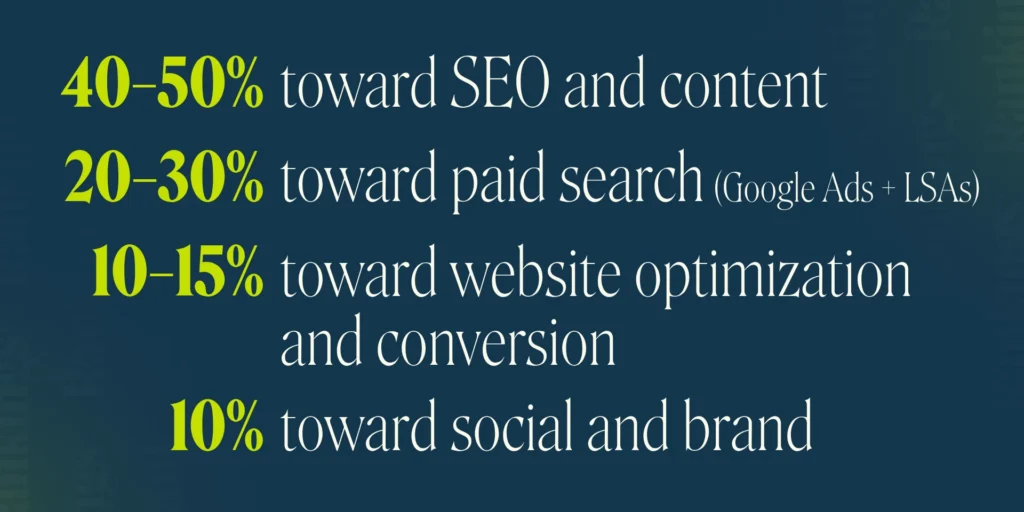
2. Set a realistic budget by channel
Not all channels are equal for PI firms. SEO for personal injury lawyers and a well-built website deliver compounding returns over time. Google Ads and Local Service Ads generate leads immediately, but stop the moment you pause.
A balanced marketing plan for a personal injury law firm typically combines both: long-term visibility through organic search and short-term volume through paid.
A rough starting framework:
3. Pick your channels based on your growth stage
Just starting out? Lead with SEO and a conversion-optimized website as your foundation. More established and looking to scale? Layer in Google Ads, AI-powered search optimization, and organic social to capture demand across every stage of the funnel.
At Rankings.io, the firms we see grow fastest don’t do the most things. They do the right things in the right order.
4. Track what's actually working
Define your KPIs before you launch: cost per lead, cost per signed case, lead-to-consultation rate, and organic traffic by practice area. If you can't measure it, you can't improve it.
Once you create your plan, the marketing ideas below give you the tactics to execute it, channel by channel.
1. Implement SEO for Personal Injury Law Firms
Over 93% of online experiences start with search engine results, and law firm clients are no different. When someone gets into an accident and needs help from an attorney, your best chance of standing out to them is to have a functioning, user-friendly, optimized website.
First, implement a search engine optimization plan. SEO for lawyers can make sure search engines like Google can easily crawl and understand each page on your site. Content marketing helps you reach your target audience with topics they care about.
On-Page SEO: Your site structure and content should clearly state who you serve and how, positioning you as a leading personal injury practice in your region.
Content Marketing: Go beyond basic content by focusing on first impressions, people-first copy, interactive elements like settlement calculators, and clear calls to action. Highlight your unique value propositions. If someone at your firm speaks another language, feature that prominently.
Create Niche Pages: Broad "Personal Injury Lawyer" pages no longer compete in search. Today's clients search with intent, and your website should meet that intent precisely. Niche practice area pages help you rank for long-tail keywords and increase conversion rates.
Examples of niche pages:
- Car accidents vs. truck accidents vs. rideshare accidents
- Slip and fall vs. premises liability vs. negligent security
- Traumatic brain injury, spinal cord injury, burn injuries
- Wrongful death caused by specific accident scenarios
If you want a deeper, step-by-step framework tailored specifically to PI firms, check out the book Personal Injury Lawyer Marketing: From Good to GOAT, by Chris Dreyer, a practical guide on turning visibility into real case leads.
2. Leverage AI SEO and LLMs for Competitive Advantage
AI SEO is quickly becoming one of the biggest competitive advantages in legal marketing, especially for personal injury firms operating in crowded markets. Large language models (LLMs) like ChatGPT are changing how people search, how people surface content, and how law firms should structure their websites to win visibility.
Forward-thinking firms optimize their websites not just for Google's traditional rankings, but for how AI systems interpret and recommend legal services.
AI SEO structures your content so AI-driven systems like Google AI Overviews, ChatGPT, and other LLM-powered search platforms can easily understand, cite, and surface it .
AI-friendly content optimization includes:
- Writing clear, structured answers to common accident and injury questions
- Using concise headings, bullet points, and FAQ-style sections
- Demonstrating strong E-E-A-T (experience, expertise, authoritativeness, trustworthiness)
3. Dominate Local SEO and Google Business Profile
Most clients searching for legal representation want a lawyer in their geographical area. Optimizing for local searches can attract clients who are ready to hire immediately.
Key local SEO tactics:
- Google Business Profile: Claim and optimize your listing with accurate NAP info, high-quality images, and regular posts
- Local Keywords: Incorporate phrases like "personal injury lawyer in [City Name]" throughout your content and metadata
- Location-Specific Pages: Create separate pages for each area you serve with tailored content
- Online Directories: Ensure consistent listings on Yelp, Avvo, and local legal directories
4. Run Local Service Ads (LSAs)
Local Service Ads appear at the top of Google search results when potential clients search for legal services in their area. With LSAs, you only pay for leads when someone contacts you directly through the ad, making this a cost-effective option for generating qualified leads.
The Google Screened badge adds trust by showing your firm meets Google's verification criteria.
5. Launch Google Ads Campaigns
Google Ads capture high-intent search traffic from users actively looking for legal help right now. Searches like "car accident lawyer near me" signal immediate intent.
Effective Google Ads strategies
- Target practice-area-specific keywords (car accidents, truck accidents, wrongful death)
- Use location-based modifiers to control geographic relevance
- Send traffic to dedicated landing pages—not generic homepages
- Highlight trust signals like experience, reviews, and free consultations
6. Social Media: Paid and Organic
Social media works on two levels for PI firms, and most lawyers underinvest in both.
Paid ads on Facebook and Instagram reach injury victims before they ever search for a lawyer—while they're scrolling in the hours after an accident.
The highest-value use is retargeting. Someone who visited your site after searching "T-bone accident lawyer" and left without calling is still in decision mode. A retargeting ad brings them back at a fraction of the cost of a new click.
Organic social is a different job. It's not a lead generation channel, it's a credibility channel. It's where a prospect who found you on Google goes to decide whether you're the kind of firm they want to call.
High-performing content includes:
- Short videos explaining what to do after an accident
- Common personal injury mistakes that hurt claims
- Insurance tactics people should watch out for
- Plain-English explanations of legal rights
8. Create Short-Form Video & YouTube FAQ Content
Video mirrors how potential clients consume information—quickly, visually, and on their phones. Most personal injury lawyers answer the same questions repeatedly during consultations.
A video FAQ strategy lets you answer those questions before prospects ever contact your firm.
High-impact video topics:
- "What should I do after a car accident?"
- "How much is my personal injury case worth?"
- "Do I have to pay a lawyer upfront?"
- "What does a contingency fee mean?"
Record once and repurpose across TikTok, Instagram Reels, YouTube Shorts, your website, and email campaigns.
9. Design a User-Friendly Website
A visually appealing website isn't enough. If users can't quickly find answers, understand your value, or contact you in moments of urgency, they will leave and hire a competitor. Injury victims often feel stressed and overwhelmed. Your website should reduce friction, build trust instantly, and guide them toward taking action.
Focus on:
- Fast page load speeds on mobile and desktop
- Clean layouts with clear visual hierarchy
- Easy-to-read fonts and strong contrast
- Simple navigation with obvious next steps
10. Develop Lead Magnets for Injury Victims
Lead magnets help turn high-intent website visitors into qualified leads. Many injury victims have urgent questions but aren’t ready to call a lawyer yet. The goal is to provide immediate value while capturing contact information.
High-performing lead magnets include:
- Statute of limitations and deadline trackers
- “What to Do After a Car Accident” checklists
- Insurance claim and adjuster conversation guides
- Medical treatment timelines and documentation tips
In addition, interactive lead magnets often convert at higher rates. Creating calculators—such as settlement estimate ranges, medical cost projections, or time-to-resolution estimators—gives injury victims personalized insights while positioning your firm as helpful and transparent.
Well-designed lead magnets not only grow your email and SMS lists but also improve conversion rates across SEO, PPC, and local traffic, supporting long-term case acquisition.
11. Build Relationships With Local Referral Partners
Who else knows your target audience? Beyond the obvious chiropractors, consider local yoga studios, rehabilitation centers, or other professionals who see people after accidents.
Focus on forming authentic, trusting relationships. Bring value through referrals back to them and by providing excellent client experiences.
Lawyers in other practice areas are also great referral partners. When you build genuine relationships, referral partners will happily keep mentioning your name to their clients who need PI representation.
12. Bar Associations, CLEs, and LinkedIn
Speaking at bar association and CLE events positions you as an authority within the legal community—the people most likely to refer high-value cases to you. Focus on topics that provide genuine value, such as recent changes in PI law, trial strategy, and insurance litigation trends.
Pair this with a consistent LinkedIn presence. Post commentary on verdicts, share practice insights, highlight firm milestones. LinkedIn is where referral attorneys, medical professionals, and expert witnesses decide whether you're someone worth sending cases to. You don’t need to do this daily. You just need consistent and substantive posts.
13. Build a Client Review System
Reviews are the single most underused growth lever for PI firms. They directly affect your local SEO rankings, your LSA performance, and your conversion rate — all at once.
The difference between a firm with 40 reviews and one with 400 isn't luck. It's a system.
Build yours by:
- Asking every satisfied client for a review at case close. Timing matters. Ask when the outcome is fresh.
- Making it easy. Send a direct link to your Google review page.
- Coaching clients on what to mention: their hesitation before hiring, how your team handled their case, what made the experience different.
- Responding to every review, positive or negative. Prospects read your responses as much as the reviews themselves.
Strong reviews also directly improve your LSA rankings. Google prioritizes firms with more high-quality, recent reviews, meaning a better review profile translates directly into lower cost per case from your ad spend.
14. A Personal Injury Podcast
A podcast builds familiarity and trust that no ad can buy. It humanizes your firm, demonstrates expertise over time, and creates content you can repurpose across every other channel.
Topics that work well for PI podcasts:
- What really happens after a serious accident
- How insurance companies evaluate and fight claims
- Issues faced by medical experts, investigators, and other attorneys
- Behind-the-scenes case breakdowns
You don't need a massive audience. You need the right audience: referring attorneys, medical providers, and injury victims who spend 30 minutes listening to you before they ever pick up the phone.
How to Track What's Working
Running personal injury lawyer marketing without tracking is like settling a case without reviewing the evidence. You need to know what's driving signed cases — not just clicks.
These are the four metrics that actually matter:
- Cost per signed case. Not cost per click, not cost per lead, but cost per signed case. This number tells you whether a channel is profitable. Track it by source from day one.
- Lead-to-consultation rate. Only 7% of personal injury firm leads actually set a consultation appointment industry-wide. If you're below that, the problem isn't your marketing. It's your intake. If you're above it, double down on whatever's working.
- Response time. Research conducted by Dr. James Oldroyd at MIT and reported in theHarvard Business Review, analyzed more than 15,000 leads and found that responding within five minutes makes you 100 times more likely to reach a prospect than waiting just 30 minutes.
- Organic traffic by practice area. If your car accident page drives 80% of your SEO traffic, that's not a win. It's a dependency. Monitor rankings and traffic at the page level so you know exactly where you're growing and where you're exposed.
Tools you need:
- Google Analytics 4 for traffic and conversion tracking
- Google Search Console for keyword rankings and organic visibility
- A CRM connected to your intake, so every lead has a source attached to it
- Call tracking software to attribute phone leads to the right channel
The goal is a simple dashboard you review monthly: Where leads came from, how many became consultations, how many became signed cases, and what each cost Everything else is noise.
Marketing for Personal Injury Attorneys Is More Than Just Marketing
If you're just getting started, don't try to do everything at once. Pick your foundation first: a conversion-optimized website, local SEO, and a fully built-out Google Business Profile. These three alone will put you ahead of most firms in your market.
If you're already established and looking to scale, the next layer is paid: Google Ads and LSAs to capture immediate demand combined with a review system and an intake process that actually converts the leads you're already getting.
And if you're playing the long game, the firms that dominate their markets over time don’t just outspend competitors. They build authority through AI-optimized content, consistent social presence, and referral networks that send cases without any ad spend at all.
Rankings.io has helped personal injury firms across the country build marketing systems that generate consistent, high-quality cases, not just traffic. If you're ready to see where your firm stands, get a free growth audit and we'll show you exactly where your next cases should come from.
Frequently Asked Questions About Personal Injury Marketing
How much should a personal injury law firm spend on marketing?
Most PI firms allocate between 5–10% of gross revenue on marketing. If you're in a competitive market or actively trying to grow, budget closer to 10–15%. The more important number is cost per signed case. That's what tells you whether your spend is actually working.
What is the best marketing channel for a new PI firm?
Start with local SEO and a Google Business Profile. They're the highest-intent channels. People searching for a PI lawyer are ready to hire and they build long-term value instead of stopping the moment you pause your spend. Add Google Ads once you build your website to convert.
How long does it take for SEO to work for personal injury lawyers?
Expect 6–12 months before you see meaningful organic traffic, and 12–18 months to compete for high-value keywords in most markets. PI is one of the most competitive verticals in search. The firms that start early and stay consistent dominate.
How do I get more personal injury clients without increasing my ad spend?
Fix your intake first. Most PI firms don't have a traffic problem. They have a conversion problem. Improve response time, add live chat, build a review system, and optimize your website for conversion. Then invest in referral relationships, which generate high-quality cases at zero ad cost.