Search "what are Justia reviews" and you get three different answers, because the phrase means three different things depending on who asks the question.
A consumer means the star reviews on an attorney's profile. A lawyer researching a case means Justia's free case-law library. A firm owner comparing vendors wants to know whether Justia's marketing services are worth paying for.
This guide covers everything a lawyer needs to know about Justia: what Justia reviews actually are, how the rating math works, whether Justia is a reliable source, how to read a profile, how to use one to sign more cases, and what the FTC and your state bar allow you to do with the results.
Key Takeaways
- Justia runs two separate review systems on the same profile. The Justia Lawyer Rating comes only from other verified attorneys. Client reviews come from people who hired you. Justia displays them together but calculates them apart.
- Client reviews never move the Justia Lawyer Rating. Per Justia's own documentation, it bases the rating "solely on attorney-to-attorney reviews" and advertising or payment cannot affect it.
- The rating scale is 1.0 to 10.0, averaged from peer scores across four categories: legal knowledge, legal analysis, communication skills, and ethics and professionalism, each scored 1 to 5 with a written explanation required.
- A directory profile is free. Justia Connect Pro runs $19.99/month or $199.80/year. Justia quotes Premium Placements (platinum and gold) privately and this is where the real money starts.
- Justia is reliable for finding law, not for citing it. Law library guides point researchers to Justia, then tell them to cite the official reporter.
- The rating provides a credibility signal, not a lead source. Our survey of 30+ attorneys revealed lack of exclusivity, expense, and limited lead volume as the top three complaints against Justia.
- Review incentives are now a federal violation. The FTC's Consumer Reviews and Testimonials Rule took effect October 21, 2024, with civil penalties up to $53,088 per violation. It applies to Justia reviews exactly as it applies to Google reviews.
What Is Justia?
Justia is a U.S. legal information company that publishes free case law and operates one of the largest lawyer directories on the web. Headquartered in Mountain View, California, Tim Stanley, a former FindLaw co-founder, founded it in 2003.
The company runs two frequently confused properties that matter to a law firms:
| Property | What it is | Why lawyers care |
| law.justia.com | Free database of U.S. case law, codes, statutes, and regulations | Research tool; also the source of Justia's domain strength |
| lawyers.justia.com | The Justia Lawyer Directory: attorney profiles, ratings, and reviews | Where prospective clients find you and where reviews live |
| justia.com/marketing | Paid services: premium placement, websites, content, SEO | The vendor decision covered later in this guide |
| connect.justia.com | Justia Connect, a membership program with free and Pro tiers | CLE, badges, profile features |
The marketing side funds the directory side. That is not a criticism. Every major legal directory uses this business model, but it explains why a free profile exists at all and why an upsell follows it.
What Is Justia Lawyers?
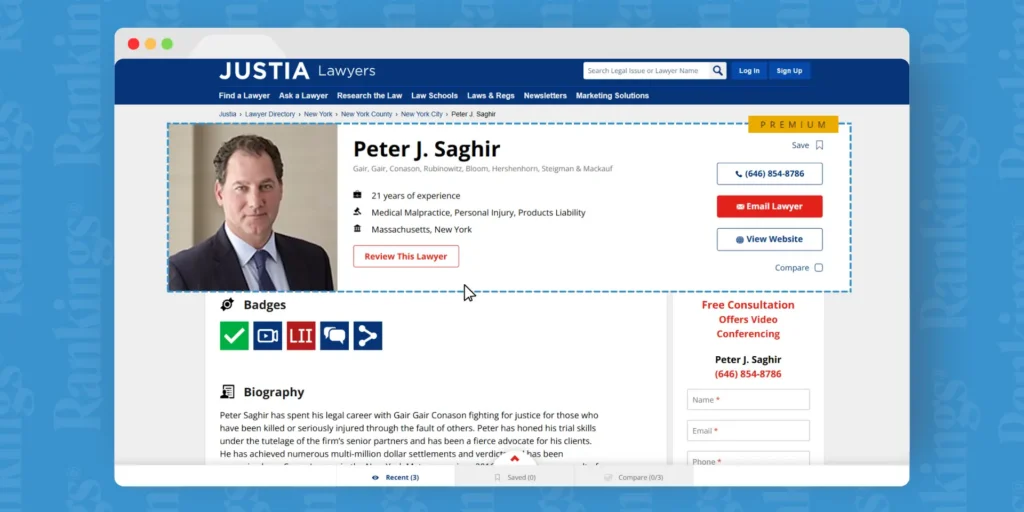
"Justia Lawyers" refers to lawyers.justia.com, the Justia Lawyer Directory. Any licensed U.S. attorney can claim a free listing after bar verification. The free profile includes your contact details, practice areas, jurisdictions, education, a biography, and both review types.
This matters more than most firms assume, because the profile inherits the authority of a domain that publishes the entire U.S. Code and every Supreme Court opinion.
A claimed profile on a domain that strong is worth the 20 minutes it takes, regardless of whether you ever pay Justia a dollar. See our breakdown of domain authority for law firms for why the host domain changes what a listing is worth.
What Are Justia Reviews? The Two Systems Explained
Justia offers peer reviews from other verified attorneys, which generate the Justia Lawyer Rating, and client reviews from people who actually hired you, which Justia moderates and publishes separately without touching that rating.
Most articles about Justia lawyer reviews collapse these into one thing. They are not one thing, and reading a profile correctly depends on telling them apart.
| Justia Lawyer Rating (peer reviews) | Justia client reviews | |
| Who can submit | Verified attorneys with active Justia profiles who know the lawyer's work | Anyone who received paid or pro bono legal services from the lawyer |
| Free consultation counts? | N/A | No. Justia prohibits consultation-only reviews |
| Scale | 1.0 to 10.0 overall, from four categories scored 1–5 | Star rating plus written review |
| Narrative required | Yes. Reviewers must explain their scores | Yes |
| Identity check | Bar-verified Justia profile | Facebook or LinkedIn verification, plus email confirmation |
| Limit | One review per reviewing attorney | One review per client, per attorney |
| Affects the Lawyer Rating | Yes, it is the entire input | No |
| Can be bought or advertised into | No | No |
| Publication time | After moderation | Within 24 hours of verification, if it passes moderation and is not flagged |
How the Justia Lawyer Rating Works
The Justia Lawyer Rating averages peer scores, on a 1.0 to 10.0 scale, and it appears once you receive at least one review from a colleague.
Justia launched the peer rating system in April 2018, a move covered at the time by the ABA Journal. Each reviewing attorney rates four dimensions from 1 to 5:
- Legal knowledge
- Legal analysis
- Communication skills
- Ethics and professionalism
Your average in each category displays on the profile alongside the overall number. Reviewers must personally know your work and must write a narrative supporting the scores, which is what separates this from a one-click star.
Two consequences follow for anyone reading a profile:
- A single peer review sets the rating. A 10.0 built from one colleague's review does not compare to a 9.4 built from 20 reviews.
- The rating says nothing about client experience. This professional judgment comes from other lawyers, which assesses competence but not responsiveness, billing clarity, or how the firm treats people in crisis.
How Justia Client Reviews Work
Client reviews require a real attorney-client relationship, identity verification through Facebook or LinkedIn, and they pass through moderation before publishing, usually within 24 hours.
Justia's client review policy sets stricter rules than most directories:
- The reviewer must base their review on paid or pro bono representation. A free consultation does not qualify.
- Justia may require proof of the relationship (an engagement letter, retainer agreement, or court appointment order) to publish or keep a review live.
- Each client may review a given attorney one time.
- Justia prohibits non-client reviews, fake reviews, obscene or illegal content, and advertising or spam.
- Justia encourages attorneys to flag offensive reviews, and holds a flagged review rather than auto-publishing it.
That proof-of-engagement requirement is the single most underrated feature of the platform. On Google, a competitor or a disgruntled non-client can post at will and your recourse is to flag and wait. On Justia, you can push the burden back onto the reviewer to document that a representation ever existed. It does not make you immune, but sets a higher floor.
Is Justia a Reliable Source?
Yes for research and yes for verifying an attorney's credentials but with two different caveats, because "reliable" means something different for case law than it does for a lawyer directory.
The question splits cleanly, so we answer it in two parts.
Is Justia Law a Reliable Source for Legal Research?
Justia is a reliable place to find a case and an unreliable place to cite one. Law library research guides, including those maintained by UCLA School of Law and the Library of Congress, routinely direct researchers to Justia for free federal and state case law, statutes, and regulations.
The limit is citation, not accuracy:
- Courts and law reviews generally require citation to official reporters and primary sources, not to a secondary website.
- Coverage varies by jurisdiction and court level, with thinner older or lower-court material.
- Justia is not a citator. It will not tell you whether a case was overturned, distinguished, or superseded.
The practical rule: Use Justia to locate the authority, then pull and cite the official version. Every free case law database operates the same way. It is not a knock specific to Justia.
Is Justia a Reliable Source When Vetting a Lawyer?
The credentials are reliable.
The ratings are real but narrow, and the placement is partly paid, so read the page knowing which parts money can touch.
| Element of a Justia profile | Reliable? | What it actually tells you |
| Bar admission and jurisdictions | High | Verified against bar records at claim |
| Justia Lawyer Rating | High integrity, narrow scope | Peer judgment of competence only. Lawyers cannot purchase them. |
| Client reviews | Moderate to high | Requires a documented attorney-client relationship, but Justia gets low volume compared to Google |
| Practice areas listed | Self-reported | Lawyer-selected, not verified or certified |
| Biography and case results | Self-reported | Written by the firm, subject to state bar advertising rules |
| Top-of-page placement | Paid | Premium Placement is advertising, not a ranking of quality |
| Badges and awards | Mixed | Some lawyers can earn, some require a paid membership |
The honest summary: Justia's review systems have more integrity than most legal directories, because payment cannot buy a rating and client reviews require proof of representation. However, they lack volume. A profile with two peer reviews and one client review offers thin evidence either way, and thin evidence is normal across the directory.
How to Read a Justia Profile: A 6-Point Check
Whether you are a consumer vetting counsel or a firm sizing up a competitor, read the profile in this order:
- Separate the two scores. Find the 1.0–10.0 Justia Lawyer Rating (peers) and the client star reviews (clients). Never average them in your head.
- Count the reviews, not just the score. One peer review producing a 10.0 is a data point, not a track record.
- Read the narratives. Peer reviews require written explanations. A specific one from a named opposing counsel counts more than five generic ones.
- Check whether the attorney claimed and completed the profile. Justia builds unclaimed listings from public bar data. An empty profile usually means neglect, not incompetence.
- Identify what lawyers paid for. Top-of-results placement and some badges are advertising. Position on the page does not constitute a quality ranking.
- Cross-reference Google. Justia verifies its sparse client reviews. Google collects many more reviews but polices them less. Reading both is the only way to see the whole picture.
Justia vs. Google vs. Avvo: Where Justia Reviews Fit
Google decides whether you get found and called. Justia and Avvo decide whether you survive the background check that happens between the click and the call.
| Justia | Google Business Profile | Avvo | |
| Primary rating input | Attorney peers only | Clients and the public | Algorithmic score plus client reviews |
| Proof of relationship required | Yes, may be required | No | No |
| Free consultation reviews | Not permitted | Permitted | Permitted |
| Typical review volume | Low | High | Medium |
| Can placement be bought | Yes, Premium Placement | Yes, ads only — not organic rank | Yes |
| Feeds map pack rankings | No | Yes | No |
| Main value to a firm | Authority link, credibility, entity consistency | Discovery, calls, and cases | Consumer trust, secondary discovery |
Justia is a trust and authority asset. It is not a lead channel, and it will disappoint firms that buy it expecting one.
For the full landscape, see our guide to the 10 best legal directories for law firms.
How to Use Justia to Sign More Cases: A 7-Step Playbook
Claim the profile, complete every field, match your NAP to your other citations exactly, earn a handful of substantive peer reviews, invite real clients to review, and link it into the rest of your presence. Most of this takes one afternoon and pays off permanently.
1. Claim and Verify the Free Profile
Justia generates listings from public bar data, so a profile may already exist with stale information. Claim it, verify your bar credentials, and take control of the record before you do anything else.
2. Make Your NAP Match Everywhere
Make your name, address, and phone number byte-identical to your Google Business Profile and every other citation. Firms often break this consistency with different suite numbers, abbreviations, and tracking phone numbers. Inconsistent data weakens the entity signal that ties all your listings together. We cover the mechanics in our guide to local citations for lawyers.
3. Complete Every Field, Including the Ones That Feel Optional
Fill the biography, education, admissions, languages, professional associations, and publications. Add a professional solo headshot, not a group photo. A complete profile does two jobs: It converts the person reading it, and it gives AI systems structured, corroborated facts about who you are.
4. Write a Description That Names the Work
Use 100 to 200 words that state your practice area plainly, the jurisdiction you serve, and the kinds of matters you handle. Vague positioning ("zealous advocate for the injured") gives a search engine and a large language model nothing to work with.
Specific positioning ("truck accident and commercial vehicle litigation in Bexar County") gives them everything. The same principle drives our approach to legal content writing.
5. Earn Peer Reviews From Attorneys Who Actually Know Your Work
This is the highest-leverage step and the one almost nobody does. Peer reviews require the reviewer to hold a verified Justia profile and to write a narrative. Ask co-counsel, opposing counsel who respect you, referral partners, and bar section colleagues, people who can speak concretely about your legal analysis.
Five substantive peer reviews probably put you ahead of the overwhelming majority of profiles in your market.
Offer nothing in exchange, and do not trade reviews reciprocally as a quid pro quo. See the compliance section below.
6. Invite Real Clients, With the Documentation Ready
Only clients who received paid or pro bono representation qualify, and Justia may ask for proof. Build the ask into case closure the same way you build the Google review ask. Expect a lower conversion rate, because the Facebook or LinkedIn verification step costs you some percentage of willing clients. That friction pays for a cleaner review corpus.
7. Connect the Profile to the Rest of Your Presence
Link the profile to your website, keep practice areas synchronized with your service pages, and make sure the firm described on Justia is the same firm described everywhere else.
Consistency across your law firm's online presence turns a scattered set of listings into a single recognizable entity.
What Justia Reviews Do for Your SEO and AI Visibility
A Justia profile contributes authority, citation consistency, and corroboration for AI systems. It does not contribute to your Google map pack ranking the way Google reviews do.
Three distinct benefits, in order of how much they actually matter:
- Entity corroboration. Search engines and large language models confirm facts about your firm by finding them repeated consistently across independent, trusted sources. A complete Justia profile is one of the highest-quality corroborating sources available in the legal vertical.
- Authority association. Justia's domain carries the weight of publishing the U.S. Code and federal case law. A profile there creates a relevant, topically aligned listing on a domain that search engines have trusted for two decades.
- AI answer sourcing. When someone asks ChatGPT, Gemini, or Perplexity for a lawyer, those systems pull from the structured, crawlable profiles that dominate legal search results, and directory profiles are heavily represented in that set. LLMs summarize your profile. This is the core of generative engine optimization and our work in AI SEO.
What it does not do: Justia reviews are not a Google local ranking factor. Review count and recency on your Google Business Profile drive map pack position. Justia reviews drive credibility once someone is already looking at you.
The Compliance Layer: What You Cannot Do With Justia Reviews
You may ask any client or peer for an honest review. You may not offer anything of value in exchange, condition anything on a positive review, write reviews yourself, or advertise a paid placement as if it were an earned award.
Three rulebooks apply at once, and they apply to Justia exactly as they apply to Google.
| Tactic | Allowed? | Which rule |
| Asking every client for an honest review | Yes | Permitted across all three |
| Asking co-counsel or a referral partner for a peer review | Yes | Permitted, if honest and unpaid |
| Emailing a review link at case closure | Yes | Permitted |
| Paying for Premium Placement | Yes | ABA Model Rule 7.2 permits paid directory advertising |
| Offering a gift card, discount, or drawing entry for a review | No | FTC rule; conditioning on sentiment |
| Trading reviews with another attorney as an explicit swap | Risky | Undisclosed material connection under the FTC rule |
| Having staff, family, or your marketing agency write reviews | No | FTC insider rule; potential bar violation |
| Reviewing yourself under another account | No | FTC rule; potential bar violation |
| Review-gating — sending the link only to happy clients | Risky | Deceptive review practice under the FTC framework |
| Advertising a paid badge or placement as an award | No | Model Rule 7.1; misleading communication |
| Responding to a negative review with case facts | No | ABA Formal Opinion 496; Model Rule 1.6 |
The FTC Rule
The FTC's Rule on the Use of Consumer Reviews and Testimonials (16 CFR Part 465) took effect October 21, 2024. It bans buying or selling fake reviews, prohibits compensation conditioned on a review expressing a particular sentiment, and requires insiders (employees, family, anyone with a material connection) to disclose that connection.
Civil penalties for knowing violations run up to $53,088 per violation, and the rule holds advertisers responsible for what their agencies do on their behalf.
Nothing in the rule is platform-specific. A gift card offered for a Justia review is the same violation as a gift card offered for a Google review.
The Bar Rules
ABA Model Rule 7.2 permits lawyers to pay for online directory listings and internet advertising. It does not permit paying a service that states or implies it recommended you, that it made a referral without payment, or that it analyzed the person's legal problem before pointing them to you.
Rule 7.1 then governs how you talk about the result. Displaying a badge that came bundled with a paid membership as though it were a peer honor is the classic failure mode, and several states impose additional requirements on advertising ratings and awards, including disclosing or making available the methodology behind them. Check your jurisdiction before you put a Justia badge in a television ad or on a billboard.
Is Justia Worth It? A Review of Justia for Lawyers
The free directory profile is worth it for every lawyer, without question. The paid marketing services are a reasonable low-cost option for a small firm and a poor fit for any firm competing in a serious market.
Here is where the money goes.
| What you are buying | Cost | Verdict |
| Directory profile | Free | Do it. Twenty minutes for a credible listing on a top-tier legal domain |
| Justia Connect (basic) | Free | Worth joining; CLE and profile features at no cost |
| Justia Connect Pro | $19.99/mo or $199.80/yr | Modest. Useful if you will actually use the CLE and profile enhancements |
| Premium Placement (gold / platinum) | Quoted privately | Test, don't commit. Value swings hard on practice area, city, and how many competitors are pay |
| Websites and CMS | Quoted privately | Caution. Proprietary CMS; see below |
| Content and SEO services | Quoted privately | Budget-tier output, template-driven, thin word counts |
The Bottom Line
Justia reviews are the most rigorously gated reviews in legal directories and the least voluminous. You cannot buy peer reviews and they require a narrative from a verified attorney. Client reviews require a documented attorney-client relationship. That integrity is real, and it is also why your profile will never carry 200 reviews the way your Google Business Profile can.
Read that as an instruction about roles. Google reviews help people find you and get them to call you. Justia reviews get people to believe in you once they check you out. Justia frustrates firms that treat it as a lead channel. Firms that treat it as a credibility and authority asset — a free, complete, peer-endorsed profile on a domain search engines have trusted for two decades — get exactly what it is good for.
Claim the profile. Complete it. Earn a handful of real peer reviews. Keep your NAP consistent. Then think carefully about the paid tier, and very carefully about the website.
And keep the whole thing in proportion: A directory profile is one input. Sustained case volume comes from the rest of the system: your site, your content, your local presence, and your law firm SEO program working together.
That is the work we build our SEO services for lawyers around. If you want an outside read on where your firm actually stands, talk to our team.
Frequently Asked Questions About Justia Reviews
Is Justia law a reliable source for case law?
Justia Law is reliable for locating federal and state case law, codes, and regulations at no cost, and academic law libraries widely recommend it. It is not appropriate as a citation in court filings or scholarship, which require official reporters, and coverage varies by jurisdiction and court level. Use it to find the authority, then cite the authoritative version.
How does Justia calculate its Lawyer Rating?
It averages scores submitted by reviewing attorneys, expressed on a 1.0 to 10.0 scale. Each reviewer rates four categories: legal knowledge, legal analysis, communication skills, and ethics and professionalism, on a 1 to 5 scale and must provide a written explanation. Only verified lawyers with active Justia profiles who personally know the attorney's work may review. The rating appears after at least one peer review and advertising or payment cannot influence it.
Do Justia client reviews affect the Justia Lawyer Rating?
No. Justia explicitly bases the Lawyer Rating solely on attorney-to-attorney reviews. It displays client reviews on the same profile but calculates and presents them separately, so a lawyer can have excellent client reviews and no Lawyer Rating at all, or the reverse.
Are Justia’s lawyer reviews legitimate?
They are among the more tightly controlled legal directory reviews. Client reviews require an actual attorney-client relationship, Justia prohibits reviews based only on a free consultation, reviewers verify their identity through Facebook or LinkedIn plus email confirmation, each client may only review an attorney once, and Justia may require an engagement letter, retainer agreement, or court appointment order as proof. Reviews pass through moderation and publish within 24 hours if the attorney does not flag them. Justia restricts peer reviews to bar-verified attorneys and requires a written narrative.
How much does Justia cost for lawyers?
A directory profile and basic Justia Connect membership are free. Justia Connect Pro is $19.99 per month, or $199.80 per year, which works out to $16.65 per month. Justia offers Premium Placements in gold and platinum tiers and quotes them privately rather than publishing them because cost varies by practice area, market, and competition. Justia also custom-quotes websites, content, and SEO services.
Can lawyers pay to improve their Justia rating?
No. Justia's documentation states that advertising or other forms of payment cannot affect the Lawyer Rating. Paying for Premium Placement buys visibility on the page, not a better score. Separately, offering clients anything of value in exchange for a review violates the FTC's Consumer Reviews and Testimonials Rule, which carries civil penalties up to $53,088 per violation and applies to legal directories the same way it applies to Google.
Is Justia worth it for lawyers?
The free profile is worth it for essentially every attorney. It takes about 20 minutes and produces a credible, authoritative listing that supports both search visibility and client vetting.
The paid services are a closer call. In our survey of 30-plus attorneys, users praised the customer service, low cost, and design quality, and criticized the lack of exclusivity, the expense relative to results, and limited lead volume.
Should I use Justia instead of Google reviews?
No. Use both, but for different jobs. Google reviews influence map pack visibility and drive the initial call, and review count and recency are the signals that matter there. Justia reviews do not affect Google rankings, but they provide peer-verified credibility during the research phase, when a prospective client compares three firms and checks whether the claims on your website hold up elsewhere.