To rank in Gemini, your law firm's content must first rank in Google's traditional index, then you need to structure it for AI extraction: answer-first formatting, strong E-E-A-T signals, schema markup, and consistent brand mentions across third-party legal sources.
Gemini doesn't rank pages. It retrieves, verifies, and cites the sources it trusts most.
Key Takeaways
- Gemini pulls from Google's search index, so traditional SEO remains the entry ticket — you can't rank in Gemini without ranking in Google first.
- Gemini is not AI Overviews. AI Overviews extract quick summaries. Gemini reasons deeply and leans on entity trust and authority, so the two require overlapping but distinct strategies.
- Roughly 90% of Gemini citations go to third-party editorial content, making off-site mentions in legal publications and directories as important as your own pages.
- Legal is a Your Money or Your Life (YMYL) category. Gemini holds law firm content to a higher credential and sourcing standard than most industries.
- Answer-first formatting (BLUF), attorney bylines, and fresh content updates offer the highest-leverage on-page changes for citation.
Why Gemini Matters for Law Firms in 2026
Gemini surpassed 900 million monthly active users by mid-2026, and Gemini-powered AI Overviews reach 2 billion people every month. When a potential client asks "Do I need a lawyer after a car accident in Houston?" Gemini answers directly, citing the firms it trusts. If yours isn't one of them, a competitor's is.
AI citations are the new rankings, and they work differently from Google AI Overviews. While AI Overviews extract snippets at speed, Gemini reasons across sources and rewards recognized legal entities.
The good news: Getting your law firm cited by AI builds on SEO fundamentals you may already have in place.

7 Steps to Rank Your Law Firm in Gemini
1. Nail Traditional SEO First
Gemini retrieves from Google's index, there is no separate Gemini index. If your practice-area pages aren't crawlable and competitive in traditional search, nothing else in this list matters. A strong SEO for lawyers foundation is step zero.
Your technical baseline checklist:
| Requirement | Why Gemini cares | How to check |
| HTTPS across the entire site | Baseline trust requirement | Browser padlock / Screaming Frog crawl |
| Pages indexed (no accidental noindex) | Gemini will never cite noindexed pages | GSC Pages report |
| Mobile-responsive design | Google crawls mobile first | GSC Mobile Usability / manual test |
| Core Web Vitals passing | Slow pages lose retrieval eligibility | PageSpeed Insights |
| Clean internal linking with descriptive anchors | Helps Google map your practice-area expertise | Site crawl, anchor text audit |
Actionable insight: Run a Screaming Frog crawl this week and fix indexation issues before touching content. A stray robots.txt rule will make a car accident page invisible to Gemini no matter how well-written it is.
2. Lead Every Page With the Answer
Gemini's extraction layer looks for the most concise, accurate answer near the top of the page. If your answer lives in paragraph seven, a competitor's front-loaded page wins the citation instead. Ahrefs' 2026 research found that AI systems cite content using definitive language ("is defined as," "means," "refers to") nearly twice as often as content that doesn’t.
Before vs. after: Texas car accident page:
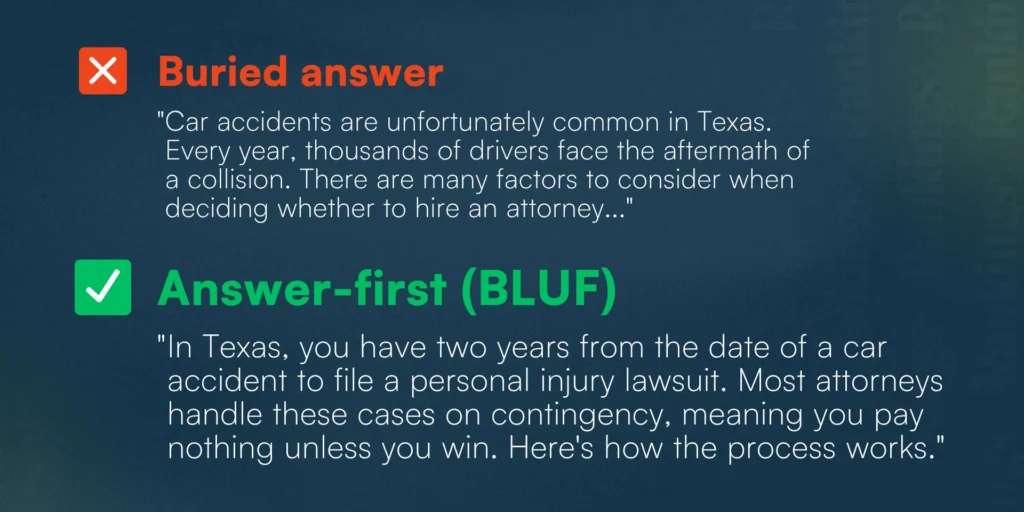
Actionable insight: audit your top 10 traffic pages. Read only the first two sentences under each H1 and H2, if they don't contain a standalone, quotable answer, rewrite them. This is the single highest-leverage change on this list.
3. Prove E-E-A-T Like Your Visibility Depends on It (It Does)
Legal is YMYL, so Gemini holds law firm content to a stricter credential and sourcing standard than most industries. Our guide to E-E-A-T and YMYL for lawyers covers this in depth, but here's how each signal maps to an action:
| E-E-A-T signal | What Gemini looks for | Law firm action |
| Experience | First-hand handling of real cases | Add anonymized case results and "in our experience representing X clients" language |
| Expertise | Credentialed authorship | Attorney byline with bar number, practice areas, and linked bio on every content page |
| Authoritativeness | Recognition from the legal community | Bar association memberships, awards, speaking engagements, media quotes on bio pages |
| Trustworthiness | Verifiable, sourced claims | Cite state statutes, court rules, and .gov sources. Provide visible office address and contact info |
Actionable insight: Create one authoritative bio page per attorney with Person schema, then link every article byline to it. Gemini connects content to entities — an article "by John Smith, Board-Certified Personal Injury Trial Lawyer, Texas Bar #12345" carries weight an anonymous post never will.
4. Structure Content for Machine Extraction
Gemini extracts at the chunk level — it may lift a single paragraph, table, or list rather than reward the whole page. The meaning of every section needs to survive when quoted out of context.
Formatting rules that win citations:
- One idea per H2/H3, sections under ~150 words
- Tables for anything comparative. This is where lawyers underuse the format
Example: a table Gemini loves to cite:
| State | Statute of limitations (personal injury) | Comparative negligence rule |
| Texas | 2 years | Modified, 51% bar |
| Florida | 2 years | Modified, 51% bar |
| California | 2 years | Pure comparative |
- Numbered lists for processes ("What to do after a truck accident: 7 steps")
- FAQ blocks phrased exactly how clients ask ("Do I have to pay my lawyer if I lose?")
Actionable insight: Take your three highest-value practice pages and add one comparison table and one numbered process list to each. Chunk-level extraction means these elements can earn citations independently of the page's overall ranking.
5. Implement Legal-Specific Schema Markup
Schema converts your content into structured data Gemini can map to entities: who you are, where you practice, what you're an authority on.
Priority schema stack for law firms:
| Schema type | Where to apply | Key properties |
| Attorney / LegalService | Homepage, practice-area pages | name, areaServed, priceRange, knowsAbout |
| LocalBusiness | Location pages | NAP, geo coordinates, openingHours, sameAs |
| Person | Attorney bio pages | jobTitle, alumniOf, memberOf, award |
| FAQPage | FAQ sections on practice pages | mainEntity Q&A pairs |
| Article | Blog posts | author (linked to Person), datePublished, dateModified |
Actionable insight: Ensure NAP (name, address, phone) is character-identical across your site, Google Business Profile, Avvo, Justia, and state bar listing. Inconsistent entity data fragments the trust signal you need to build.
6. Earn Third-Party Mentions Where Gemini Looks
This is the step most firms skip — and it's arguably the biggest. Citation data shows roughly 90% of Gemini's citations go to independent editorial content, with brand-owned pages accounting for under 7%. Your website alone cannot win this game.
Where to build presence, in priority order:
| Source type | Examples | Effort → impact |
| Legal directories | Avvo, Justia, Super Lawyers, FindLaw, Martindale | Low effort, foundational |
| Local/regional press | "Local attorney explains new distracted driving law" | Medium effort, high impact |
| Bar publications & legal trade press | State bar journal articles, ABA features | High effort, highest authority |
| Expert commentary | HARO/Qwoted responses, journalist quotes | Ongoing, compounding |
Unlinked mentions count: Gemini picks up brand references without backlinks. Amplify this footprint with AI-assisted social media and AI-powered ad campaigns that drive branded search demand, which reinforces entity recognition.
Actionable insight: Pitch one commentary piece per month tied to a new law, verdict, or local news event in your practice area to the local media. A quote in your city's newspaper does more for Gemini visibility than ten new blog posts nobody cites.
7. Refresh Content and Track Your AI Visibility
Gemini favors freshness, especially in legal, where statutes, damage caps, and filing deadlines change may. But cosmetic updates (swapping "2025" for "2026" in the title) signal nothing.
A refresh that actually counts:
- New legislation or amended statutes since publication
- Recent verdicts or settlements relevant to the topic
- Updated FAQ answers reflecting how clients ask now
- Refreshed schema dateModified
Then measure. Monthly tracking routine:
- Test 10-15 priority prompts directly in Gemini ("best [practice area] lawyer in [city]," "how much is a [case type] worth in [state]") and log whether your firm is mentioned or cited
- Monitor citations with Ahrefs Brand Radar or a similar AI visibility tool
- Watch GSC for branded search growth. Gemini citations often surface as branded queries and direct traffic, not referral clicks
Actionable insight: Build a simple spreadsheet with your prompt set, competitor mentions, and your citation status per month. Movement typically shows within two to three weeks of placements on cited domains, so this loop tells you what's working.
The same playbook adapts to other engines. For example, see our guide on how to rank on Perplexity.
Pitfalls That Keep Your Firm Out of Gemini's Answers
- Anonymous content. Pages without attorney authorship fail YMUL scrutiny. Gemini needs a credentialed entity to trust.
- Burying the answer. If your best answer sits in paragraph seven, Gemini will cite a competitor's front-loaded page instead.
- Treating Gemini like AI Overviews. They share only about a third of top-cited domains. An AI Overviews-only strategy leaves most of Gemini's citation pool untouched.
- Keyword-stuffed, robotic copy. Gemini rewards conversational phrasing that matches how clients actually ask questions.
- Cosmetic "updates." Changing the year in your title without adding substance signals nothing.
- Ignoring off-site presence. A perfect website with zero third-party mentions is invisible to an engine that cites editorial sources 9 times out of 10.
Get Gemini to Cite Your Firm
Ranking in Gemini demands the intersection of elite legal SEO and answer engine optimization, and that's exactly where Rankings.io lives. Our AI SEO services get law firms citations across Gemini, ChatGPT, Perplexity, and AI Overviews with entity building, E-E-A-T engineering, and citation tracking built for legal.
You can even see how we think about AI tools day-to-day in our Claude for lawyers guide.
Schedule a consultation and find out where your firm stands in AI search today.
Frequently Asked Questions About Rank in Gemini
How does Gemini decide which law firms to cite?
Gemini retrieves pages from Google's search index, then evaluates factual accuracy, E-E-A-T signals, structural clarity, and entity recognition. Gemini cites firms with credentialed content, schema markup, and consistent third-party mentions most often.
Do I need to rank #1 on Google to appear in Gemini?
No. Gemini can cite well-structured, authoritative pages that aren't the top organic result, but Google must index your content and generally it must compete well in traditional search.
Is ranking in Gemini the same as ranking in Google AI Overviews?
No. AI Overviews extract fast summaries inside search results, while Gemini performs deeper reasoning and weighs entity authority more heavily. The two share only around 38% of their top-cited domains.
How long does it take a law firm to show up in Gemini?
Firms with existing rankings often see citation movement within two to three months of restructuring content and building mentions. New sites need to establish traditional SEO authority first, which takes longer.
Can Gemini citations actually bring my firm new clients?
Yes. Gemini answers include source links, and cited firms gain branded search demand and direct visits — high-intent traffic, since users have already received a recommendation.