In the world of SEO, domain authority (DA) acts as a benchmark for your website’s overall strength and credibility. It’s a metric developed by Moz that predicts how likely a website is to rank in search engine results. The score ranges from 1 to 100, with higher scores correlating to stronger ranking potential.
For law firms, domain authority is more than just a number. It reflects how trusted your site appears to search engines and potential clients.
A firm with a DA of 60 is generally seen as more reputable online than one with a DA of 25 and that perceived authority can directly impact who gets the click when someone searches “best personal injury lawyer near me.”
It’s important to note that DA isn’t a Google ranking factor. Google doesn’t use Moz’s score internally.
However, the elements that contribute to domain authority: backlinks, content quality, technical SEO are exactly what Google values when deciding which websites deserve top spots.
In short: High domain authority mirrors strong SEO performance.

Why Domain Authority Matters for Law Firms
Law is one of the most competitive niches on the internet.
Every major city has dozens (if not hundreds) of personal injury, criminal defense, and family law firms fighting for the same keywords. When Google sees multiple pages optimized for “car accident lawyer Atlanta,” it looks for additional signals to decide who deserves to rank first.
That’s where domain authority comes in.
Firms with higher DA tend to have:
- More backlinks from credible sources, like local media, bar associations, or trusted legal blogs.
- More consistent content output, showing expertise in legal topics.
- Stronger technical SEO foundations, meaning their sites are fast, mobile-friendly, and secure.
A law firm with DA 55 might outrank a competitor at DA 28 even if both pages are optimized for the same keyword because search engines trust the higher-authority site more.
And from a client’s perspective, that matters too. When potential clients see your firm consistently ranking high, they associate that visibility with credibility, professionalism, and expertise long before they pick up the phone.
How to Check Your Law Firm’s Domain Authority
You can check your site’s DA for free using tools like:
- Moz Link Explorer – the original metric creator
- Ahrefs (Domain Rating, or DR)
- Semrush (Authority Score)
- Ubersuggest or SEOquake browser extensions

You don’t need to obsess over one exact number. Instead, track trends over time and compare your score against key competitors.
If your DA rises from 22 to 35 over six months, you’re making progress, even if a national firm sits at 70.
How to Improve Domain Authority for Law Firms
Improving domain authority doesn’t happen overnight, but the payoff is massive—better rankings, stronger visibility, and more qualified leads. Here’s how to build it effectively:
1. Create Link-Worthy Legal Content
Google rewards websites that act as information authorities. For law firms, that means publishing content that earns backlinks naturally.
Examples include:
- Comprehensive legal guides (e.g., “Complete Guide to Car Accident Claims in Illinois”)
- Statistical studies or case summaries that local journalists can cite
- Interactive resources (settlement calculators, legal timelines)
- Client education blogs explaining key laws in plain English
This type of content attracts attention, shares, and links, all of which build DA over time.
2. Earn High-Quality Backlinks
Backlinks are the backbone of domain authority. But not all links are equal. One mention in The New York Times or Law.com can outweigh 100 low-quality directory links.
For law firms, focus on:
- Local PR: Sponsor community events, scholarships, or charity drives that get covered by news outlets.
- Guest Posting: Contribute articles to credible legal websites, podcasts, or bar association blogs.
- Legal Directories: Submit your firm to reputable sites like Justia, Nolo, and SuperLawyers.
- Testimonials & Partnerships: Exchange testimonials with verified partners (e.g., expert witnesses or consultants).
Avoid cheap link packages or private blog networks. They can damage trust instead of building it.
3. Strengthen Internal Linking
Internal linking distributes authority across your site and helps Google understand which pages are most important.
For example:
If your blog “What to Do After a Truck Accident in Texas” links to your Truck Accident Practice Page, that page receives an authority boost.
Use internal links to:
- Connect related practice area pages
- Direct users from informational blogs to service pages
- Keep visitors engaged longer
Every link is a signal telling Google which pages deserve attention.
4. Optimize Your Technical SEO
Even with great content, a weak technical foundation can hold your DA back.
Audit and fix:
- Broken links and redirects
- Slow-loading pages
- Missing SSL certificates
- Unoptimized images and videos
- Mobile usability issues
Tools like ScreamingFrog, Sitebulb, or Google Search Console can help identify and resolve these errors quickly.
5. Leverage Digital PR and Thought Leadership
Digital PR goes beyond basic backlink building. It positions your attorneys as trusted authorities earning coverage that enhances both reputation and DA.
Effective strategies include:
- Publishing data-driven reports on local accident statistics or injury claims
- Offering expert commentary on breaking legal news
- Partnering with journalists through HARO or Qwoted
- Featuring attorneys in podcast interviews and LinkedIn articles
When you become the go-to source in your niche, backlinks and brand trust follow naturally.
6. Stay Consistent with Content Publishing
Search engines reward consistency. A stagnant website signals low activity, while steady updates indicate expertise and relevance.
Commit to a content calendar with 2–4 monthly posts targeting high-intent keywords like:
- “Slip and fall lawyer Chicago”
- “What to do after a motorcycle accident”
- “How long do I have to file a personal injury claim in Texas”
Pair evergreen topics with fresh, timely updates to maintain momentum.
How Long Does It Take to Increase Domain Authority?
Improving DA takes patience, but measurable results typically appear within 3–6 months of consistent effort.
Growth depends on:
- Competition level in your market
- Current DA baseline (it’s easier to move from 20 to 30 than 60 to 70)
- Quality of backlinks earned
- Content production frequency
Think of DA as a lagging indicator: it reflects improvements you made weeks or months ago. Stay focused on strategy, not short-term fluctuations.
Domain Authority Benchmarks for Law Firms
Wondering what a “good” domain authority looks like in your space? Here’s a practical breakdown:
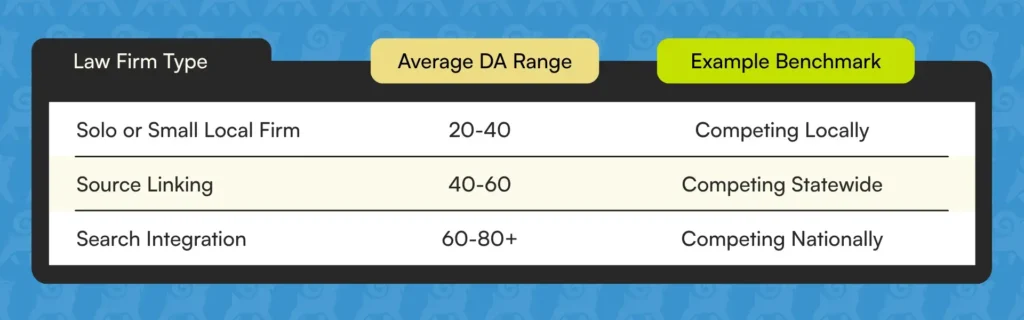
The key is relative authority: You don’t need to hit DA 80 to dominate your market. You just need to outperform your closest competitors.
Domain Authority vs. Other SEO Metrics
Domain Authority is useful, but it’s not the full picture. To make data-driven SEO decisions, compare DA alongside:
- Organic traffic growth (via Google Search Console)
- Keyword rankings for your target practice areas
- Conversion metrics (form fills, calls, case evaluations)
- Page authority (PA) for your key landing pages
A high DA site that doesn’t generate leads is just as problematic as a high-traffic site with low conversions. The best results come when authority meets conversion-driven strategy.
Authority You Can Measure, Trust You Can Build
Domain authority gives you a measurable way to track your firm’s SEO progress but real authority goes beyond metrics. It’s built through consistency, credibility, and content that proves your expertise in every client interaction.
The higher your DA, the easier it becomes to rank, attract backlinks, and convert leads. But the real power lies in what that authority represents: trust, recognition, and market dominance.
If you want to grow your domain authority faster and turn those rankings into new cases. Partner with a legal SEO agency that knows exactly how to get law firms to the top.
Because in this business, authority isn’t given.
It’s earned.