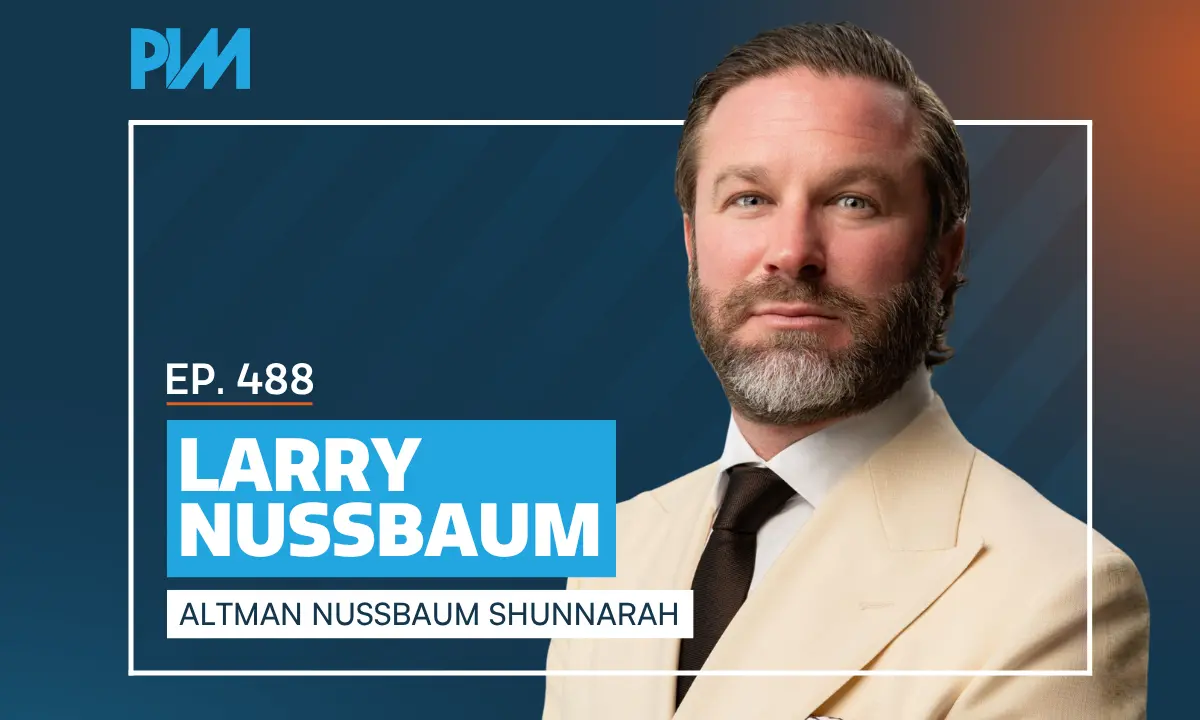
Larry Nussbaum:
Guy loses his leg and there's only a $20,000 policy. I'm not taking my $6,666 fee. I'm just not. Bad business, probably. I mean, the guy just lost his leg. You should get two million. There's only a 20 policy. A lot of lawyers are keeping that fee. It can't just be about the money.
Chris Dreyer:
Personal injury is the most cutthroat legal market. With private equity pouring in and advanced analytics turning cases into mere math equations, it's easier never to scale, but at what cost? Treating clients like widgets isn't just bad karma. It's bad for business. The firms that actually dominate and succeed over the long run are the ones that combine top-notch operational efficiency while not forgetting that they're serving real people.
Larry Nussbaum:
They could run a Meta ad, I could buy a lead gen, whatever. Easy to get that case. Hard to keep the case, hard to get the second generation and the third generation and all that.
Chris Dreyer:
Today we're joined by an attorney who proves you don't have to sacrifice your soul to build a massively successful practice. This is Personal Injury Mastermind. I'm Chris Dreyer, founder and CEO of Rankings.io, a legal marketing agency for elite law firms specializing in personal injury. We help firms sign more auto and truck accident cases. My guest today is Larry Nussbaum, a Massachusetts-based PI attorney with over 70 employees and over a billion dollars recovered for his clients. We get into why consolidating to one headquarters changed everything, how the DocuSign era is quietly destroying client trust, and the importance of time and achieving success. In the six years I've been doing this show, Larry is one of the most candid attorneys I've talked to, so let's get right into it. Hey guys, I'm really excited. I got an amazing guest. Larry Nussbaum, welcome back to the show.
Larry Nussbaum:
Do we know exactly how long it's been is the question.
Chris Dreyer:
You were legit the fourth episode of Personal Injury Mastermind. I think we're like 450 now.
Larry Nussbaum:
What year did you start it?
Chris Dreyer:
2019 or 2020, something around that.
Larry Nussbaum:
All right, so we did it in 2019. So it's been six, seven years.
Chris Dreyer:
Yeah, a ton has changed.
Larry Nussbaum:
Little more gray. My shirts don't fit me. I tried to put a suit on yesterday. It didn't fit, honest to God.
Chris Dreyer:
I was joking with you though. Best hair in the legal vertical though. Looking good. Looking sharp, man. Looking sharp.
Larry Nussbaum:
Thank you. I try. I try.
Chris Dreyer:
Give me a recent win. What's firing you up? Something for the firm. Could be business, could be cloud, could be anything.
Larry Nussbaum:
So we moved our headquarters June 1st, so now it's about a month and a half. And so there was a period of time where we had... a lot of it actually had to do with Google Maps and all this where there was a point, I forget when, but we followed the trend where it was like, "All right, have a bunch of satellite offices and they got to be real offices." And then we had people that lived all over. So why drive all the way into Boston if I could just have my office 10 minutes away? So we had a main office in Boston and then five smaller offices. I would've never done it but for the recommendation to do it for Google. And then as the leases were expiring, I was like, "The one thing I tremendously missed was having 90% of my staff under one roof."
Nobody know each other. We would have a couple office events, but nobody knew each other. And then even it's basic things where it sounds cliche, but it's like, "All right, I can just walk into someone's office and talk about a file or you overhear something when you're walking by." It's amazing the type of things that happen, or especially as the business owner, the amount of stuff that I didn't know was going on over the last few years, some good, some bad. And so for me, again, we built out this beautiful headquarters, new clean office, new furniture, new everything. We had a rule. I mean, there was not one piece of furniture that could come to... I don't care what anybody wanted. I wanted everything clean and fresh.
And so it's just kind of been almost like a rebirth a little bit. I have good energy. I feel good in my new office. I feel like a real lawyer. I've had a lot of offices over my career. As we've grown, we just run out of space and run out of space. As I've been more successful and made more money, I've wanted my office to reflect that. I've always wanted an office that would be... They can shoot a television show in my office now, and I wouldn't have been able to say that two years ago. They could have, "Okay, this is what a real office looks like on TV." So I still love what I do. I'm a little fatter and a little grayer, but things are great. I got no complaints.
Chris Dreyer:
It's interesting knowing you, and I was reading your bio before, I've got my prep doc, and you've always loved people, so that makes sense to me that you like people being in the building.
Larry Nussbaum:
Like I said, for me, yes, there's the social aspect of it, just being around people and it's hard working from home and I've done it and I still have those days, but I think you have to get out, you have to get dressed, you have to be around people. I do believe getting up in the morning, getting to an office, having to be presentable, socializing with your peers and colleagues, I still see tremendous value to that. I mean, again, our rent, I always joke, just let everybody work from home and we'd have no rent, it would be a lot of savings, but I still think there's something to be said for having everybody in and interacting with each other.
Chris Dreyer:
I think there's a ton of advantages, especially in legal, these complex cases and run-of-the-mill auto, but you get something wild, you need to talk about it and strategize.
Larry Nussbaum:
The problem is, it's not necessarily a problem, is that it still doesn't resolve the fact that 10 years ago, almost every signup we did would be in our office or we'd even go out to clients. You go out to the client's house, depending on the case. Sometimes it would be me, sometimes it'd be an employee. What language do they speak? But at least everybody would come in and meet with their lawyer once. Now the trend is quick sign up, DocuSigns, you don't have to even take a pen out and listen, it makes things a lot easier. But I can tell you one of the things that I study and I go over with young lawyers is at the end of the case, you could have done a great job for your client. You got $3 million, but they don't know you and they don't trust you.
And so when they think their case is worth 10 million and you're telling them it's worth three million or your case is worth 10,000 and you're telling them it's 3,000, that's where I've seen a huge drop-off is that people are like, "Well, the client's crazy. They don't know what their case is worth." It's like, "No, you didn't do a good job getting to know the client personally, getting them to trust you." I never have an issue with my clients. When I tell them, "Hey, listen, this is what your case is worth," they never have an issue, but that's because I've built a relationship with them during the course, and I still try to do that to the best of my ability. But even just meeting a client once in person or even having that now, I mean, even if you want a little cheap Zoom instead of a phone call, get to know them, a lot of time it gets overlooked now.
But when you're having a problem with the client, especially at the end and all law firms have it, the easy answer is they're crazy or they want too much money, everybody wants more money, blah, blah, blah. No, do a better job building a relationship and a trust factor with your client, and I promise you, you would never have those problems. So that's something I'm still working on is I want to see my clients, but again, it's not even just us being lazy on the lawyer side. Clients don't want to drive in. Clients don't. I got free parking. It doesn't matter. For most of these people, you're telling me I can just do a quick intake and sign documents on my phone. That's why. Otherwise, I would change it. But it's not that it's just beneficial to the law firm. It's beneficial to the clients in their heads. They don't want to spend the time. And so because it's good for the client, there's nothing I can really do about it.
Chris Dreyer:
Automating your intake with DocuSign and ACH payments is incredible for scale. It reduces friction and speeds up the operational pipeline, but it also introduces a massive vulnerability. When you remove the human element from the beginning of the case, you lose the opportunity to build a relationship through trust. If a client doesn't know you personally, they aren't going to trust you when it's time to discuss one of the most difficult conversations you need to have. How much should they settle for? Let me ask you just a couple questions on that. I mean, you got the e-sign on the front end and then you got the ACH on the back end getting the payment, right? So they don't have to see you at all in some scenarios.
Larry Nussbaum:
Never. Honestly, never.
Chris Dreyer:
Again, I've never had to think about this from this perspective, but you got these case managers that have a ton of cases and then you've got the litigating practices that maybe they don't even have case managers, the lawyer's really involved, they meet the family, they learn about their lives because it helps them in trial. But there's also the cost that you got to worry about to get the value out of the case. I mean, do you try to shrink the docket so they can get more of that personal...
Larry Nussbaum:
So that's where, again, unfortunately, as a business owner, so as you know, especially the way things have gone with AI and everything, a law firm isn't what a law firm used to be. And what I mean by that is now we're like this big business and we provide a service that's a legal service. That's how it's become. So we provide legal service. Where 10 years ago and way before that, a law firm would be a bunch of small mom and pop shops and you hang a shingle and they come in and you can start doing some advertising, but it really was about giving these people just really hands-on attention. But as a business owner, the first thing I learned is, okay, you have to scale, you have to scale, you have to scale. Well, I can't be in a hundred places. I can't take a hundred phone calls at the same time.
So no matter how good someone is, in order to actually scale, you can't do all the work yourself anymore. You just can't. So as you scale, you can train people and do this and that, but then you're factoring in the cost and all that, right? Everybody's got a number. I'm sure for a lot of people it's probably a million dollar plus, and that's because when they go to a conference or they learn from a coach, it's not worth their time to be on a phone with somebody for 10 minutes on a case that could only make them 10 grand, and that's too transactional for me. I take, and this isn't a brag, every coach I've ever had said this is like the worst attribute I have. But when they say worse, what do they mean by worse? They mean profitability. It's actually a great attribute I have, but they mean profitability.
It's horrible for my profits when I take all these calls from every single client. I spend 30 minutes on a call with a client that I know I'm turning down the case right away. Right away I know, "Oh my God, here we go. This is going to be terrible." But I show them respect, I give them the time, and guess what? Yes, I like being a good person, but I also know that there's a strong chance that when this person has another issue down the line or has a family member, they're going to remember, "Hey, this person took the time and understood and they kind of got to know me and I got to know them. I give them all my cell phone." So I do have some strategy to it, but the hardest thing I think about any business is, again, I want to do good work for my clients. That's why we all become lawyers. But when you start focusing, which you have to.
I have this whole part where it's just, "Hey, we're a business. Forget that you're a law firm. You could be a dentist, you could be a doctor, you could be an SEO company. We're a business. Our goal is to grow and profit." Well, the things you do to grow and profit are not necessarily everything that you would do. If I didn't have to worry about money, I could run this firm differently and we could all do things differently. And so trying to find that balance is extremely hard, but I can say this truthfully that for me, I know for sure there's a lot of money that this firm has left on the table by just being good people. Guy loses his leg and there's only a $20,000 policy. I'm not taking my $6,666 fee. I'm just not. Bad business, probably. I mean, the guy just lost his leg. He should get two million. There's only a 20 policy. A lot of lawyers are keeping that fee. It can't just be about the money.
Chris Dreyer:
Private equity and institutional capital are pouring into personal injury, treating mass torts and auto dockets like financial engineering problems. When non-lawyer investors treat case acquisition like pure math equations, operational goals shift to pure volume, but if you optimize entirely for margin and forget the human element, you destroy the client experience that drives organic referrals and that multi-generational brand value.
Larry Nussbaum:
Private equity certainly changed because again, when you're talking private equity, and I've had all the phone calls most law firm owners have, because I like to, even if I'm not interested in selling at this point, I'd like to be in the know. I want to know how it works. I want to know what's the atmosphere look like out there. But again, just in the name of itself, the minute you're talking private equity, you're talking really transactional. This is about numbers. Again, I've gone into these calls just to educate myself. I mean, we're talking about all law firms run up numbers, but they get into such detailed things that I've never even though about, which is fantastic to learn. But again, when you're having those conversations, there's no value given to being a nice guy or there's no... Yeah, you have to have good lawyers, but there's no real value given to being an excellent lawyer, highly educated.
It's just a numbers game. And so when you're talking private equity, it's a hundred percent just become numbers. But where I think is interesting is that what I have seen with the private equity, and then there's other firms out there that are basically just marketing companies where they're running these campaigns and it's just a marketing game, right? Hey, I'm going to excel at not being a good law firm and not providing good legal service. I'm going to excel at targeting a demographic and getting them to buy... It's no different than me wanting to buy a pair of Michael Jordan sneakers when I was 14 years old and playing varsity basketball in middle school. I remember my parents, I see the new Jordans out. I was a little bit of a spoiled kid. I want those new Jordans. Who doesn't want the Jordan? I'm still a big Jordan guy.
Who doesn't want the Jordans? Fast-forward to now where I am in my life and a lot of what I do is marketing daily. I never really realized that yes, I love Michael Jordan and yes, I'm sure the sneakers are good, but it's really great fucking marketing, great marketing. I want to be like Mike, right? I mean, who doesn't want to be like Mike? And I promise you, I know kids still do it today. You think you're going to be better by just wearing the sneakers, you're going to be respected, you get the girl, whatever. And so there's a lot of marketing out there right now, and it's good marketing. It's actually great marketing where the only goal is, "Hey, I'm going to get this client to sign up off of my Meta ad or my Google ad." And so between private equity and these kind of lead gens, it is unbelievable how some of this targeted marketing works.
And where I've still seen success and where I think you still win as a good law firm is what I'm about to say is that it's very, very, very easy, as you know. If all your goal is to, "Hey, I want to sign up a case." I can give you a million different ways. Call every one of your Facebook friends. I guarantee you somebody has a signable case right now. I say this to my office. If all I needed to do today was get one case, I could run a Google ad, I could run a Meta ad, I could buy a lead gen, whatever. Easy to get that case. Hard to keep the case, hard to get the second generation and the third generation and all that. So I see a lot of these... We get a lot of clients who have had a terrible experience with a different type of firm or a lead gen. And listen, I've used lead gens and I still joke with my office. I say, "Listen, we all do it, all law firms, myself included. Could you imagine having a catastrophic injury?"
I mean, whether it's a death or paralysis, and again, that's making an even better case. It's with a Walmart truck. You have a hundred million dollar case and you're not going to interview 10 different lawyers in person. You're going to click a button while you're scrolling on the toilet on your phone and click a button and get transferred to a live person and they're going to text you documents, you're going to sign it on this hundred million dollar case, and it happens every day. That's how you make your money is by allowing law firms to do it. I always look at it. They say, "I'm not the consumer." Can you imagine having a hundred million dollar case and not having 10 of the best lawyers try to put on a huge presentation for you and your family on why they're the right lawyer, and instead you don't even research the lawyer, you just click a couple buttons and you're signed up off of a random ad with a shark symbol of that they're going to-
Chris Dreyer:
Settlement calculator.
Larry Nussbaum:
Oh, the settlement calculators, come on. I don't even know how to use them. But yeah, it's crazy. It's crazy to me, the industry.
Chris Dreyer:
And then there's the opposite, right? There's the litigation that don't do any marketing and they're still paying for the marketing because of the referral fee.
Larry Nussbaum:
Correct. The referral fees are more expensive if you can afford to pay it on the... It's easier to pay upfront. Well, it's harder to pay upfront, but it's much cheaper. Those referral fees will get you.
Chris Dreyer:
I've always wondered too, that the big marketing firms, they have leverage because they can send so much volume, so they're not getting a third.
Larry Nussbaum:
Correct.
Chris Dreyer:
They're getting at least 40 or 50 because they have leverage, right? If you're just going to receive one case, you're probably going to... I mean, if it's a great case, you'll pay 50%.
Larry Nussbaum:
So I talk about that all the time. Every now and then we'll get a real old timers, small-time lawyer, and he'll just say, "Hey, I'll take..." It's just assumed, "Hey, you're going to send me a third." They don't even get into it. But actually, I don't know if it's a famous saying, I truthfully believe the industry has changed, the standard has changed. The standard referral fee is 40% now. It is not a third. Now, again, there's still some old timers that they don't go to these conferences, they don't know how to use the internet, and so they still will send you a case and they just assume they're getting the third back. But I think it's actually, it's not even leverage. I think there is leverage, and I pay 50%, like you said, for a good case, but the 40% is your new standard. I truthfully believe that.
Obviously, everybody has their own thing. Like I said, it's pretty generic out there where, again, there's a recipe out there where, okay, borrow some money, go buy a bunch of leads, do some marketing. Like I said, the cases will come in, hire some good staff, and you'll have a nice little law firm. One of the things that I have to remind myself all the time is that it takes time. One of my idols is John Morgan, who I think everybody knows, and I'm honored to be able to say that I speak to him sometimes and he's always been very good to me. And you look at him, and I'll be honest, I don't know his exact age, and I won't even guess on here because again, I could get offensive, but he's on the older side, not the younger side.
I mean that respectfully, but I think people forget if you do a little digging, he's had multiple firms prior to starting Morgan & Morgan. I don't know the details, I know it's out there, but he's had prior firms. And so I'm 42 and I've been doing this for a while and it's like, "Man, look at him." That takes time. It takes time. And so I go to these conferences, I go to these masterminds, and I don't count other people's money, but it's like, "Oh, this guy flew in a private jet." Do a little time and dig and you'll see that took... Most of that, you can get lucky out there and you could come from a trust fund. These guys and gals, they all put in their time and they stuck with it. And so I think consistency.
So listen, I've had bad months. I've had great months. All I can do is just keep coming in every... I'm a hardworking... I believe in hard work. So a lot of lawyers don't show up to their office anymore. Now, I promise you, I like to go on Instagram a little bit now. If you see me on vacation, vacation for me is a different definition than vacation for other people. Vacation for me just means I'm not sitting in my office. So I might be in Florida, I might be in Vermont skiing, but if I'm in the car, I'm on my phone 24/7. If I go to the bathroom, I'm putting in a full day's work where no matter where I am, I don't know what a vacation looks like. So just things like how do you win? The basics, right? I always say, "Listen, I go to the gym. If you just did pushups, sit-ups, and pull-ups or whatever prison yard type workout, you will be just fine."
It's boring. It's not sexy, but if you just did a hundred sit-ups, a hundred pushups, and a hundred whatever dips every day, give it 365 days, you'll probably be better shape than any workout you've ever done before. And so you don't have to over compromise. Come into the office, actually work hard, care about what you do, and just keep doing it and doing it and doing it. You can't ride the highs and the lows. That's so hard in this industry. You could have a terrible month and the next month settle a case for 30 million and now you're having the best year. It really can change on a dime. Just keep coming, keep being a good person, keep doing it for the right reason. And again, I'm a big believer. Listen, you can outwork someone. You can outwork someone, and that's an advantage that you have. It's not everybody's working hard. Just work. It'll happen.
Chris Dreyer:
I think there's so much great advice there. There are two books I've picked up, Larry, that's exactly this. One, it was The Dip by Seth Godin. It's just talking about it's the shit, it's the shit, the shit. And then on the other side, it's like, "Oh, hey, I'm doing well," but it's like just sticking with it. And then the other one I picked up just recently is called Perennial Seller by Ryan Holiday. I didn't even know he wrote a business book. I've always saw he did the stoicism, Ego Is the Enemy book, and it's just like trying to think long-term and staying in the game. I think John, who you mentioned, he says 30 or 40% of his business are referrals. I mean, you're not getting that out of the gate. I mean, that comes with building relationships and reputation.
Larry Nussbaum:
No, it takes time. And again, like I said, he's had plenty... Again, I forget the exact things, but there was a firm before Morgan & Morgan that he was a part of. It didn't work. I'm sure there's plenty of people that fall into it. It was just one of those things. A trivia answer is the only reason I know what I'm about to say, but Samuel L. Jackson, who's a big star, I'm not a huge Samuel fan, but I always knew this fact. He didn't make his first million dollars till he was 50 years old. And he was in New York from the age 20 to 50. So he was a poor, poor, struggling actor for 30 years until he made a million dollars. I still love, it's cliche, that picture of the Amazon guy working in his garage, Bezos. The funny part about that is you would think it's just like a marketing scheme, which it is a great story, but the truth of the matter is that's a real fucking picture. That is his real first office. He had no money.
Chris Dreyer:
Peanut butter and fluff sandwiches and ramen noodle. That was my first year.
Larry Nussbaum:
Yes. You got to just, like I said, just kind of stick to it. I think they say there's some kind of stat. Most people give up. I study the Navy SEAL training. It's like, "How the hell do they do that?" Well, listen, humans are built in a specific way. It's scientific. We don't ever put ourselves... It's not a comfortable position, but you can hold your breath a lot longer. If I asked you to hold your breath right now, at some point you would stop. You're actually capable of holding it much longer than when you're... You're going to stop because it gets very uncomfortable and you're like, "Listen, there's nothing in this for me. Something mentally triggers, let me just stop. There's no money on the line." If I put a million dollars on the line, your breath would hold longer.
Chris Dreyer:
You're right.
Larry Nussbaum:
And so you just got to stick with it. Simple, simple. Keep it simple.
Chris Dreyer:
Talk to me because you're a through and through lawyer. You care about your work, you get in early, you care about this profession, right? For our audience listening, talk to me about how you treat a case, how you're developing lawyers, how you get maximum value and all the things on the legal side, and that's not my expertise.
Larry Nussbaum:
First, so again, and at this point in my career, I'm doing a lot of trying to mentor some of the younger lawyers in my office, because again, it's one of those things that what you learn in law school doesn't really necessarily... I'm in personal injury, but I don't care what kind of law you're in. Dealing with the real life situations, dealing with the office dynamics, the drama, none of that is textbook, right? So you really need to learn. And so for me, and I don't want to sound like I'm repeating myself, the first thing any of my new lawyers or even staff is I always say this, almost anything you do on a file is fixable, almost anything. You can miss an answer, and again, unless you have a real asshole on the other side, they'll give you an extension. You can really mess certain things up.
I don't recommend it, but you can and you can fix it. If you mess up the relationship with the client, there's no fixing it. So first, literally, we have this rule. First, literally, I write it down on my note. I get a new paralegal. I say, "Here's what you're going to do when I give you your first case. Get the client to love you. Call the client, check in on them. It doesn't take much. The client needs to love you. The client shouldn't be chasing you. Update them, even if it seems over. Just, Hey, just wanted to let you know everything's going fine. I don't have an answer for you yet. They won't call you 10 times because you just gave them the update. If your client loves you, everything else is fixable." So that's always rule one, get the client to love you. You can't fix that. When a relationship goes wrong, there's no fixing it.
I can come in, I can try to fix it, but it's still a sour taste in their mouth. There's no fixing that. So if you do that, everything else is kind of easy. Other than that, the main thing that this industry... Things change, insurance companies change. And so back in the day, you could have what insurance companies would call a soft tissue case or a minor accident, and you go to the chiro in your local neighborhood and you could get 15,000, 20,000 or whatever the random number would be. Fast-forward to 2026, you get in a small accident and you go to just your local chiro, what used to be 20,000 is now 2,000. So in order to prep your case properly, and again, I've said everything can be fixed, which it can to a certain extent. It's all driven. I think I'm a great lawyer, and lawyers hate when I say things like I'm about to say. Listen, if you have no medical documentation and you get to the best law firm in the world, your case is still not worth a lot of money.
They have no evidence of your injury. The evidence of injuries are medical records and bills. Now, we can get complicated and complex. Now I need experts on this big case, but on a basic case, I can't go and say, "Hey, my client was in a lot of pain. They weren't able to help with their children." I can say it. It sounds nice. I can testify, "Hey, this and in the opening, you're going to hear about how this woman couldn't help with her children." Ultimately though, the value of your case is driven by the evidence of your injuries, how it's affected your life, and whether we like it or not, that evidence is the actual medical records, the medical bills, and that paints the picture. What a lawyer does with it has value, but again, I can't make something out of nothing and no lawyer can. So focusing on getting yourself the proper treatment, getting everything documented, that's king nowadays.
Chris Dreyer:
This has been amazing. I love the passion and you're saying it how it is. Some people are so gated with what they think, and you're just spreading the truth in how you see it, and I love that. So for our audience that wants to connect with you, they got a case, got a case in Massachusetts or around the country, just wants to connect, wants to get that cell number. What's the best way to get in touch?
Larry Nussbaum:
My cell, 857-383-8047. And then social media, larry_nuss. I'm going to try to become an influencer for the positivity.
Chris Dreyer:
Let's go. Let's go.
Larry Nussbaum:
And send me a hat, Chris. Send me a hat.
Chris Dreyer:
My man. Will do. Will do.
Larry Nussbaum:
All right. Appreciate it, Chris.
Chris Dreyer:
Larry, thanks for coming on the show. Scaling a high volume law firm doesn't mean transforming your practice into a heartless machine. Larry Nussbaum demonstrates that operational vigor and authentic human empathy aren't opposing forces. They are the exact combination that drives multi-generational referrals and long-term brand equity. When you build a culture built on relationships and trust, you can create an institution built to last.
That's it for today's episode. Personal Injury Mastermind is powered by Rankings.io, a legal marketing agency for elite law firms specializing in personal injury law. We've made the Inc. 5000 nine years running. We're founder-owned and led, so our only job is your growth. We handle the full marketing engine, so you don't even have to think about it. If you want to be the firm injured people call first for auto truck accident cases, book a complimentary growth audit at Rankings.io. I'm Chris Dreyer. Thanks for listening to Personal Injury Mastermind. See you next time.