Chris Dreyer:
When you're in a practice with a 60-year legacy, it's tempted to stick with what built your foundation, but success in personal injury isn't about doing what worked yesterday, it's about adapting to what works today.
Ken Harrell:
There's just no way that you can continue to excel at the top level of our world without adopting these tools, that's just going to be too much of a competitive disadvantage not to use them.
Chris Dreyer:
The firms that truly dominate are the ones willing to break their own mold, make the tough operational changes, and actively scale their marketing engines to capture the highest value cases available. If you're ready to future proof your firm and leave the competition in the dust, you're in the right place.
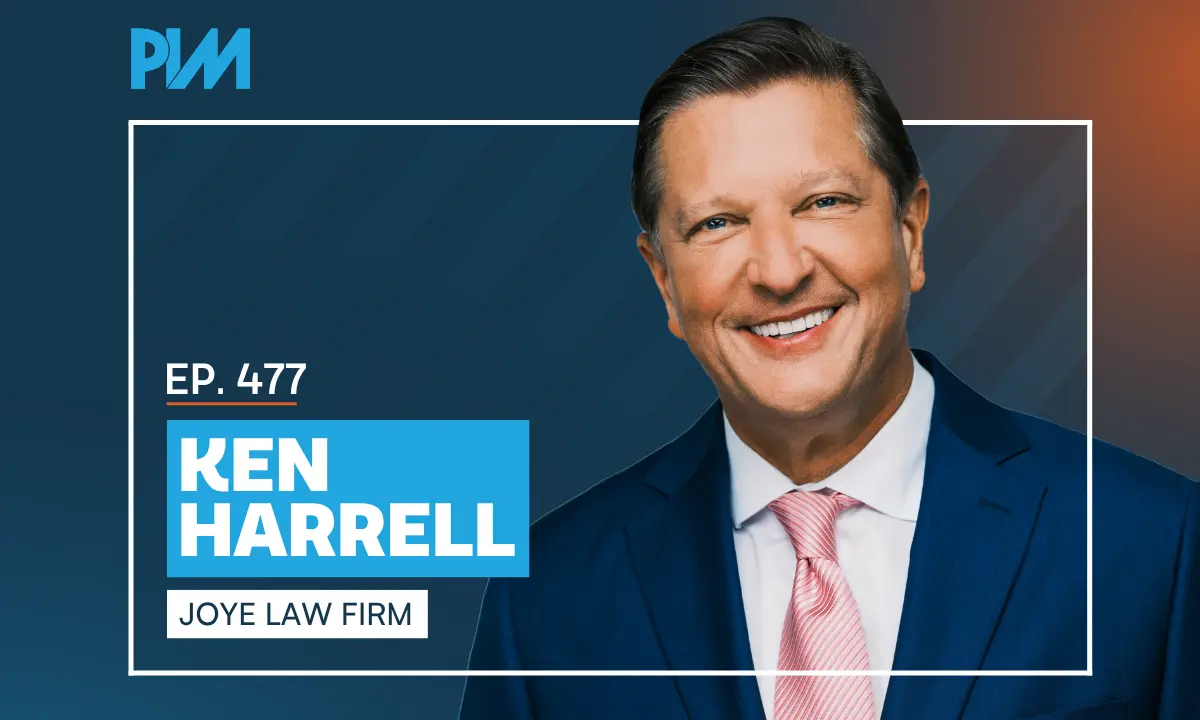
This is Personal Injury Mastermind. I'm Chris Dreyer, founder and CEO of Rankings.io, a legal marketing agency for elite law firms specializing in personal injury law. Simply put, we help firms sign more auto and truck accident cases. Today, we're talking about evolving a firm for the modern area. Our guest is Ken Harrell, managing partner at Joye Law Firm in South Carolina. He's been practicing for decades, growing a 60 plus year old practice statewide and consistently delivering massive seven figure verdicts. Today, we talk about hiring an AI coordinator, beating rising acquisition costs with offshore intake, and navigating the wave of industry consolidation. Let's get into it.
What's something current that you're excited about, a current win?
Ken Harrell:
Like everybody else, we are feeling our way through how AI is going to transform our business, our industry, but I am excited about what it's going to do. Right now, we just got a new document management system that has, I think, at least for a guy that's getting ready to be 63 years old, it seems like a really good AI tool, NetDocs. So we've been very pleased with that. It seems to be doing a really great job in terms of medical chronologies and helping with the demand process. So that's something that we all will be learning as we go because it changes every single day. There's just no way that you can continue to excel at the top level of our world without adopting these tools. It's just going to be too much of a competitive disadvantage not to use them.
So we're trying to embrace them. I have a couple of really good young lawyers that ... We have an AI coordinator that we hired as a separate position. I think that was a win because we copied some good friends of ours that told us, "Hey, you just need to have somebody at your firm and their job is basically to vet and help implement these AI tools." And I think that was a smart thing to do.
Chris Dreyer:
Ken, this is completely deviating from my normal question set, but I call certain roles like quantum leap type of roles or force multipliers, where that role you just mentioned is a force multiplier. It's exponential benefit across a wide variety of departments. Another one would be maybe like a productivity manager or an LMS coordinator. At your firm, what would you say one of those force multiplier ... What are some of those force multiplier roles?
Ken Harrell:
Yeah, I think that is one of them. That's a great though to say that that is just the exponential impact that could have if we do that well. We took our best pre-lit case manager who's been with us for almost 30 years and put her, I hate to call her in an auditor position because we all hear audit and kind of a chill goes down our spine because we're just taxes, but sort of a quality control position to where she now just spends her time. I look at it as helping the other pre-lit case managers to make sure they're doing things the right way. And there's some training component to that as well. So I feel like that's been one because we've seen a market. All the lawyers, when you have good people you hate and they're helping you produce, you don't want to lose them in that role. So they were all kicking and screaming when we said, "Hey, we're going to take her out of active file management and put her in more of a supervisor position."
But she's been in that position long enough now that they all said, "Oh man, that was a great idea." That's definitely lifted the others up. I think anytime whoever your training coordinator or director is, that's clearly one of those roles. That's something else that's always a work in progress. We're always copying ideas from other really good law firms. I just went to a conference a couple of months ago and one of the firms there said, "Hey, we are having all of our lawyers go through AAJ's depositions college and you can do it remotely. They set it up to do it in four different sessions that you can access remotely." I'm like, "Yeah, of course." We call ourselves trial lawyers, but in truth, we are deposition lawyers. So few cases actually go to trial these days. These cases are won and lost and the value is established based on how well your lawyers do in the discovery phase. And so the better off you are when it comes to deposition skills, I think the more value your cases will have.
Chris Dreyer:
Can I ask you something on the depo? And I'm jumping all around, but I think these are interesting. I think our audience benefits from hearing different talk tracks too is I've heard AI on the MedChron and that kind of stuff, demands, and I've even held the paperless reducing paper. What about on the depo side? Is there anybody that you like that's you're doing a deposition and maybe the AI's listening and it pops, "Hey, you should ask this question"?
Ken Harrell:
We've used a program but not extensively. There's a group or a company called Second Chair and basically, Chris, that's what they do. They have a product that the mic is on, it's being recorded. AI is doing, it's obviously not the official transcript, but they're doing a summary. And then to the extent that we've used it's really probably only our top two trial lawyers that have used it with what I would call success. What they like, it works well. Let's say you are deposing the other side's neurosurgeon, neurosurgery expert, and then to be able to take a break and to ask, "Hey, is there anything that I've missed" or, "This doctor just testified to X, are you able to pull up any instances where perhaps he's testified inconsistently in the past?"
And as I understand it's not like it's going out ... Because it wouldn't be able to go out and have access to 300 deposition transcripts from this neurosurgeon in the past. But if we've gotten 20 from colleagues, because we're always exchanging that type of information, as long as you put it in the system, it can do a good job of saying, "Well yeah, in this case he testified 180 degrees with a different opinion." So that's helpful. But again, there's so many tools out there. It's a little overwhelming really. I feel like even our lawyers feel a little overwhelmed.
We have a good friend down in Louisiana with the Dudley DeBosier firm, a guy, Paul Wilkins, and Paul was my age, maybe a year or two older. And so in all honesty, when Paul first said, "Hey, I'm really working with AI a good bit and would like to speak to your lawyers about some of the things we're doing," it was ageism on my part like some guy in his 60s going to teach people how to use AI. But Paul can, it's phenomenal. So he's probably spoken with our lawyers I think maybe three times and each time we do walk away just saying, wow. I think the good thing is that the lawyers walk away knowing that the potential is just incredible, but you still have to then figure out, all right, well, what do I have the bandwidth to be able to actually learn and implement? Because hearing about it is one thing, but getting it implemented, that's the challenge. That's the challenge.
Chris Dreyer:
Getting new tech like AI implemented is only half the battle, but it's what separates the elite firms for the rest of the pack. Once you have the infrastructure in place, you have to feed the machine. Ken has built a massive statewide footprint and with the advertising landscape more fragmented than ever, I want to know how he approaches marketing the firm today to maintain and grow the presence. You've built a large brand in South Carolina. You've been expanding a 60-year-old plus practice statewide. How do you approach it? How do you think about the different channels available?
Ken Harrell:
Yeah. Well, first we've got a great in-house marketing team and I've had the same marketing director for 12 years, Nicole Cerullo. She's awesome. She's just terrific. We've got two other in-house people. That has been a huge help because like your company, there's so many great vendors out there, but it is nice if you can find the right roles where people are just dedicated and only working on your brand, your firm. Again, it's something else that's evolving at warp speed. We all saw what happened to Yellow Pages and when they disappeared, and that used to be a big part of our world, sitting down with that rep every year, felt like you had a gun to your head like, "Well, if you don't do this double truck, somebody else is," or, "If you don't get the back cover, Joe Schmoe's got it." And all right, let's do it.
There's still a role for TV. I'm amazed, Chris, that I'm saying that in 2026 because I don't remember the last time that I watched broadcast TV, but we've gone dark for different times and we have seen ... So it all has to work together. I think we're doing our first big foray in the radio, and if I though TV was down on the bond, I mean, Lord, you could not have convinced me that, well, who's listening to the radio? I mean, I get in my car and I listen to a podcast or I turn on Spotify. When we went into the Greenville market, the upstate market, we had an opportunity to do a big radio blitz up there. And I have to say, we've been pleased with the level of signups there.
But again, so much of it works together. Clearly, the digital marketing now is the key. I mean, that is the one thing that I think is a constant. So many people will call us to say, "Yeah, I saw you on TV or heard your spot on the radio." But they've gone to look at our website or even if it's a lead or a local service ad, it all kind of works together because if we pop up and they're like, "Oh, well, I know those guys. I've seen the billboard" or, "I've seen the TV ad," or, "I've heard them on the radio," there's a sense that they already know you, even though they don't know anything about the firm other than that 30 second ad.
It's wild how fast it is changing as well. You know the old adage about marketing that it's hard to know exactly what is working. And there's all these things we track, but it's only as accurate as the information coming in. And so somebody tells us, "Oh, well, I saw your billboard." I'm like, "Really? You chose a law firm for a serious injury case based on a billboard?" I mean, it's hard for me to believe. But it all kind of works together, I think.
Chris Dreyer:
There's so much there. The radio and not MySpace, but I got a good relationship with Gary Sarner and the thing I see is you can get those one to $3 CPMs that you just can't get anywhere else on the cost and the frequency. And then the billboards, one of the things that's kind of tricky is you put those billboards up, but then if you take them down, it's like, "You guys still in business?" So you're kind of stuck with them. And I know you guys did a big push on the billboards, and was that kind of later in the game like, "Hey, I had TV," all the distribution component? It's like, "Hey, this is that final proof." Obviously it's awareness, but it's kind of like some social proof in the area too.
Ken Harrell:
Yeah, it probably was later for us. I mean, Reese Joye started our firm, like I said, almost 60 years ago. Reese was early to the TV marketing, and really when it was still taboo. Reese probably started running TV spots, at least in Charleston, which is really. We were not statewide at the time, we were just here. Probably mid, late 80s at the time. I mean, there were maybe two or three firms that were doing TV spots. The billboards, we've done a mix. We'll have what I call the interstate boards, which obviously are God awful expensive.
We've liked the posters campaigns where we don't know where they're going up, and sometimes that can get awkward. I had a state senator who's a good friend of mine who's got a law office up in the Grand Strand area. At one point we popped up, because we don't know why these billboards are going up because we got 40 posters and put them up and it was right over his office. It's like, "Man, what the hell?" We get that one down, "Hey guys, you got to take that down, put it up somewhere else."
The buses, I guess that's really part I adore as well. The buses, of all the stuff we do, that's the one that drives my kids crazy because they all joke about, "My God, it's just creepy. I'll be at a stoplight and then there you are peering over my shoulders like you're following me around town."
Chris Dreyer:
What are you guys doing? What are you up to?
Ken Harrell:
Yeah, exactly, exactly. But yeah, it's all a mix, all a mix. And for the most part, we set a budget at the start of the year, I kind of give that to the marketing team. There are certain decisions that will come up, maybe, I've been more involved with some of the NIL stuff we've done with the college kids, just really wanting to make sure it's the right fit. But for the most part, once I've turned it over and once we've set the budget, I try not to micromanage the marketing team. And really what I'm more concerned about, Chris, is really just leads and signups, and if signups are staying strong, and even that's relative, because again, that cost per case, I can remember the days when we would say, "Oh my God, cost per case, if it hits a thousand dollars, that's just not sustainable. You can't make money in this industry." And now it's four times that, sometimes more. To think that we would reach a point where the average acquisition costs would be over $4,000. But times change, times change, and it's a reality now.
Chris Dreyer:
Client acquisition costs are skyrocketing. You could spend millions on marketing, but if your intake team isn't dialed in, you're setting money on fire. Adapting to this new reality means finding elite talent wherever they are. And for Ken, that meant looking beyond the US for what he needed.
Ken Harrell:
A couple things. I mean, obviously, to have a good intake department, you got to have a good intake attorney because you need to have a lawyer at least involved. Doesn't necessarily need to be someone of a lot of experience, but I feel a lot more comfortable knowing that there's an attorney involved in the process. We've had a great director for our intake department for the last decade. She's actually retiring in two weeks, but we've got somebody that's been training under her for the last three years who I'm fully confident will hit the ground running.
The biggest change for us, Chris, and we were a little bit late to the game compared to some other firms, but we've brought in a number offshore workers to work with our intake department. I got to tell you that it hasn't worked 100% of the time, but when I hire somebody in Columbia, South Carolina or Myrtle Beach, South Carolina, it doesn't work 100% of the time because until you get somebody in there and you don't know how they're going to do. But we've got some stellar members of our intake department now that are in Nicaragua, Costa Rica. They've been great. I mean, they have bought into the firm's culture. They take a lot of pride in doing good work.
They're all driven. We set a goal for number of signups in a month, and if we hit that number, each member of the intake team gets a bonus at the end of the month. They work really hard to get to that number month in and month out. But if somebody's listing and they're thinking about trying an all sourced employee, there's a number of companies that do it. I have to say our experiences, by and large, it's been pretty positive. Some bumps in the road. But that just comes with hiring people, there's always going to be some bumps in the road.
Chris Dreyer:
Look, transparently, so I think we've had Legal Soft on the show. I think they do some recruiting there. We use a couple, I think it's, I don't know, maybe 5% of our base, but we use Hire With Near and TalentCross. Those are both South America. But yeah, we've had a great experience too, the same time zone, speak English perfectly or culture's good. So yeah, we've had a great experience as well. We do ours on the account management still. A lot of the firms like the US based attorneys, but more on the delivery side.
Ken Harrell:
So mostly intake medical records procurement is, so far that's what we've used it for. We haven't done it yet for any of the actual case management, but I think that day will come.
Chris Dreyer:
Look, the industry's changing. There's a lot of money getting dumped in, PE, MSOs, you got Keller Postman, Orion with the Dudley DeBosier, you got Roffe and Fortress, there's about five or six that I know of. I read in Bloomberg Law with Holland & Knight doing another one. Amaro's talking about it. Just any thoughts on the change of the industry and all this money getting dumped into it?
Ken Harrell:
Yeah, it's here and we're looking at opportunities there as well. I think most really good firms are. It eventually got on my radar screen with the Dudley DeBosier deal because Chad, Steve, James, those guys have all been friends for a long, long time. So when that deal came down, my phone's blowing up and I got on the phone with Chad Dudley, "Hey, what's going on?" Of course, got an introduction to what this would entail shortly thereafter. Some friends of ours in Texas, the Daniel Stark firm say, "Hey, they're looking to do a similar situation." That got it to where I basically went to my partner now 33 years, Mark Joye. I'm like, "Mark, we need to figure out what's going on." So we are vetting those opportunities.
I do think some of it is exciting in the sense that the nature of the collaborations that will get formed, they're obviously going to be building a really dynamic. I look at Dudley DeBosier, I know some of the firms that will likely be a part of that platform. That's going to be an incredible venture. I think there are some marketing advantages, clearly, just having the resources and additional capital. I do think there'll be some technology aspects to it as well because these are really smart people. We have a lot of capital. So I think we'll talk about these AI tools, there's a way to be cutting edge. So yeah, it's here.
I would anticipate for us that more likely than not, we will be a part of a similar platform at some point because the way I look at it is if you have that opportunity, and of course they're going to be interested in firms that hit certain criteria, there's key factors they're looking at for who's attractive to us to bring on. And if you build a firm that has those traits, I think five years from now, if you're a part of one of those platforms, one of those groups, you're going to be participating in this world at the major league level.
If you're not, doesn't mean you can still be a good lawyer to good firm, and maybe you're playing at AAA, using the baseball analogy, but you might be in the rookie leagues, but I don't know that you're going to be in the Majors because it's going to be so many competitive advantages that will come from having those resources.
Chris Dreyer:
I agree entirely. Being a part of the MSO, it's like now your buys, instead of doing the local spot television, you can do the national buys, you get scale economies, you get the data component for more intelligence there. And so a lot of advantages, the consolidation tech, like you said, and all those things. It's interesting, and I think, look, the case costs have increased every single year, maybe it's going a little faster now, but I think it's also going to force people to be better, which in the end, that's going to help the client, right? This competition's going to force people to be better lawyers and better law firms.
Ken Harrell:
Absolutely. Absolutely. And there's no ifs, ands, or buts about it. I mean, yeah, if you want to be participating, again, at the major league level, and I'm thinking about the people that are part of that firm, you better be committed to being part of something that's world-class. That's not for everybody, because I look at our lawyers right now got a great team. I think for the vast majority of them, yeah, it's a great opportunity and they're going to thrive. But it also brings some pressure because you're right, the higher up in any industry that you go, I feel like the higher the expectations go as well, and that is going to be part of it.
Chris Dreyer:
I saw, and I won't go too much longer, but Harvey had this conversation, they're raising a bunch of money for AI. I think all these tech companies, what's the line being drawn to where they're kind of classified as a law firm, right? The deeper they get in the value chain, they start handling all your pre-lit, then your trials, and it's like before you know it, they're a law firm. So then how does that impact ... Because that's really what's happening, is they're turning into a law firm. Super interesting times. I really appreciate your transparency in sharing your thoughts on this.
Ken Harrell:
It's no reason not to. Again, it is part of our world now. It's interesting. Two and a half years ago we had lawyers, good lawyers, that had bought another firm here in South Carolina approached us. At the time, looked like we had a deal, and at the very last minute my law partner had a change of heart. At the time, I was sort of ticked and I was like, "Man, I don't want to hear anything else about it. Let's just get back to work and focus on building the best mousetrap that we possibly can." And what changed my perspective on it is just the realization that this is now happening and it is going to be a big part of our industry. So if nothing else, you at least need to educate yourself, figure out, all right, well, what are the opportunities and weigh the pros and cons.
It will not be for everyone. It's not going to be a good fit. Some of it may be, depending on what stage of your career you're at. I'll go ahead and date myself since my birthday's tomorrow, but at age 63, I still love what I do. I still love showing up to work. I'm as happy to be in here on a Saturday as I am on a Monday because I just love the work. I love the profession of law and I love the business of law. I think you got to be good at both to have a good law firm. But I am at an age where I can realize that, hey, the hourglass is more than half empty at this point. Those sands are flowing pretty fast, so it has definitely got me more open-minded to looking at this.
Chris Dreyer:
Private equity and MSOs might be changing the business law, but the practice of law still comes down to human beings. As we wrapped up, I asked Ken how a massive expanding firm maintains its edge in complex litigation, and he shared the ultimate north star that guides every decision they make.
Ken Harrell:
We used to do medical malpractice work and we stopped well over a decade ago. Frankly, it was just one very painful defense verdict in a case that I'm still convinced was a really horrific injury situation where I'm still convinced that the jury got that one wrong. I thought it was definitely negligence on behalf of the treating physician. But we sort of had that experience. It's two and a half week trial, defense verdict, and you got a few hundred thousand dollars invested. I remember Mark saying, "We need to get these cases out of the office." I tend to agree with that because I would say that is a niche that if it's not your focus I don't know that it's necessarily in the client's best interest.
I feel like that medical malpractice ... And of course, nursing home is a sort of medical malpractice case. It is a medical malpractice case. I think you need to have people that to do it the right way, that's what they focus on. So on our end, we've had some really good experience in product liability cases. If you're a good personal injury lawyer, but you've never handled a product liability case, then you should not be doing your first initial foray on some catastrophic injuries case. You need to pull in somebody that's got some experience there.
I would say a trucking litigation is the same. I do think that most lawyers, they tend not to pull in outside counsel on those cases a lot of times, which I think is, again, if it's something that you don't have a lot of experience in, maybe use that as a chance to bring in a firm that does have that experience. And so five years down the road, yeah, maybe you've learned and you've developed the expertise, then you can handle it on your own, but there's a lot of cases getting settled for one, $2 million that frankly are a heck of a lot more valuable than that.
At the end of the day, and I'm sure most guys take this approach, we've had one north star principal and I'm like, "Look, let's do what's best for the client." And so where I see it's sort of the same situation. I'll have a younger lawyer and suddenly this case has morphed into something a lot more significant than we realize on the front end, and then we'll bring in a more experienced attorney to work with them on the case. And initially, there can be some kicking and screaming and, "Oh man, it's going to cut into what I get credited for on this case." I've always had the same question, "Well, tell me how it would be in the client's best interest to let you handle this case on your own without bringing in the more experienced lawyer." You can't answer that. I mean, not truthfully, because the truthful answer is you're right, the client's going to benefit from having more experience, help them out.
Chris Dreyer:
Final question. For audience listening, has a case that wants to send over your way, has questions about the pod, just wants to connect with you, what's the best way to get in touch?
Ken Harrell:
Oh, yeah. Well, cell's the easiest. 843-670-4788 is my cell number, so feel free to call me or text me. Obviously, the website, joyelawfirm.com. If you want to learn more about the firm, then email kharrell@joyelawfirm.com, but don't hesitate to call me on the cell. It's on my business card, so I give it out all over town, so I have no problem with somebody reaching out to me using my cell number.
Chris Dreyer:
Well, thank you, Ken. Thanks for coming on the show.
Ken Harrell:
Yeah, thanks, Chris. Enjoyed it.
Chris Dreyer:
Complacency is a firm killer. Ken Harrell proves that true leaders never stop learning, evolving, and hunting for a better way to operate. Whether it's implementing cutting edge AI software to assist with demands, reimagining intake with offshore talent, or keeping an open mind of new financial models, long-term success demands relentless adaptation. If you want to future-proof your firm's revenue and dominate your market, you need a digital strategy that evolves with the times. At Rankings, we stay ahead of the curve delivering elite performance marketing that secures high value cases you actually want. Heading over to Rankings.io and see for yourself how we can take your business to the next level.
I'm Chris Dreyer. Thanks for listening to Personal Injury Mastermind. See you next time.