Your firm can hold the #1 organic spot and still get zero clicks if Google's AI pulls its answer from a competitor instead of you.
AI Overviews now sit above ads, the Map Pack, and position one, so learning how to show up in Google AI Overviews as a lawyer is no longer optional.
This guide breaks down what these summaries are, the five steps to earn citations, and how to track your wins.
Key Takeaways
- AI Overviews sit above everything else on the page. Being a cited source is the new position one.
- In your content, lead with the answer, then prove E-E-A-T with real attorney credentials and authoritative citations.
- Structure for machines: headings that ask questions, short paragraphs, lists, and FAQ/LocalBusiness schema.
- Keep content fresh and build off-site authority through directories, reviews, and earned mentions.
- Track citations with Search Console, AI visibility tools, and manual checks. Measure both volume and quality.
What Are Google AI Overviews?
Google AI Overviews are AI-generated summaries that appear at the very top of search results, synthesizing information from several sources into one direct answer with links to the pages it cites. Instead of handing users a list of blue links to choose from, Google chooses for them.
That shift matters for law firms because of the high-stakes nature of most legal searches. A Pew Research Center study of 900 U.S. adults found that when an AI summary appears, users click a traditional result only 8% of the time, versus 15% without one. Eighty-eight percent of those summaries cite three or more sources. In other words, being one of the cited sources is the new page one.
How to Get AI Overview Citations in 5 Steps
Getting selected isn't about tricks. It's about meeting the criteria Google's AI uses to decide which sources it trusts. Here's how to rank in Google AI Overview placements, step by step.
Step 1: Lead With the Answer
AI models reward content that answers the question in the first two sentences. Start each page or section with a direct, plain-English response to a real client question, then expand with detail, statutes, and context underneath. Bury the answer under "In today's evolving legal landscape" and the AI moves on.
Example: For the heading "How long do I have to file a personal injury claim in Florida?" open with the answer: "In Florida, you generally have two years from the date of the accident to file a personal injury lawsuit (Fla. Stat. § 95.11)." Then unpack the exceptions (wrongful death, claims against government entities, the discovery rule) below it.
The AI gets a clean, quotable answer up top and the depth it needs to trust you underneath.
Step 2: Build Topical Depth Around a Niche
Google's AI rarely cites thin posts. Instead, it favors comprehensive resources, so go deep on a specific micro-topic rather than broad practice areas.
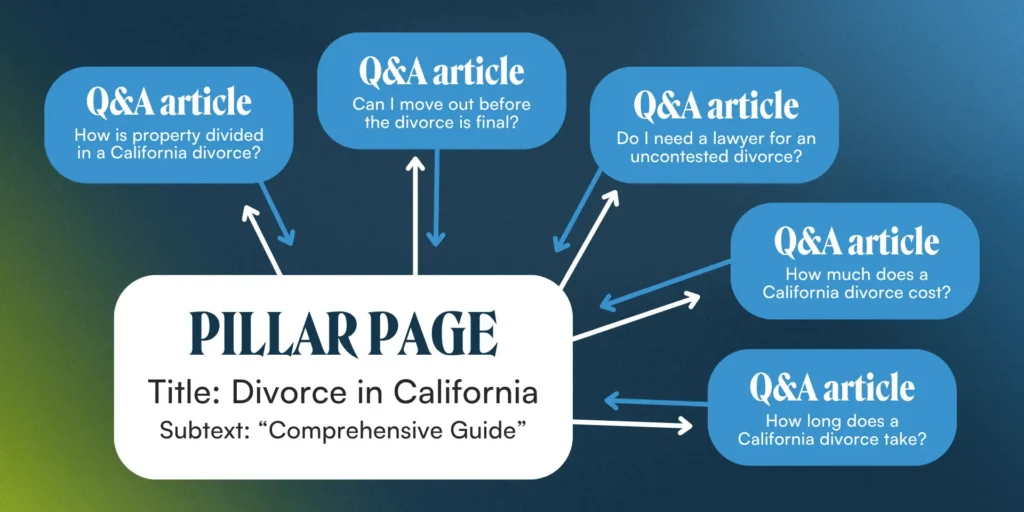
Deploy a cluster of connected pages. A pillar guide supported by question-level articles signals genuine authority. This is the same topical-authority logic behind effective SEO for lawyers, now applied to AI search.
Example: Instead of one shallow "Divorce Lawyer" page, build a pillar on "Divorce in California" supported by satellite articles like "How is property divided in a California divorce?" "Can I move out before the divorce is final?" and "How long does a California divorce take?"
Each satellite answers one real question and links back to the pillar—exactly the question-and-answer pairs that AI Overviews pull from.
Step 3: Prove E-E-A-T With Real Credentials
Legal content is a YMYL ("Your Money or Your Life") category, so Google holds it to a higher trust bar. Add a real attorney byline with bar admissions, years of experience, and a linked bio, never "Admin."
Have a licensed attorney review each page, show a clear "last updated" date, and cite authoritative sources like government (.gov) statutes. Pew found .gov sources appear in AI Overviews three times more often than in standard results.
Example: A strong byline reads "Written by Jane Doe, Personal Injury Attorney, 14 years' experience, admitted to the Florida Bar (#123456)" with a link to her full bio page, plus a footer line: "Last reviewed: June 2026."
Demonstrate first-hand experience too. A short, anonymized note like "In the cases we handle, insurers often dispute liability within the first 30 days" signals real practice, not theory, which is exactly what the latest E-E-A-T guidelines reward. These unique insights can allow you to earn citations that might otherwise go to official .gov sites. They’re also harder to summarize, making it more likely that an AIO will quote you, not just cite you.
Step 4: Structure Content for Machines
Use clear question-based headings (H2s and H3s), short paragraphs of two to four sentences, and bulleted or numbered lists. Add FAQPage, Article, and LocalBusiness schema so the AI can extract your answers cleanly. Structured, scannable pages are far easier for AI to parse and quote.
Example: Turn a dense paragraph on "what to bring to your first consultation" into a scannable checklist: police report, medical records, insurance correspondence, photos of the scene, a list of your questions.
Then wrap your Q&A section in FAQPage schema so each question maps directly to how a user phrases it to Google.
You can validate the markup for free with Google's Rich Results Test before publishing.
Step 5: Keep It Fresh and Earn Off-Site Authority
Ahrefs research shows AI-cited URLs trend fresher than standard SERP results, so refresh high-value pages quarterly with new data and rulings.
Pair that with off-site trust— earned mentions on legal directories, bar associations, and reputable publications, plus a steady flow of Google Reviews, which feed directly into local AI Overviews.
Example: When your state raises its minimum auto insurance limits or a new ruling changes how to calculate damages, update the relevant page that week and bump the "last updated" date. Don't let an outdated 2023 statute sit on a page in 2026.
Off-site, claim and complete your Google Business Profile, get listed on Avvo and your state bar directory, and ask satisfied clients for reviews right after a successful resolution. Those signals tell the AI that other trusted sources vouch for you.
How Law Firms Can Track the Mentions on Google AI Overview?
You can't improve what you don't measure. Traditional rank trackers cannot analyze AI answers, so you need to combine a few methods:
- Google Search Console: Watch for high impressions but low clicks on question queries, a classic sign you appear in an overview without earning the click.
- AI visibility trackers: Tools like Ahrefs Brand Radar, Semrush, or Profound monitor how often AI Overviews, ChatGPT, and Perplexity cite your firm.
- Manual spot-checks: Run your top client questions in an incognito window and note whether an AIO cites your firm, a competitor, or no firm at all.
Track both mention volume (how often you show up) and citation quality (whether the AIO cites you as the authority it quotes).
Real Application for Law Firms: Winning Google AI Overviews
Picture a personal injury firm that keeps losing the overview for "what to do after a car accident in Miami."
Following the five steps, it rewrites the page to answer the question in the first line, adds an attorney-reviewed byline with Florida Bar credentials, builds out a cluster of related questions (statute of limitations, comparative negligence, insurance deadlines), and marks everything up with FAQ and LocalBusiness schema.
Within a few refresh cycles, the firm starts appearing as a cited source, and because that citation lands above the Map Pack and organic results, it captures qualified, ready-to-act searchers before competitors are even visible.
The same playbook works whether you want to rank a website in AI Overview results for a single city or scale it across dozens of practice-area pages.
How Rankings.io Drives AI-Powered Results for Lawyers
Most agencies still run a 2018 SEO playbook against a 2026 search engine. But Rankings.io builds law firm content engineered for both classic rankings and AI citations: answer-first writing, attorney-reviewed E-E-A-T signals, deep topical clusters, and clean structured data. Our team also helps firms earn recommendations across the wider AI ecosystem — see our guide on Claude for lawyers for how attorneys use AI assistants safely and to their advantage.
The result: Your firm becomes the source the AI can't ignore.
Frequently Asked Questions About Google AI Overviews for Law Firms
How do I get my law firm to show up in Google AI Overviews?
Answer real client questions directly in the first sentence, prove expertise with attorney bylines and credentials, build deep topical content, add FAQ and LocalBusiness schema, and keep pages fresh. AI Overviews reward authoritative, well-structured, human-sounding answers.
How is ranking in an AI Overview different from regular SEO?
Traditional SEO ranks your page in a list of links. AI Overviews extract and synthesize content into a single answer, citing only the sources the AI trusts most. You're optimizing so that the AIO quotes you, not just lists you.
Does schema markup help lawyers rank on AI Overviews?
Yes. We have found that FAQPage, Article, and LocalBusiness schema give AI machine-readable context about your content, author, and location, making it easier to extract and cite — though strong, helpful content still matters more than markup alone.
Why isn't an AIO citing my "perfectly optimized" content?
Usually it's thin content, weak or missing author credentials, legalese that doesn't sound human, or a buried answer. AI favors clear, comprehensive, expert-reviewed pages that lead with the answer.
How long does it take to appear in Google AI Overviews?
There's no fixed timeline, but firms that publish authoritative, well-structured content consistently — and refresh it regularly — typically start earning citations within a few content cycles rather than overnight.