Competing locally is hard enough; competing globally requires discipline on another level. International SEO for lawyers is not about translating a few service pages or adding flags to your footer. It is about understanding how clients search in different countries, how search intent shifts across borders, how legal terminology transforms with culture, and how to structure your site so Google understands exactly which audience each page serves.
Firms that master these signals can break out of crowded local markets and earn visibility in places where their competitors are not even looking.
Personal injury attorneys already operate in one of the most cutthroat marketing environments in the world. Add a global layer and the complexity multiplies. Search engines evaluate your content differently in every location.
Language changes. User trust changes. Even AI Overview results behave by region. That is why firms that want to expand international visibility need a true strategic approach, not guesswork. This guide breaks down the core principles, the non negotiable technical requirements, and the strategies the top global firms use to win.
If you are looking for foundational SEO information first, explore our core resource on SEO for lawyers. This article will take you beyond the basics into global scaling.

What Is International SEO?
International SEO is the practice of optimizing your website to rank in multiple countries, languages, or regions. Search engines use signals like hreflang tags, country-specific pages, hosting, language, cultural content differences, and local backlinks to determine which version of your site should appear in each market. For law firms, this becomes even more specialized because legal intent varies more dramatically than general consumer queries.
A person searching for accident compensation in New York is not searching the same way as someone searching for injury claims in Manchester or legal damages in Sydney. Even English speaking markets differ by legal terminology, procedural structure, and user expectations. International search engine optimization recognizes these shifts and builds an architecture that helps Google serve the correct regional content to each user.
International SEO is not simply translating a page. It is aligning your information with how people in a region actually talk about the law, how they seek representation, and how they understand their options. When done correctly, it becomes a competitive moat because most law firms never take the time to get this right.
International SEO vs General SEO: What Is Different for Law Firms?
Most attorneys already know the basics of on site SEO, content quality, and technical structure. You can revisit those fundamentals in our on-site SEO guide. The moment a firm expands internationally, the rules change. General SEO focuses on one primary audience. International SEO focuses on multiple audiences, each with unique search behavior and expectations.
Search engines treat international queries differently. They evaluate region specific authority. They rely more heavily on language detection, localized signals, and content relevance. For law firms, these differences become mission critical. A single mistake, such as publishing one page for English speakers worldwide, can collapse rankings in every region due to cannibalization.
Search Intent Changes Across Countries
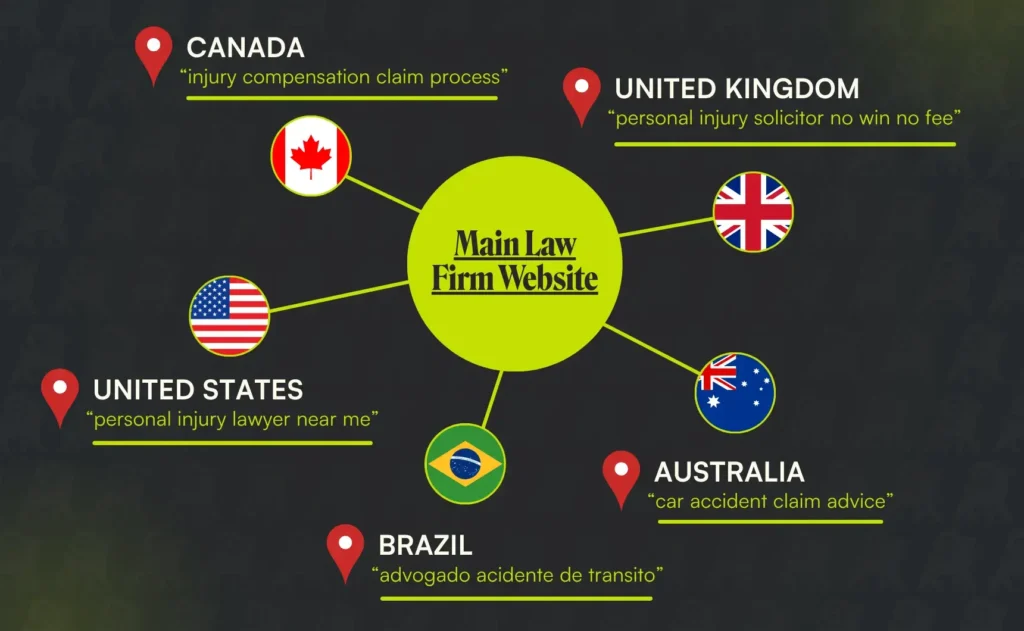
User intent is not universal. Even when two countries share a language, they do not share the same legal vocabulary. The phrase personal injury lawyer is widely used in the United States, while personal injury solicitor is common in the United Kingdom.
Someone searching for accident claim advice in Canada might use different phrasing than a user in Australia. Matching regional intent determines whether you show up at all.
Legal Terminology Requires Localization, Not Translation
Machine translation fails when legal terminology carries jurisdiction-specific meaning. A word like damages does not always translate cleanly across languages or systems. Localization ensures that content sounds natural, accurate, and aligned with the region’s legal realities.
Global Technical SEO Signals Matter More
International SEO relies on technical clarity. Hreflang signals inform Google which users should see which content. Failure to implement them correctly can cause content duplication and major ranking losses. URL structure and hosting setups also influence how Google interprets your site by region.
Content Authority Expectations Vary by Market
Global users have different trust signals. An attorney bio that builds massive credibility in the United States might be too aggressive or too minimalistic for European audiences. Understanding authority expectations makes your content land more effectively.
Best 5 Strategies for International SEO
Great international SEO is not built on guesswork. It is built on repeatable frameworks. These strategies are the same ones top performing global firms rely on to win visibility across borders. They are also the same principles we use in our personal injury SEO services.
1. Build a Market Specific International SEO Strategy for Each Country
Each target country must have its own strategy, including keyword sets, content structure, backlink opportunities, competitor analysis, and regulatory considerations. Trying to use one universal playbook guarantees weak results because Google needs clarity, not ambiguity.
2. Localize Legal Content Beyond Language
Localization accounts for differences in legal procedures, cultural expectations, case examples, terminology, and typical compensation frameworks. Your content should feel native to each audience, not like an imported template.
3. Use Hreflang Correctly to Prevent Cannibalization
Hreflang implementation tells Google which page belongs to which region. It prevents your United States content from competing against your United Kingdom page, or your Spanish language page from appearing where Portuguese Brazilian users should find content.
4. Build Authoritative Local Backlinks in Each Region
For international markets, backlink profiles must be region specific. A firm wanting visibility in Mexico needs local directories, publications, and legal mentions from Mexican sources. This builds localized authority rather than relying entirely on United States based citations.
5. Create Location Specific Service Pages for International Search Intent
Just like local SEO requires city specific content, international SEO benefits from country level landing pages. These pages should target how users in that country search. For example, long tail keyword research shifts dramatically in global markets. To explore long tail strategy deeper, use our guide here.
How to Make Local SEO Work Inside an International SEO Strategy
International SEO is the macro strategy. Local SEO is the micro engine inside it. The firms that win globally understand that visibility is earned region by region. You need strong local signals for each market you want to dominate.
Optimize Google Business Profiles for Multiple Regions
Your Google Business Profiles should reflect local languages, local addresses, and local service areas where legally appropriate. Each profile builds trust within its target region.
Build NAP Consistency Across Languages and Countries
Name, address, phone number consistency matters, but the patterns differ internationally. Formats vary. Address structures change. Phone number formats must be correct. Think of this as the foundation that prevents ranking conflicts.
Create Country Specific Citations and Legal Directories
Regional citations matter more than global ones. Even high authority directories from one country do not help significantly in another. Build location appropriate authority.
Publish Localized Case Studies and Social Proof
If your firm operates in multiple regions, highlight success stories per location. People trust results that look like their situation. They also reinforce local authority within Google’s ranking systems.
How to Use Tools to Analyze International Keywords (Complete International SEO Checklist)
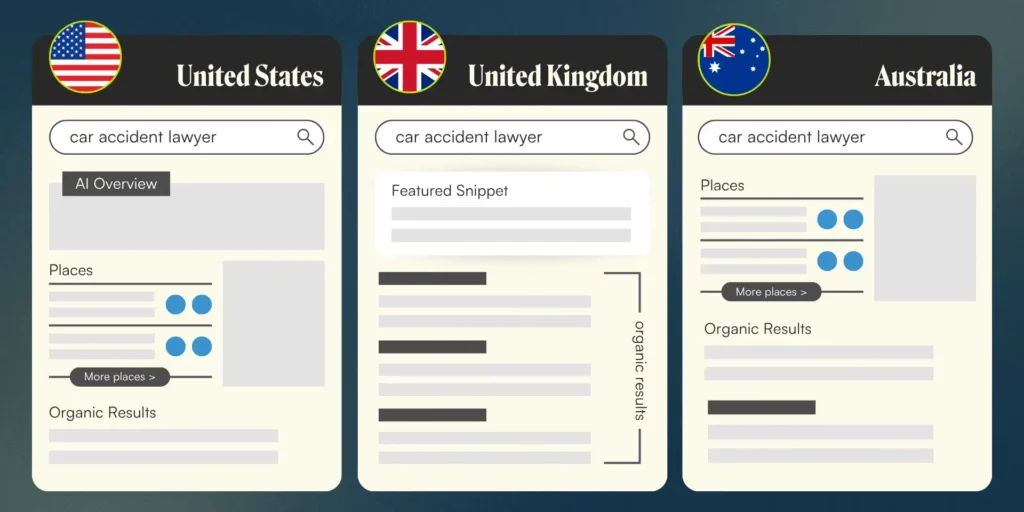
International keyword research requires a different mindset. Search volume changes by country. Language changes the meaning entirely. Even English speaking countries have different SERP structures and different AI Overview behavior. Tools help you measure these shifts with precision.
Use Ahrefs, Semrush, and Sistrix for Country Level Keyword Data
Filtering keyword research by country ensures that you are building content for real demand, not assumptions. Analyze difficulty, competitors, and intent variations for each location.
Use Google Trends and Entity Patterns by Region
Trends identify how topics evolve in different markets. Entity understanding helps you build topic authority in clusters that align with local search patterns.
Compare SERP Features and AI Overview Results Across Countries
AI driven results change by region. A term that triggers an AI Overview in the United States might not trigger one at all in Australia. Understanding this gives you a strategic advantage when planning content. If your team is exploring AI adoption in legal workflows, you can also reference our guides:
AI for personal injury lawyers
Your checklist should cover technical signals, content structure, localization requirements, backlink plans, and performance measurement. Consistency creates scalability.
International SEO Best Practices for Law Firms in 2026
International visibility requires a discipline-first approach. The law firms dominating global SERPs treat SEO as infrastructure, not a creative experiment. They build processes that work at scale and they follow them relentlessly.
Create a Scalable Multilingual Content Framework
A framework ensures that every version of a page aligns with the same business goals while still adapting to local context. This includes tone, terminology, service positioning, and user expectations.
Prioritize Legal Accuracy in Every Region
Legal errors destroy trust instantly. Each region’s content must reflect the correct judicial system, claims process, forms of compensation, and deadlines.
Invest in Regional Experts or Local Legal Translators
General translators cannot handle legal nuance. Regional experts understand the law and ensure content aligns with reality.
Maintain Consistent Branding Across Countries
Your tone and identity should feel unified, even when localized. Consistency builds recognition and credibility.
Track Performance Region by Region
Rankings, traffic, and conversions differ dramatically between countries. Monitor each region independently to prevent your strongest market from hiding weaknesses elsewhere. Global growth comes from understanding these patterns.
Conclusion: Win Global Markets With a Disciplined International SEO Strategy
International SEO for lawyers is not about being everywhere. It is about being intentional with every market you enter. When your strategy respects local language, regional search intent, legal nuances, and strong technical structure, you send search engines a clear signal about who you serve and where you serve them. That clarity builds authority that compounds across borders.
This is where law firms either pull ahead or get left behind. Search is evolving fast. AI driven results are influencing how global audiences find legal answers. Competition is increasing. But the firms willing to build disciplined, country specific strategies will own the next decade of global visibility.
If your goal is to expand your reach, enter new regions, or dominate international SERPs, you need a partner built for high performance in hyper competitive legal markets. Rankings.io helps personal injury firms win at scale, whether you are targeting your city, your state, or the world.