Chris Dreyer:
The personal injury landscape is changing faster than ever. We are talking massive industry shifts, AI, private equity, and the rise of the MSO, the management services organization. Today we got one of the guys leading the charge in this new era. If you want to understand how capital allocation, legacy, brand preservation, and back office scaling actually work in the real world, you cannot miss this conversation.
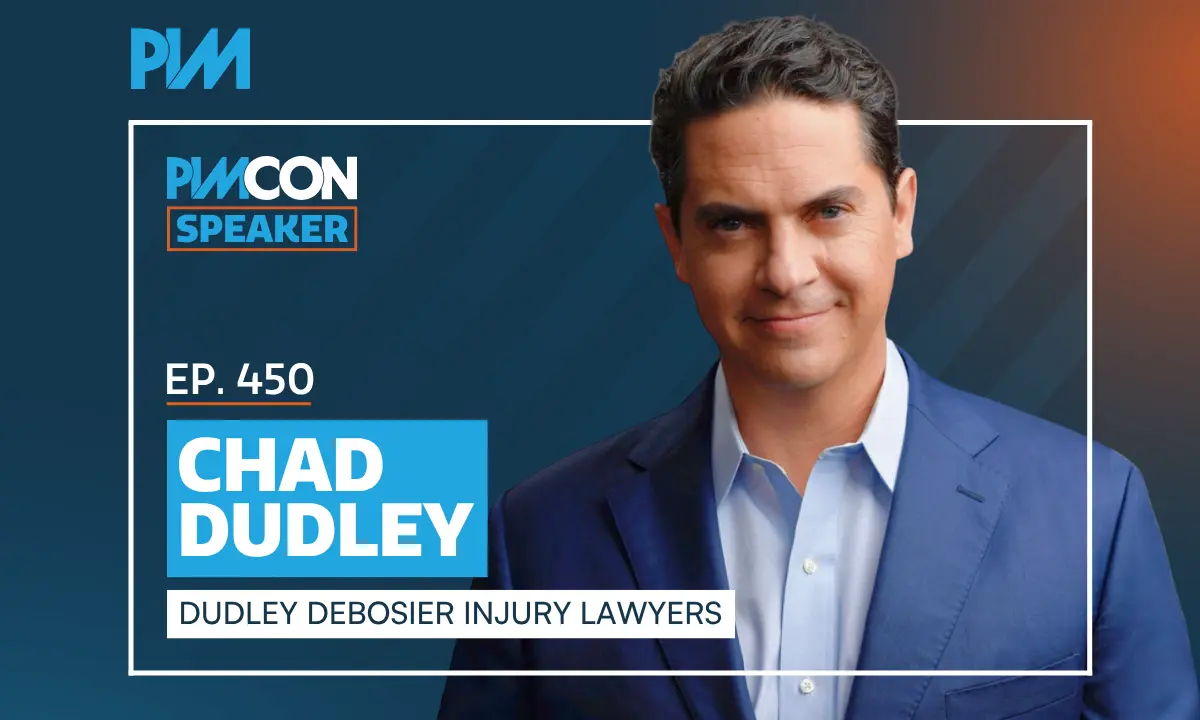
This is Personal Injury Mastermind. I'm Chris Dreyer, founder and CEO of Ranking.io, the elite performance marketing agency for personal injury law firms. Chad Dudley is back on the show. His firm, Dudley DeBosier, recently launched an MSO, partnered with Uplift, and just brought the legendary Hughes & Coleman onto their platform. I'm incredibly pumped to announce that Chad will be speaking live at PIMCON this October, breaking down exactly how to fund your PI firm at every single growth stage. This interview is just a taste of what Chad will be talking about on the PIMCON stage, so make sure to join us in Scottsdale from October 4th through 6th. All right, let's get into it.
Hey guys, I'm really excited. I got Chad Dudley back on the show. Chad, welcome back.
Chad Dudley:
Thank you for having me again.
Chris Dreyer:
So we had a great conversation. It was episode 181, that was June 2023, but since then things just haven't-
Chad Dudley:
Nothing's changed. Nothing's changed.
Chris Dreyer:
These quantum leaps, right?
Chad Dudley:
Yeah. A lot's changed. I talk to people and it's like talking about 2025, felt like 10 years ago. So much is changing in our industry with AI and consolidation and outside entities investing in our space. I mean, you're seeing it, you're at the heart of it too, Chris, right?
Chris Dreyer:
Yeah. Both sides, yeah.
Chad Dudley:
But yes, back in 2020 ... When was the last episode we did/
Chris Dreyer:
2023.
Chad Dudley:
- Gosh. Yeah.
Chris Dreyer:
Yeah. I mean, I like the start of the show off of a win. I mean, I thought maybe you could update us on you guys with Orion and Hughes & Coleman. I mean, that's a huge addition, legacy firm. Maybe talk about that.
Chad Dudley:
Oh my gosh. Chad, look, you see whatever I know about law firms on things that I've learned in this industry, gosh, so much credit goes to Lee Coleman. I mean, he's just one of the just best people in our industry who's so knowledgeable, so kind. He's been a mentor to so many people, has had a great firm for decades. And so to have him on board is just amazing. We're thrilled to death. Such an incredible partner to have involved with Orion Legal Services. So that was really, really awesome. Very, very excited to have them part of the team.
Chris Dreyer:
Yeah. I mean, talk about momentum with Dudley DeBosier kind of coming out as the first public MSO. There's been a lot of talk. And then immediately follow with Hughes & Coleman. We had Tim Mackey on, I know a friend of yours, talking about structuring the deal. And we kind of did the background on MSO, but really talk to me about how you got involved in this and why you went this direction.
Chad Dudley:
Yeah. So gosh, back in 2009, Tim Mackey and I started Vista Consulting. We started working with other law firms and that was the same year that we started. My partners and I, Steve DeBosier, James Peltry started Dudley DeBosier and we just saw both of those things grow a lot. We got to work with a lot of firms through consulting. We got to grow our firm through best practices. We're seeing firms grow at a very rapid rate using a lot of the techniques and systems and processes that we use to Dudley DeBosier. Around 2018, we had the opportunity to buy an advertising agency, CJ Advertising. It just was kind of one of those things that right time, right place. And so we did that and we got to work with 50 or 60 firms across the country and helping them grow their brands, grow their firms. That was exciting.
Then we said, "Is there a way that we can do this? Can we manage other firms? Can we have a management contract or something like that?" We did a few of those type of deals, but then it just seemed like, okay, you know what, to really make this solid, it would make more sense to have some type of equity interest or some type of longer term relationship. While we're having these types of conversations, I know Tim and I were getting called to be buy side advisors, sell side advisors, due diligence advisors for different transactions that were happening in the place. And that was not uncommon. We had been asked to do that and we said way back when there'd be like, I own a firm and I want to sell it to somebody in my firm. Can you help me do that?
And they might value the firm at one and a half or two and a half times EBITDA, their profits. And they're like smaller transactions. And then all of a sudden it's like, I own a firm and I want to buy a firm across the street or wherever. Okay, we helped out with some of those type of transactions, and those are a little bit higher multiples.
And then you saw some other deals taking place even without private equity or outside investors where they're starting to get a little bit more aggressive with the values and like, okay, that's interesting. So when we were looking at what we wanted to do and we see these transactions taking place, we said, "Okay, let's go find a partner that can maybe help us finance something here." And what's the best way to do it? The MSO structure seemed like the vehicle of choice. The ABS structure out of Arizona, we started off with a couple dozen possible partners. We narrowed it down to three. And then spent time with those guys, each of those three.
And then when we felt like, hey, here's a group that we align with on values, align with on vision and our passion about really building something great, that's how we found Uplift. And then Uplift, again, we set up the MSO with them. Steve, James and I still own 100% of our law firm. We dictate how things are handled on that end. And now we have a services company that provides those services to the law firm.
And a lot of us, even pre MSO, we're using third parties to help us with intake, help us with medical record collection, help us with demand letters, help us with marketing. And so this is kind of the next progression of that and then getting investors to invest in that services company is what we've done. It was wild way, way, way back end of November of '25, millions of years ago.
We knew there was going to be a pretty decent level of interest to pursue this. It's crazy how much interest there is in firms going, "Gosh, this could help me run my back office better. This can help me create a succession plan. Or this can help me grow faster or this can help me get more discretionary free time or this can help me ..." And so there's different reasons why people are exploring this, but what is undeniable is that there is a crazy level of interest by firms all across the country to find out, well, how can I make this work for me? It's been a busy couple months, but it's also been very, very exciting.
Chris Dreyer:
It's a brilliant setup. By separating the law firm from the services company, Chad's team gets the operational horsepower of a corporate giant without sacrificing the soul of their law practice. But when you start bringing other highly successful firms onto the platform, it presents a massive branding dilemma. When outside capital rolls up local businesses, they often wipe out the local identity and stamp one corporate name on the door, but that's not the approach Chad is taking.
Yeah. So let's talk about the strategy, right? So I see LVMH has their sub-brands, P&G has their brands from a brand architecture perspective. It's like you've got on the DSO side, it's like consolidation into one brand and you've chosen to keep the legacy brands just briefly on the brand architecture and how you think about that.
Chad Dudley:
Yeah. I think there's a lot of really great, smart people out there that have a different strategy. They're saying, "Hey, you know what? We want to bring them all under our brand. If we go buy a firm, we're going to put our name on it." And that's one way to do it. We chose to go this route where we're going, gosh, we're buying, we're taking really successful, amazingly run, great law firms. Those are the firms that we're looking at and bringing onto the platform. Hughes & Coleman is an example of that. And so we want to preserve the brand, the culture, the things that made that firm great. I tell people, these are not startups, these are not turnarounds, these are sustaining success firms and so we want to preserve that and part of that is preserving the brand and then we want to supercharge them, facilitate the operations side on the services side and that's the strategies.
Chris Dreyer:
So there's also this negative sentiment out there too, right? It's like we've heard that Charlie Munger talks about incentives, but you're saying it's like, hey, let us do the legal work and you actually do improve the client service. What would you say to like now that you have this other arm, is there conflict there or is that just part of having the right partner? Have you seen any strain there? Now you're in the game, have you experienced that?
Chad Dudley:
Yeah. And Charlie Munger is so great, Warren Buffett's right-hand man forever and ever, and some of the best books out there. And he says, "Yeah, incentives are a funny thing. You get them right and they're like magic. And you get them wrong and they can work against you." He tells the story of a college, this is way back when, and the college was overrun by mice, right? And so they came up with the idea, you know what? We got so many mice. We're going to pay the students a dollar for every dead mouse that they bring to the whatever, grounds crew. And then people started breeding mice, right?
So I always think about that when we're putting together incentives, and how do we keep people engaged, how do we keep them motivated. And are we creating a system that encourages them to breed mice, game the system, so to speak. And I think that everyone is approaching this for different reasons. Like I mentioned, there's some owners that go, "Hey, look, I want to be out completely in six months or 12 months. I want to be on an island somewhere and drinking a fruity drink on the beach." Then you have other owners that are like, "Look, I love what I do. I'm just looking for some support and some resources." And other people are like, "Okay, I got about two years and I want to pass it on to these guys."
Chris Dreyer:
So there's all these different reasons that people come and have been calling us and saying, "Hey, does this fit with the model?" And the model is the model. How we apply that in different scenarios is dependent on what is the desire of the existing owners. What are they trying to accomplish and how can we take this model and apply it to those desires, right?
The advantage that I see at least, and look, and I'm not an attorney, is on the insurance side they're not fragmented and so they're the ones coming at you for tort reform and it's like at least with the consolidation and multiple jurisdictions, like maybe it gets some combined efforts to counter some of those attacks. I see that as like an immediate and just the capital resources to do so.
Chad Dudley:
100%. I mean, a part of the reason why I got into this, why my partners got into this, why so many people that we've worked with got into this practice is that we all like fighting for the underdog. We're like, "Hey, this person does not have the resources to fight this fight on their own." And it can sound a little cliche, but I mean at the heart of it, that's what we love doing. And so the other side's always had more resources. They've always had more dollars to spend. They've been obviously more coordinated. And then with that said, I believe that the plaintiff's bar has done a lot of great things for the community and in a lot of ways I believe we've made it a safer place. I believe that we've been a voice when there's not other voices present. I believe that we've accomplished a lot of really great things and hold people accountable that need to be held accountable and we've done that with much less resources. Now this is a chance to get more resources allocated to that fight, so to speak.
So I look at it going, "Yeah, this is a good thing." And I get it. I think if you hear these murmurings on the plaintiff's side of like, "Okay, well, this looks weird. This feels like this is different," then it's a change, right? And I understand that. At the heart of it and the people that I see doing this are going, "Look, we can't lose sight of that." Going, "Hey, what did we originally get involved in this industry for? Why do we do what we do? " And it's been like, we got to take care of the client. What's in the best interest of the client? That's been a driving question that we ask at every turn at Dudley DeBosier, and it's a driving question that we will continue to ask in this next journey.
Chris Dreyer:
Chad is spot on. For decades, the plaintiff's bar has been fighting giant, well-funded insurance companies. Now Capital's finally flowing into the PI space helping to level the playing field. But what if an MSO isn't the right fit for your firm right now? How do you stay competitive when case costs are guaranteed to climb? Chad breaks down the exact three options you have moving forward, and we tee up what he'll be sharing live at PIMCON this fall.
I have a ton more questions on the MSO and kind of the state of this and I appreciate you sharing all this, but I kind of want to just segue just briefly. So I'm excited. You're going to be speaking at PIMCON in October. I'm so pumped to have you. You're going to talk about funding PI different growth stages, and that kind of like leads me to my next segment is, if you're a firm that needs access to capital and you don't do an MSO or an ABS type of means of access to capital, what options do they have? Is it just line of credit through a case inventory? What's their options?
Chad Dudley:
Yeah, there's options out there. I just spoke at the Esquire Bank presentation where they're talking about, "Okay, what do those options look like?" I mean, finding a bank like them that knows what our industry is intimately familiar about how it runs and can meet those needs is absolutely continue to be there. But when I talk to the firms that are like looking at this, I go, "Look, there's three options, right? The first option is I want to go build my own team. I'm going to go find capital or something and I want to go put together a group of firms."
And okay, usually what they're looking for is firms, usually pretty large size firms that have also a pretty lockdown infrastructure of leadership, executive team, et cetera. In addition to that, working with firms in different jurisdictions with different rules, different cultures, different technology, different personalities is no easy task, right? So if your first foray in doing that's going to be through this, I would say, "Beware. Watch out." And I'm not saying that just to scare people off, just going, "It can be tricky." But that's an option, right? So you can create a team.
Another option is join a team. I think people ask me, going, "Okay, Chad, should I do this now or should I wait at some point down the road?" And there's more than a number of factors that would go into answering that question, but one of the factors is that right now we are at a unique time and place in this whole process in that you have a pretty open choice about which teams you can join. Two years from now, you're going to, I think, see a lot of teams that have been formed and they may have already have someone in your jurisdiction that they're already working with by that time.
They may have somebody that's already in that market, right? And will the opportunity still be there? Yeah, it's going to be there. I don't see that going away, but this time like no other, it's wide open. You can go, "Hey, I like ..." And you got to find a group where you, if you're hanging out with the other people in the group and you look around the room and you go like, "I could have a beer with anyone here and really have a great time. I can have a great conversation with you. I enjoy hanging around this group of people because you're going to be working together, you're going to spend time together." And so when you look at joining a team, there's a great opportunity right now to look at that. I think it's unique for the next 12 to 24 months after that a lot of teams are going to be formed and you may not have the same, you might not be able to join with the group you want to. So start a team, join a team.
The third one is build a great firm while you intentionally and intelligently watch the market, right? Going, "Hey, look, I'm not there where I want to create a team. I'm not there where I necessarily want to join a team, but I'm going to build a great firm and watch what's happening in our industry." And you can do that in a very smart way that may put you in a better position down the road and that's also a great option. I get that. I talk with some firms that for whatever reasons, the first two options are not where they want to be right now and I'm like, "All right, option number three is good." The only thing you cannot do, which would be, I don't even call it option four because I don't consider it an option is just pretend that nothing's happening.
Just pretend that you know what, nothing's changing, because a lot is. And you're talking about what's going on, and that's all from the consolidation standpoint. Having even started talking about AI and how that's changing so much in our space and every space and so do you want to navigate AI without any support on your own? Do you really understand how much that's going to impact what we do?
Chris Dreyer:
Also, just data as the intelligence layer, the combined data is what fuels the AI. So that gives you the consolidation of data is a huge advantage. I see all that. And it's interesting, if I go look at big commercial real estate on the real estate side, there's the big syndicates everywhere, but there's a few I've seen. Bloomberg just put a post about Holland & Knight and Amaro starting an MSO, there's some rumors around Keller Postman, and I've seen stuff who knows who ended up buying Nulo. And whether it was Fortress, Jacoby & Meyers, or what have you. It's like, so it's happening and it's happening fast, and it's coming from all angles.
So obviously this consolidation and all the capital being deployed, it's supply and demand. So I mean, it's going to naturally, the case costs are going to rise because I can't remember there's also that saying is whoever can afford to pay the most to obtain the client as the winner, something like that. I think Amazon, maybe Bezos said that.
Chad Dudley:
Yeah. I don't totally disagree with that. I mean, I think that you're going to see that there's increased competition to reach the clients and potential clients. And sometimes you get all caught up in this stuff and you're like, "Okay, let's just step back for a second and look at, okay, what is in the best interest of the client?" And we know that typically clients that when they're in an incident or crash with injuries or they have some type of personal injury, the clients that hire an attorney tend to get three times more than the clients that are self-represented. And you're like, "Okay, well, let's educate people on that and let's educate people that because it can be a life changing circumstances in a lot of cases." Okay, that'd be good if there's more information out there about that. And then we just kind of look at that cost.
But with all that said, I also think about, gosh, you look at maybe restaurants and where you maybe choose to eat on a night out or something and there's certain well-known high end exclusive restaurants that call them a chain or call them what you buy. And then there's these like sort of solo ones. And sometimes I'll find ourself at the solo one because you go in and you can text the owner and say, "Hey, we're coming in." And you have this relationship. They walk in and you know this person, that person, boom, they know what you like to eat, they know what you'd like to drink. And you get such a high level of client service and quality of food. You're like, "I don't care how much advertising there is out there. This is my place."
Now with that said, there's some really great experiences that when you go, absolutely. And so when I look at the landscape and what it looks like, I'm going to say, yes, there's going to be some high level competition for cases, but if we represent someone or handle their case and we have not done a good job in terms of legal representation or client service and then they're sort of back out there looking, that's a tough way to compete. And so our goal is, look, we want to have that mentality of someone, if we're lucky enough to get a call from someone that calls us in their time of need that we do everything we can to make sure that they're with us for life. If they ever need us, if anyone they know ever needs us down the road, that they're going to reach out to us.
And again, maybe it sounds cliche, but you cannot underestimate the power of executing on that at scale has on your ability to not only just survive, but thrive in highly competitive markets. Yes, I agree that cost per case is going to go up, it's going to get more expensive. The firms that also are incredibly intentional about executing on client service and legal representation will still be able to thrive in these environments.
Chris Dreyer:
Let me ask you just a couple final questions, Chad, at the end. And this is just top of the dome, and maybe this is a really dumb question, but I'm going to ask it. Let's say a firm decides to join your group and you do acquire, how does the capital allocation work? Since they have the share of the back office, obviously people are money motivated and one firm wants to grow a certain, how does that function?
Chad Dudley:
Yeah. So essentially what occurs is that if a firm decides to go down this path, we look at what basically everyone that's a non-attorney that's delivering some type of service to the firm, we would pull them into the MSO and they would continue to report to the same people they report to, deliver the same services that they deliver, right? They do what they do, right? The firms that we brought on board, they said they don't necessarily notice other than getting their employment check from another entity, not much changes in the reporting structure and what they do on a day to day basis and how they do it. And so they're still using the same people and the cost of those services is what, that's how it's allocated.
Chris Dreyer:
That's how the shared, like the marketing services agreement comes in.
Chad Dudley:
Correct. And you look at, okay, well, there's some things that you're like, "Hey, let's have a chief technology officer that serves all the member organizations." Well, then there's a way to divvy that up.
Chris Dreyer:
Got it, got it. Okay. I was just a little confused on that. And I see the advantages of the consolidation on your buys, especially with the big media buys and those situations too. Tech integrations, the CRM case management, all of that.
Chad Dudley:
That's right.
Chris Dreyer:
This has been incredible. I'm really excited to have you at PIMCON in October. So what's the future? What's next? Is it now integration time? Is it like-
Chad Dudley:
Yeah, we're bringing firms on board. We have a couple other firms that are coming on board in the next 30 days, and then a couple others that are looking like they're going to come on board shortly thereafter. And so it is spending time with those firms.
In addition to that, I just had a book that came out, The Seven Disciplines of Successful Law Firms, which takes 15 years of consulting. And if I were to look at all the firms I've worked with over those years, big firms, small firms, everything in between, I said, "Just get these seven things right." That's what the book is about. And so I'll be speaking on that and visiting. And that'll be a big talk about that. But what's really just getting these firms on board on the platform and starting to see how we can help them at an accelerated rate improve their back office operations.
Chris Dreyer:
Amazing. Amazing. And then final question, Chad, for our audience listening that has interest in this, has questions about the pod, wants to connect with you, what's the best way to get in touch?
Chad Dudley:
Cdudley@dudleydebosier.com. So that's my email address. Feel free to reach out to me directly. I'm talking to people every single day on this topic, and I'm an open book.
Chris Dreyer:
Love it. Chad, thanks for coming on the show.
Chad Dudley:
Thank you, Chris.
Chris Dreyer:
The game is changing in personal injury, and it's changing fast. Whether you're looking to build your own MSO, join a powerhouse team like Chad's, or just double down on elite client service to stay competitive, the one thing you cannot do is sit on the sidelines. And if you want to get in the room with the guys who actually make these moves, if you want to hear Chad Dudley break down exactly how to fund your PI firm at every single stage of growth, then you need to be at PIMCON this October. Head on over to pimcon.org to grab your ticket today and get in the room with some of the best and the brightest.
I'm Chris Dreyer. Thanks for listening to Personal Injury Mastermind. We'll catch you next time.