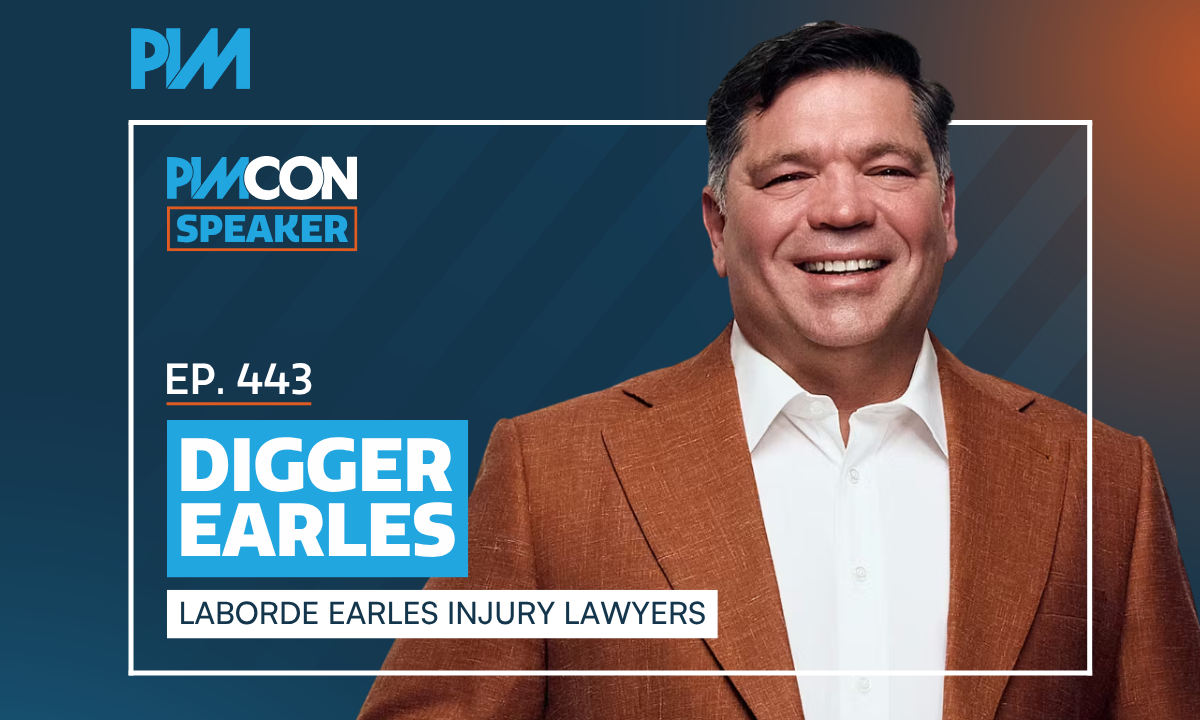
Digger Earles:
I heard someone on this podcast, or maybe it was even me that told you that on my deathbed, I want my kids to know I love them, I want my wife to know I love them, and I want to know how many cases we signed that day, right?
Chris Dreyer:
Top line metrics feel great, but vanity numbers don't pay the bills.
Digger Earles:
At the end of the year, when you start looking at projecting revenue, there's a really big number you also need to consider and that's close without fee. If you sign up 100 cases but only 75 pay, then you need to know that, right?
Chris Dreyer:
Having the right data truly changes everything, and today's guest understands that as well as anybody. Today we're bringing back Digger Earles. He has helped build the Laborde Earles Injury Lawyers and one of the largest firms in Louisiana. With seven offices, over 30 attorneys, and over $1 billion recovered for their clients, Digger knows exactly what it takes to scale.
Digger Earles:
And I tell people all the time, you know why Shaquille O'Neal wears Reeboks or why Peyton Manning stands there with Papa John's or State Farm has Aaron Rogers? Because it works. That's why.
Chris Dreyer:
This is Personal Injury Mastermind. I'm Chris Dreyer, founder and CEO of Rankings.io, the elite performance marketing agency for personal injury law firms. Today, I'm pumped to announce that our guest Digger Earls will be speaking live at PIMCON this year, October 4th through 6th in Scottsdale, Arizona. He'll be diving deep into NIL, name, image, and likeness deals to help you dominate your market. In this episode, we're talking about building in house AI, why reducing attorney caseloads actually maximizes fees, and the numbers you actually need to be tracking. Let's get into it. Hey guys, I got one of my favorite humans back on the show. Digger Earles, welcome back.
Digger Earles:
Yeah, thanks, Chris. Glad to be back.
Chris Dreyer:
I know we talked just back in November, but I always like to start with a win. What's something recent the firm's excited about, you're fired up about?
Digger Earles:
Yeah, I guess one thing I'm really excited about is all the AI craze sweeping the world these days. A lot of changes in the legal community, lots of different AI products coming to market. We've tested a bunch of products. We reached out to some colleges and hired our own AI in-house data guru, I guess. I don't know his exact title, but he has his doctorate in Artificial Intelligence and he's helping us do some pretty amazing things with our own in-house data and our own workflows and how our systems and processes are moving along. That's a huge win for us. We saw the need, we went out and got it, and it's already proven to be beneficial to us and just a wonderful, wonderful home run for us.
Chris Dreyer:
That's amazing. I know I joked with you before that I creep all the company profiles and I noticed him on the team. Are you guys looking at where you're going to data warehouse? Are you going to do a big query, a snowflake? Have you got into the weeds there? I mean, to me, that seems like one of the biggest hurdles/opportunities for the law firms.
Digger Earles:
Yeah, so he's deep into the weeds already. He hit the ground running. He started in our mail room just creating a workflow through AI software that automatically populates the files as the mail comes in. That was a huge home run for us. I guess the power of what he does or what his background is, it was a pretty flawless project. It went pretty quickly, much more quickly than any other software implementation we've ever done before. He's moved on to the next project and we're looking at how we can streamline those workflows and become even more efficient than we already are.
Chris Dreyer:
Let me ask you a question, I just thought of this. Having the AI specialist in the office, is it like, "Oh, shit, this guy's about to automate my role"? How has the team felt with his presence in the office?
Digger Earles:
Yeah, that's a great question, Chris. So far we haven't been met with that feedback. It's more people are excited to learn from him and see how he can make them more efficient in their roles or how he can help them in their roles. If I would leave him alone, he would be much better off, but I keep pulling him into projects. I'm starting a trial next week and he's helped me really comb through piles and piles and piles of medical records and data and expert reports. We're utilizing AI for our jury venire next week, we've done a lot of background work on the panel, and I'm amazed at what he's brought to the table so far.
Chris Dreyer:
Having a custom AI expert in house gives Digger a massive operational advantage in the courtroom and the back office, but technology is only as effective as the business strategy driving it. A lot of firms fall into the trap of thinking that more volume automatically equals more revenue. Up next, we talk about how Digger built a moat around his firm using name, image, and likeness deals.
I'm also excited you're going to be speaking at PIMCON this year. You're talking about NIL, name, image, and likeness, professional athletes, the partnerships, and some of the things that you've done in that space that's had an impact on your marketing. Maybe just a little preview of what you're going to talk about. Talk to me about some of these deals that you've done, maybe the impact.
Digger Earles:
Yeah, a lot of changes in the world with the NIL world right now. We were with professional athletes and celebrity endorsements before NIL became legal. Then with the NIL sweeping the nation, we jumped in the NIL world as well. I tell people all the time, you know why Shaquille O'Neal wears Reeboks or Reebok has Shaquille O'Neil and Reeboks, or why Peyton Manning stands there with Papa John's or State Farm has Aaron Rogers? Because it works, that's why. We picked up on that. We partnered with Alvin Kamara his rookie year and we saw that really take off and rolled into an older Saints legend, quarterback Bobby Hebert, and then into Taysom Hill and Jamal Williams. We partnered with some NIL deals with LSU athletes and it's proven to be very beneficial for our brand. It's wild that someone would choose a lawyer based on who they associates himself with, but just look at the business world and it's why celebrity endorsements are such a big deal.
Chris Dreyer:
I agree. 1,000%. I mean, there's a reason why Patrick Mahomes is State Farm. I mean, there's a reason, because people like Patrick Mahomes and then by nature they think, "Hey, let me go with State Farm on the opposite side."
Digger Earles:
It's wild to think that you get credibility just for standing on TV or social media with a NFL player, but you do. I'm in Louisiana, in football-crazed South, and people hold these athletes as superheroes. To have them give the public their vote of confidence or endorse me in some way just by being on the commercials with me, it's amazing. It's really cool. We're really proud to have pioneered that in the legal world. When I started doing it with Alvin Kamara years ago, no one else was really doing that. Now, I mean, imitation's the best form of flattery and some other lawyers throughout Louisiana have started to bring athletes onto their marketing campaigns. But anyway, it's good stuff.
Chris Dreyer:
Let me ask you this, and just touching on it, I see a lot of firms will try to do the full team and you went the player route. I think we buy from people, there's the emotional, the relationship there. A lot of times too, there's fans like me that when a player moves, I go to that team because I'm following the player. Have you thought about that, that strategy of the individual versus the team? Because I know these licensing deals are massively expensive for the team stuff.
Digger Earles:
The team stuff, the licensing deal, I mean, you're negotiating with the NFL or the NBA, some real players there, Chris. We felt that focusing on the individual player was more of a connection to the fan base. Instead of just a team or a brand, being able to connect with an athlete and have those athletes participate. Instead of just using the NFL or the NBA team's logo or brand in commercials or naming the commercials, you have that athlete themselves come in and make appearances and make commercials. It lets the public see behind the scenes who they are underneath that helmet.
Chris Dreyer:
I like that. It makes it real. They can see them laugh at your association right next to them. I've seen some of the commercials, amazing. I am the worst design critic. I look at my website today and I like it. I look at the next day, then I hate it. I look at your guys' website, I think your website is phenomenal.
Digger Earles:
Thank you.
Chris Dreyer:
But one of the things... I genuinely mean that. One of the things is I like the... It's not stuffy. It's like you guys are in jeans, you're doing the flex, you're smiling. Everybody's in the polo. Your professional attire, but it's not like the suits with the one guy standing with the frown on his face. You look approachable.
Digger Earles:
One of the reasons we partnered with the athletes in our marketing campaign is how do you be different? How do you stand out? Years ago, every lawyer commercial on TV was the lawyer in a stuffy law library talking about how he's the greatest lawyer and he's going to fight for you. After 20 lawyer commercials like that, how do you differentiate yourself and how do you stand out? We came up with the NFL athlete. Well, lawyer websites, every lawyer website, "We've recovered billions for you and we fight for you and we're the best for you and we can do this for you." Well, our website's more, "This is who we are." Yes, we're lawyers, and you'll see that side of our website. Yes, we've won billions, you'll see that side of our website. But this is who we are as people too, and you'll see it's kind of a fun, lighthearted parts of it as well. The comments have been pretty overwhelming favorable since the launch, so it's good stuff.
Chris Dreyer:
Everybody in the team, they just seem approachable, right? I feel comfortable. I think people get in these-
Digger Earles:
Yeah, that was the idea. That was really the idea, is the user experience when you come to that website, if you're searching or trying to choose between lawyers in our markets and then you come up, every law firm website kind of looks similar. Then you come across ours and it's like, "Hey, those guys look like they're serious at what they do, but they also are very relatable." That was the whole idea behind the user experience of the website.
Chris Dreyer:
Well, it's working, so I love it
Digger Earles:
Thank you. Onmyside.com, y'all check it out.
Chris Dreyer:
You can have the best marketing in the world, but if your staffing model is broken, you're going to bleed revenue. Digger's built a culture that completely defies industry norms, even if it wasn't necessarily up to him. His hyper-focused approach to client care is exactly how he turned his firm into a 70% referral machine and why he realized that pushing his attorneys to handle hundreds of files is actually leaving money on the table.
I want to talk a little bit about team. The more I start to learn about this industry, I see the different staffing models and it kind of tells a story about the type of firm you are. A lot of these firms that process a lot of volume, very heavy on the case managers. I've heard some comments of anywhere from 100 to 150, and now you got tech-enabled. The one thing that stood out for your firm that's different, I didn't see any case managers. I saw pre-lit paralegals. That's not to say that you don't care about client experience, clearly you do, even from the website. I mean, you've 1,000 reviews for your main office, 4.9, a five star, glowing reviews, you have a client experience manager. Is it Louisiana and their Direct Action Statute, the modified comparative, the one-year statute? Talk to me about this decision and how you're staffing versus other firms.
Digger Earles:
It may be wild for some of your listeners to hear, but in Louisiana, you cannot have case managers. It has to be a lawyer that settles your case or negotiates your case.
Chris Dreyer:
Didn't know that.
Digger Earles:
Yeah, so we have a lot of pre-litigation paralegals that helps us build the files and gets them in order, but the pre-lit lawyers... Our model is separated in between pre-litigation lawyers and litigation lawyers. The pre-lit calls come in, pre-lits get them set up, get them treating, figuring out insurance coverage, and then ultimately trying to get that case settled for policy limits. If it can't, then it gets pushed to the litigation guys and they file the lawsuits and litigate the case. But we have a customer experience manager here, we've mapped out our customer journey from the time the phone rings to the time the settlement check is placed into their hands. We take it extremely serious, that customer journey from start to finish, because we want to create fans. We want to create not only happy customers or happy clients, but we want to create fans that goes out into the community and promotes our brand and sends their family and friends to us.
Chris Dreyer:
Yeah, those evangelists, I can't remember the exact stat you told me, but the percentage you told me on referrals was way higher than I've heard of before.
Digger Earles:
Yeah, it's like 70%.
Chris Dreyer:
Yeah, unreal. I mean, that's amazing. You want to talk, all this consolidation, everybody's costs go up and you're like, "Hey, I've got 70%." You've got a nice moat there.
Digger Earles:
Yeah, marketing costs seem to go up every year. Our CAC seems to increase every year, year-over-year. So how do you combat that? If your competitors are spending more money, you have to spend more money, and there's only X amount of pool of injured people in Louisiana and that pool's even shrinking with safer cars and just fewer wrecks. So what do you do different? You lean into your customer base that you've already built out over the years and you take really good care of them, and you stay in touch and you stay in front of them, and you create fans, or evangelists as you called them, and whenever their friends and family need a lawyer there, you're at the top of their mind.
Chris Dreyer:
That's really smart. People talk about, "Well, what is marketing?" Well, marketing is everything you do. The client experience is marketing. The other thing I was going to ask about is combating the rising costs on the front end is obviously being great litigators. You've got some amazing results for your clients. I guess for our audience, and this is more for audience, not for me, of course, but what's some tips to maximize fees just in general, if you're trying to maximize and increase your average fees?
Digger Earles:
Well, Chris, one thing I always appreciated about your podcast and all the guests you've had on it is the guests that truly dialed into the numbers and the guests that really got into the details and shared information. That's what made an interesting podcast and what made me want to listen, so I want to do that for you as well.
Chris Dreyer:
Thank you, thank you.
Digger Earles:
What we have found is you get all these lawyers, and all your lawyers just want as many cases as they can because they think more cases equals more money. We've found that there's a fine-tuned number. You can only touch X amount of cases, X amount of files per day. Whether you have 50 files or 500 files, only X amount of files per day can get your attention. That number's different for every lawyer, every lawyer's very different, but we try our best through our leadership team here to really fine-tune what number these lawyers work best at. The best tip that I could tell you is more cases doesn't necessarily mean more money or more revenue for your firm or for that lawyer.
Our lawyers are all commission-based, and so they want to work hard and settle for as much as they can, settle as many cases they can to make more money for their families. What you find, and it was a tough sell at first, but like, "Hey, instead of 200 cases, we're going to give you 75 and you're going to work the heck out of those 75 cases." What do I find helps maximize those case values is fewer cases, but really focusing on attention to detail in those files. It's amazing what you find in those files when you really dig down or have the time to really dig down into what the case is, who your client is, who the defendant is, what you can uncover when you really spend the time to focus on it.
The second part of really maximizing fees is taking them to the mat. Look, pet peeve of mine is these lawyers that come on and say, "Oh, well, we're going to fight for you. We're going to fight so hard." But insurance companies have amazing records and amazing data and they know when you settle 90% of your cases, they know when you accept less than policy limits on your cases, and they know who does it. I'm not beating on my chest to tell you that I'm going to fight harder than anybody else, whatever. I'm just telling you that the devil's in the details on our side and their side and they know who is going to stand up and take them to the end. I try a lot of cases. Our firm tries a lot of cases, I try a lot of cases myself. I start trial next Monday. It means something to really hold them accountable and to not accept their first offer, their second offer, or even their last offer, but really take them to the jury and let's see what the jury has to say.
Chris Dreyer:
Thank you for sharing that, that's incredible. The first comment on the 75, I'm sure you did get pushback in the beginning, but it makes me think, I can't remember who I was talking to, it was a Fine Law rep, was talking about how they split the territory in half. I think it was a St. Louis Fine Law rep. I was like, "Well, did you hit your quota?" He was like, "Yeah, I hit my quota." They're like, "We get half your territory, so smart business move, right?" They just doubled their revenue and-
Digger Earles:
Great point. I'm not saying that 75 is the magic number. I'm telling you Lawyer A may be rolling on all cylinders at 80 when lawyer B does his or her best at 60. It's all about them and the team they have around them and their systems and their processes. We have a lawyer who will read every word of every page 10 times. He can't have 100 files. That's just his method, his way of doing things, and it works really, really well for him, but he needs fewer files to be able to do that.
Chris Dreyer:
You've got the team surrounding, you've got the paralegals, you've got the investigators, you've got all the resources. I guess a few other questions, like if you're going to choose to have a smaller docket of cases, I know attorneys hate the word soft tissue, but is it like, "Hey, this is an A, B, C, and D. Hey, maybe the Cs and Ds now go to another firm"? You want to monetize, of course, because you spend so much to market. Does that naturally happen on the front end where you're screening a little bit more on the front end?
Digger Earles:
No, we are screening better for losing cases. Tort reform hit Louisiana pretty hard in the last couple of years and no pay, no play in Louisiana used to be $15,000. You were barred from recovering the first $15,000 of your claim if you didn't have insurance. Last legislative session, they upped that to $100,000. If someone doesn't have insurance, they're barred from recovering the first $100,000 of their claim. Our intake team and our intake attorneys really focus on trying to figure out viable money-making cases on the front instead of bogging our team down on cases that may not ever pay a dividend in the end. For example, no pay, no play. If they don't have insurance on their automobile when they get in an accident and their injuries aren't severe enough to ever surpass that $100,000 mark, then we cut them loose pretty quickly. Because if it's going to be a loser or a case that you don't make a fee on, then you don't want to tie your team up or bog your team down for a month or two for no reason.
Chris Dreyer:
I talked to a big name, one of the bigger attorneys in their state, and they said during COVID they didn't know how it was going to go, so they signed up all the cases that they wouldn't normally sign. He was cursing and he's like, "I didn't make money on any of those." He was just afraid during COVID.
Digger Earles:
I just used no pay, no play as an example of something we would cull and get rid of, but your lower value cases, your young lawyers can cut their teeth on those lower value cases and they can get them in. If they're a pre-lit lawyer, they can get them in and get them set up and figure out the fleas on the case and try to expose the fleas early or how to beat back the fleas and make the case better. If they're young litigation lawyers, then you don't cut your teeth on the multimillion dollar cases. Where you really learn and fine-tune your craft is with the smaller cases with issues, with problems. That's how you become a better trial lawyer, is when you handle cases with issues. Any dummy can handle a rear end collision with neck and back surgery and they just offer you the policy limits. That's not how you fine-tune your craft. Where you really get good is whenever you've got problems that you have to overcome, and young lawyers dealing with problems make them better lawyers.
Chris Dreyer:
Well said, well said. One other question I had is we got a lot of EOS, I know you're in a lot of masterminds, you're constantly growing and making improvements, and in EOS they have track these leading indicators, these KPIs, make your scoreboard, make your Jumbotron, whatever it's called. In your seat at the top, what's some of the numbers, key numbers that you're looking at to judge the health or just things that you're interested in and seeing?
Digger Earles:
Yeah, we track and measure everything and some of the numbers... I look every day on how many cases we sign up every day. That's all I used to care about. I heard someone on this podcast, or maybe it was even me that told you that on my deathbed, I want my kids to know I love them, I want my wife to know I love them, and I want to know how many cases we signed that day. That's all I cared about was how many cases we signed. Then at the end of the year, when you start looking at revenue numbers or projecting revenue, there's a really big number you also need to consider, and that's closed without fee. If you sign up 100 cases but only 75 pay, then you need to know that. You're not basing your financial projections on 100 cases paying, it's only 75 that pay. Two big numbers are sign-ups and then closed without fee.
You want to know your cost per acquisition, your marketing dollars, how well they're working. You want to know your average fee of the kept cases, what amount fees paid per case, what's the average pre-lit versus lit. All kinds of numbers we're tracking, but I think those are the high level most important ones. It's amazing what the data will show you. When you start tracking large amounts of data, it's amazing the trends that become easily identifiable and the things you can recognize. My CFO predicts our revenue every year within one or 2% at the beginning of the year, and it's just data. We know we signed up this many cases last year at this average fee, we know we settled this percent of cases per month and this many in lit and this many in pre-lit. When you start tracking all that data over multiple years and over that much data, the trends become easy to see and easy to spot. From a business owner standpoint, it's invaluable information to know within one or 2% where you're going to end that year
Chris Dreyer:
Yeah, I couldn't agree more. Let's you forecast and avoid those pitfalls of over-hiring, under-hiring, all the things.
Digger Earles:
Every Monday my CFO sends my partner and I, we call it the Jumbotron, and it's everything you can imagine that we are tracking. Every department reports up and has their report weekly. So every Monday afternoon, we get that, we meet on it every Tuesday morning. We're monitoring cases signed, cases closed, closed without fee percentages, average fees, how many settlements we're in this week, how many fees we're in this week, attorney caseloads, paralegal caseloads, all those good things. But when you compile that data and you keep that data in a way that you can understand it, it's amazing what that data will tell you and where it will lead you. It helps you make better decisions.
Chris Dreyer:
Very smart, thanks for sharing. Digger, this has been incredible. I'm really excited to have you speak at PIMCON. For our audience that wants to connect with you, has a case in Louisiana it wants to send to you, wants to talk shop, what's the best way to get in touch?
Digger Earles:
Yeah, onmyside.com is the website. My email is digger@onmyside.com. Cellphone, 318-359-5069. Instagram, Facebook, all those good things, you could find me there. I love what I do. I love legal marketing. I love talking about it. Anybody, anytime you have an issue in Louisiana or you have something, maybe you want to bring a celebrity athlete to your hometown, call me. I've got some connections that maybe can make some introductions for you, so love to help.
Chris Dreyer:
Amazing. Digger, thanks for coming on the show.
Digger Earles:
Yeah, thanks, Chris.
Chris Dreyer:
What an incredible conversation. Digger has proven that you don't have to accept the industry standard. By leaning into technology with custom in-house AI, tracking the exact data that drives profit, and having the courage to reduce caseloads to maximize case values, he's built an absolute powerhouse down in Louisiana. If you want to hear more from Digger, and trust me, you do, you need to be at PIMCON this year. He is taking the stage to break down his exact playbook for using name, image, and likeness deals to completely dominate your market. You do not want to miss it. It's happening October 4th through 6th in Scottsdale, Arizona. Head on over to pimcon.org to secure your tickets before they're gone. I'm Chris Dreyer, thanks for listening to Personal Injury Mastermind. See you next time.