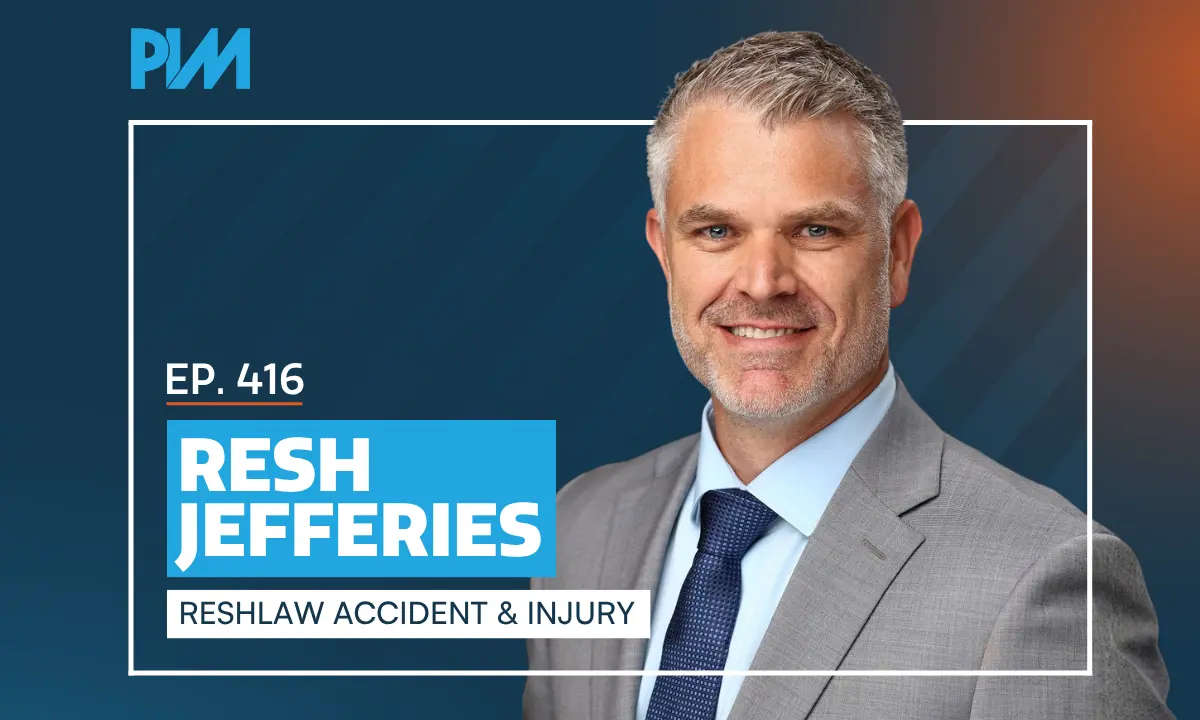
Chris Dreyer:
You don't always need a multimillion dollar ad budget to build a massive personal injury firm. Sometimes you just need to be scrappy and hit the pavement.
Resh Jefferies:
We worked off of Rice Krispy Treats and a business card. They were Costco Rice Krispy Treats that we repackaged in clear foil. You're talking about 30 cents a unit for a case here and there. I mean, that's what we could afford.
Chris Dreyer:
Fast-forward from those 30-cent treats, since January 1st, 2023, Resh Jefferies has gone from six cases to over 600 cases today.
Resh Jefferies:
We've made a pretty good business where we've gone from three employees to currently 16.
Chris Dreyer:
But how'd he do it? By being the exact opposite of a volume-based mega firm.
Resh Jefferies:
People like going to Trader Joe's. They don't like going to Walmart. And if you're the Trader Joe's of personal injury attorneys, then they're going to go to you.
Chris Dreyer:
Resh didn't just meet people and hope they'd send cases. He deliberately set out to develop a network that would act as a powerhouse referral engine. By treating every local relationship like a high stakes opportunity, he's completely bypassed the traditional marketing rat race because you never know who holds the keys to your next big file.
Resh Jefferies:
The reality is it's the real estate agent who gives you the biggest case that you never expected.
Chris Dreyer:
This is Personal Injury Mastermind. I'm Chris Dreyer, founder and CEO of Rankings.io, the elite performance marketing agency for personal injury law firms. Today's guest is Resh Jefferies, founder of Resh Law out in Utah. Today, we talk about how to turn local BNI meetings into a massive pipeline, treating medical providers like genuine partners, and why old school networking still has a place in today's world. Let's get into it.
So usually we start with a win, but I think it's kind of obvious, you went from six cases January 1st, 2023, and now you're 600, 700 cases to date. I mean, that's a massive increase.
So for this perfect kind of scenario of growth, you got the momentum here, but jumping from a handful of cases in 2023 to the amount of cases in the run you're on, that's uncommon. So was it a perfect storm of omnichannel marketing, or was there a specific channel that really contributed to that?
Resh Jefferies:
I started out at two of the bigger firms, so I had a lot of contacts that I met in those places. And then it was a lot of the chiropractor and physical therapist market. I think for whatever reason, when people get in auto accidents, the chiropractor seems to be the first place that they seem to go. And they have been a great resource for me. I have learned a lot about what they do as a practice and how they make people better after an accident. I've taken a proactive approach in getting to know who they are and what they do and where they went to school and those types of things. And those connections have helped me immensely and represent a big part of what I do. The other thing would be networking of all shapes and sizes, certainly attending seminars like yours and meeting other attorneys and that sort of thing.
Chris Dreyer:
Thank you. Thank you. It's one thing to get referrals, but also the intentionality and the strategy behind it. I'm sure you're doing other things than just dropping off the business card and maybe some donuts. So what are some of the strategies that you've kind of deployed to help you build these connections with these chiropractors?
Resh Jefferies:
So the chiropractors, ultimately, a lot of them, they went to school to help people. And I see the attorney sort of like a concierge in a nice hotel. They're sending their people to you and they want to know that you're going to take care of them. And if you're not, the other thing you have to realize is chiropractors have longstanding relationships with people after the case is over. People will come in for a monthly adjustment for the rest of their lives. And so they want to send them to an attorney that is going to wait on them hand and foot and that they feel comfortable sending them to, because ultimately they want them coming back for the long term. And we as the attorney, we may get the case back in some way, shape or form someday, but the chiropractors may get it back immediately for what they call maintenance or adjustment or that sort of thing. And so we just take care of them and they're comfortable that we're going to take care of them. And, unfortunately, the bar can be sort of low in that personal touch.
Chris Dreyer:
Client service is being talked about more today than ever, I guess, just because of the necessity of the reviews. But going the extra mile, it also has these intangibles of the systemic referrals, like in activating that individual from a marketing perspective after you close out the case.
A lot of attorneys think networking with chiropractors just means dropping off a stack of business cards and a box of donuts. But to get real scalable volume, you need to align your incentives with theirs. Resh has a fresh angle. Instead of treating providers like a lead source, he treats his firm as a true concierge service for their patients. That's how you guarantee repeat business. But medical providers are just one piece of his networking puzzle. He also taps into local business groups to catch the massive cases that fly completely under the radar.
When we're doing our research, you're in the BNI as well. So talk to us about BNI. I've had some friends that are in event planning. I have another acquaintance that's a plumber that get a lot of business from BNI.
Resh Jefferies:
So I think BNI is a great avenue for a personal injury attorney because the ROI is so high on a per case basis. So a lot of people go to BNI and they get these kind of onesie-twosies, the massage therapist, the acupuncturist, and 50, 100, $150 may not ... Is it worth the time spent? But we only need five, six, seven cases a year out of BNI to make that worth it. Ironically, the case that I just mentioned, the first case that I mentioned was a BNI case.
Chris Dreyer:
Oh, wow.
Resh Jefferies:
One of the bigger cases that I've settled. And so I think anyone that's considering BNI, it's a good avenue. It's tough. The night before, you have to devote time preparing and going to a meeting early in the morning that you've got a million other things to do, but if you commit to that process, it certainly can be a really good thing, a good way to get cases. But again, you have to put in the work. You can't just check a box. They need to see your sincerity, that you're a real person, and then they'll trust you with their people.
Chris Dreyer:
I love that. I've been a part of different communities. Vistage, you get acquainted with the members. And then I remember I moved to O'Fallon, Illinois, and I'm like, I didn't have any business colleagues. I'm like, "Well, let me go hit up a chamber of commerce meeting." And I sat in there and I got to talk to the mayor and got to talk to other individuals. And I felt like I was getting my feet under me being in a new area.
Resh Jefferies:
Right. Yeah. We've found an astounding amount of a percentage of our business has come through BNI channels. It really has, more than we would've thought when we went back and looked at the numbers. And so it's certainly something that we will continue to do. But it's not necessarily BNI. It's the way that we've sort of just given ourself over to that process. And it's been awesome.
Chris Dreyer:
Yeah. I think it goes a long way from a trust perspective, that belly to belly side, where you can shake somebody's hand, look them in the eye and say, "Hey, I'm going to take care of you." Just one other question on the BNI, and correct me if I'm wrong, I believe they have exclusivity to where you're the only attorney or you're the only PI attorney. Is that true? Tell me about that.
Resh Jefferies:
Yeah. So on a per chapter basis. So in the Salt Lake Valley, there may be 30, 35 chapters, and each chapter has one plumber, one electrician, one personal injury attorney. And so I guess the way to think about it is you've got 30 other marketers out there marketing for you. And if a case comes to them, then it comes to you and you're not really competing with somebody else for that case.
One thing I will say about BNI is chiropractors are a great place for referrals in volume, but to some degree, those are always chiropractor cases. BNI can be somebody's brother or sister that was in a very serious accident and they're likely not going to see a chiropractor. They've gone to an emergency room, they got broken bones and that sort of thing. So BNI, yes, they will usually have a chiropractor in that group that you partner with, you work with closely, that sort of thing. But the reality is it's the real estate agent who gives you the biggest case that you never expected.
Chris Dreyer:
That makes a lot of sense. And each of these individuals are trying to develop their own sphere of influence because they understand the power of community. If you're the type of person that's going to BNI, you know how important referrals are. So it's not just the BNI group. It's like you're connected probably to the whole area.
Resh Jefferies:
Yeah, correct. And you've got to give your own, you got to put into it what you're going to get out. If you show up with your hand out at BNI like you're just there to receive all the time, then yeah, it won't work for you.
Chris Dreyer:
Well said. Well said. So talk to me about your intake, so how it's evolved over time, your tech stack, just your approach to intake. Just give me the summary and we can kind of dig in.
Resh Jefferies:
So with intake, I try to get either me or one of my other two attorneys on the phone whenever possible. We have a central person that answers the phone. He actually is remote, lives in a farther off place in Utah, a couple hours away, but he speaks English, speaks Spanish, is wonderful, warm, makes that first impression and will do what he can to try and get us on the phone as quickly as possible. At that point, we really try and get out and meet the individuals when we can. I did 350 or so signups last year and I'd say 310, 320 I met in person, living rooms, Starbucks, those types of things. As I get bigger and start scaling this thing, the one part I would hang onto probably is intake. And networking and intake are the two things that will be the last things that I'll probably let go of, just because I think it's so important to set a case off on the right foot. I think you get a lot more patient clients if they've met the attorney at the outset, that sort of thing. And so I believe in intake a lot.
Chris Dreyer:
Yeah, probably from a selection process due to your experience as an attorney and the range of cases that you're taking, right? It's probably like having ... you've probably saw a case where maybe an intake specialist would have missed it. Is that fair?
Resh Jefferies:
100%. I've got an example if you want it.
Chris Dreyer:
Yeah, I would love it.
Resh Jefferies:
I went to a chiropractor to sign up a basic chiropractic case, nothing special, a soft tissue chiropractic case. And it was grandma and grandson in the accident. And I was sitting there talking to mom who was there to sign up grandson and she said, "Gosh, you handled dog bites. I wish I would've known you a couple of years ago." And I said, "A couple years? Tell me what happened." And she said, "My daughter, she got bit on the face by a dog." And I said, "Well, what happened with that? Did anybody resolve that?" And she said, "No, we just kind of let it go." I said, "Show me some pictures," which she did. And the daughter had a bit of a fileted lip open and no one ever took it, but it was still within the statute of limitations. I said, "It won't hurt to take a swing at it. Why don't you let us try?" And to which she did. And we're talking about less than a thousand dollars in a medical bill and a scar on her face, and the insurance company paid the limits.
Chris Dreyer:
Wow.
Resh Jefferies:
That's a scenario where an intake person that shows up on the scene, he just wants to sign the case up and be gone.
Chris Dreyer:
That's really interesting. Once the case is in the door, intake's handled, the clock kind of starts, right? So you're processing hundreds of files, requires operational leverage, and a huge part of that is making sure that the chiropractor gets paid at the end of the case, you're taking care of them. Talk to me about how do you manage the negotiations, reductions so the client walks away happy, and the clinic feels taken care of.
Resh Jefferies:
That's a delicate balance, right? That is certainly one of the pressing issues all the time. And chiropractors at the end of the case kind of come in two forms. There are those that want to play ball and they'll reduce at the end with their bill and I'll match their reduction. I think transparency is certainly key at the end of a case. I will certainly show them what I'm going to do and let them see what they want to do and what they're willing to do. And then there are others that just say, "If I'm going to provide you with the case, I don't want to take a reduction." And we work with both sides of that.
Having said that, I believe that the client should get the largest share of the money here. And so I generally don't take more than a client and I'll ask some of the providers for the same respect to take kind of what I'm taking or match me or a pro rata share, however they want to do it. But I do leave it up to them. I think it's built on trust, whether or not ... if they trust me, then they know I'm not asking for something I don't need. But if I am asking for something, it's for a good reason. And hopefully the client comes back to them because I'm going to make the chiropractor the hero at the distribution, right? They did this, they reduced this amount, and you really should continue seeing this guy because he did you a huge favor. And ultimately, I think that comes all the way back around. I'll take reductions on cases constantly and taking less than my third and ask others to as well. And I think that leads to happier people and I get a huge bulk of my business from repeats. So it's important to do that.
Chris Dreyer:
The golden rule, right? Treat people how they want to be treated and how you'd want to be treated. And the chiropractors that truly want to help, right? They're probably more willing to entertain that. You outlayed, "Hey, BNI, I get five to 10 or whatever." As much as you're willing to share, and you don't have to say specifics, but how many cases can a chiropractic clinic refer? I mean, and I know it's based upon the size of the clinic and the TAM, but can that be an avenue for a one channel and that's the whole strategy? How do you think about it?
Resh Jefferies:
We see that with some firms, a lot of times in the Spanish-speaking community. We do not work exclusively with like one or two chiropractic clinics. I probably work with 30 or 40. I am part of what's in Utah, it's the UCPA, which is the Utah Chiropractic Physicians Association. And there's three attorneys that are part of that association. And so I've certainly benefited from knowing a lot of chiropractors that way.
But my model's actually a little bit more scary than the one that you're mentioning because I wake up every morning on the first of the month and I have no clue where they're going to come from. And they come one and two at a time. And somehow that equates to between three and 400 over the course of the year, but they just come sort of like one or two a day. And we don't know where they come from other than a chiropractor here, a repeat client there, a BNI referral here, and you add all that together and we've made a pretty good business where we've gone from three employees to currently 16.
Chris Dreyer:
Generating the leads is only half the battle. If your intake process is broken, you're just burning those hard-earned referral opportunities. That dog bite story proves exactly why Resh insists on putting an attorney in front of a prospect. But once you scale to hundreds of cases a year, how do you make sure the client actually stays happy through the entire process? For Resh, the secret is leveraging his past experience on the defense side to manage the expectations from day one.
I also know you spent a decade doing insurance defense before transitioning to the plaintiff's side. Talk to me about knowing the bad guy's playbook or the enemy's playbook. Now you're on the other side. Does that help you settle cases faster? Does it help you get better offers? Knowing kind of the inside baseball that you used to have, how does that apply to what you do now?
Resh Jefferies:
It applies in an unusual way, right? For the insurance companies themselves, they don't much care. I can speak to them in a way that I can speak their language, I can talk to them about arbitration and what the medical bills and what this arbitration will get and those types of things. But the real way that it helps me, the surprising way, is it helps me with client expectations. And when I talk to a client and say, "Hey, listen," they know my background. I said, "Your expectations are just way too high. When I worked for Progressive or State Farm, they're not going to pay that." And in a lot of ways, that is probably the biggest way that prior experience benefits me.
I would say it's helpful to know how the whole process works. And we also, we litigate, which is a massively important part of settling cases for full value. But I would say my experience on the defense side helps me with, number one, if I'm competing with somebody else about getting a case, another attorney, and I tell them that I worked for Progressive or State Farm and that's the defense firm or the defense insurance company, then that gives me that advantage and I usually end up with the case. But the second part is when I go to talk numbers and they've got expectations of this being generational wealth or something, and I tell them it's just not how they're going to do it and this is what this looks like for you for the next two years.
Chris Dreyer:
It's so important on the setting expectations, right? You hear this all the time, right? A client comes to pick up the check and they think they were going to get a bigger one, even though you did an amazing job, and it's like then they want to leave a bad review as opposed to, "If I just set expectations and discussed it, maybe I could have mitigated that and had a five-star review."
Resh Jefferies:
If I get somebody 10,000 and I told them eight, which we commonly don't tell them the final number until they come in because it's almost 100% of the time higher than what we told them because we do that on purpose. But if I tell them eight and they come in and get 10, I'm the greatest attorney they've ever heard of. But if I tell them 10 and they come in and get eight, I am toast. So we definitely set our expectations on the low end if we can and exceed those at all costs.
Chris Dreyer:
So you're making these relationships with the chiropractors, you're doing the BNI yourself. Are you passing on ... I had an employee from, I can't recall this individual's name, I apologize, from Panish Shea Ravipudi, and their attorneys, their job is to bring in business. It's to do B&B, like B2B. If they're not on a case, they're there to network and bring in cases. Is that kind of the same mindset at your firm like, "Hey, I'm doing this. Hey, go meet the Harley dealers and you ride a motorcycle and go meet the Harley dealers." And what about that?
Resh Jefferies:
Yeah, absolutely. My other attorneys have a definite stake in bringing in their own business. I incentivize them to do so. They're in their own BNI groups as well and they're making their own contacts. We've sort of divided up different counties and areas for each of them to sort of focus on. And I incentivize them when it comes time. There's a difference between a case that they settle through the firm's means versus their own means. And I think it's enough for them to definitely go out hunting on their own when they can.
Chris Dreyer:
Fantastic, fantastic. So you're at PIMCON and you heard the speakers talk about the different channels and you saw that. How do you think about the B2C marketing? Is that later on in the future? Is it, "Hey, B2B's working for me?" What do you think about some of the different channels and tactics for B2C?
Resh Jefferies:
Well, as I start to scale, certainly that becomes ... I mean, I was on a shoestring budget for a number of years. I mean, we worked off of Rice Krispy Treats and a business card, and they were Costco Rice Krispy Treats that we repackaged in clear foil. And so you're talking about 30 cents a unit for a case here and there. I mean, that's what we could afford, right? So as we continue to scale upwards, we're definitely looking into different options. I think for us, we're moving into different extra locations. So we think that a Google presence in three cities is better than a Google presence in one city. And so rather than put everything into pay-per-click, we're actually, we've opened up a location in Tooele and a location in Lehi, and we're going to sort of grow those locations from that there and kind of spread our wings outward and hope that that works. But I never anticipated scaling this thing when I built it like this. So this is new territory, which is why I'm going to seminars like your guys'.
Chris Dreyer:
That's awesome. Thank you for sharing and thanks for the compliment. I think it's smart going to other markets. Even when you're doing a search or one of the main ranking factors, proximity. So a lot of times it's better to open even a second market in the same city than it is even to go to a different state. And especially if you got the networking opportunities, and a lot of people don't know this, in Yelp, today I saw a post by Joy Hawkins, Yelp was one of the top results in the AI overview for recommended local businesses for a law firm, and they're constrained to a 20-mile radius. So if you just have one ... In some markets, like some markets, 20 miles is okay, but in others, even if you're going to do Yelp ads, you couldn't get state coverage because it's constrained. So it's super interesting.
So if you were going to coach up that solo attorney that's thinking about going out on their own, or maybe they're stuck at handful of cases, what would you say, "Hey, this is the one thing you could start doing tomorrow"?
Resh Jefferies:
I would start making relationships, personal relationships with either medical providers of some sort, whether it's physical therapists, chiropractors, insurance agents, body shop owners, even people that just see a large volume of people, people that own hair salons. They're sitting there all day long talking to people about their situation and someone that owns a hair salon is somebody that can find you cases. And so for me, I think it's personal relationships.
We started this with the idea that we were only going to get a handful of cases and that's all we needed a month. And those relationships just become so important that ... And honestly, I think the bar is fairly low. Those relationships are not being cultivated by the big box guys. And so if you can go and cultivate those relationships, people want to work with people. People like going to Trader Joe's. They don't like going to Walmart. And if you're the Trader Joe's of personal injury attorneys, then they're going to go to you.
Chris Dreyer:
It's interesting you say that. I was immediately envisioning the younger generation attorneys kind of doom-scrolling and doing all their marketing on TikTok and Instagram when there's a whole trust component and a whole relationship component that's kind of ... Ever since COVID, it's kind of the networking belly to belly stuff has kind of decreased. And just tech, having the phone connected to you.
Resh Jefferies:
Yeah. Well, and we do some of that. I mean, we do plenty of Instagram and plenty of TikTok. But for me, that stuff in a lot of ways is just verifying that I am what I say that I am, but I don't know that people find me as much just looking for an attorney. They hear my name and then they go to TikTok and Instagram and LinkedIn and all those places and see if I am what the referrer said I was. And that's how I use those sources.
Chris Dreyer:
I think exactly how you explain it is how I say it sometimes, is like, "Hey, it can be social proof to validate the choice, the decision for the consumer, or you got to be an influencer, you got to post every single day or have a team posting every single day and get involved in the hooks and the creative and all those things." But I think there's a couple different strategies to take there.
Resh, this has been amazing. For our audience listening that has questions about the pod, that wants to connect with you, send you a case, what's the best way to get in touch?
Resh Jefferies:
I mean, our website's easy enough. So my first name is Resh, R-E-S-H, and the firm is ReshLaw. So that's reshlaw.com, Resh.law on Instagram, ReshLaw on TikTok. Pretty easy to find me.
Chris Dreyer:
Amazing. Resh, thanks for coming on the show.
Resh Jefferies:
Thank you, Chris.
Chris Dreyer:
Resh proved you can explode your caseload from six to 600 with an intentional networking strategy. What started as a 30-cent Rice Krispy Treats and a handshake has turned into a relentless referral engine. When you're ready for a marketing tactic to complement the belly to belly marketing, look for a digital marketing agency that actually helps elite personal injury attorneys dominate their markets and sign more cases. Head to rankings.io to learn more. I'm Chris Dreyer. Thanks for listening to Personal Injury Mastermind. We'll catch you next time.