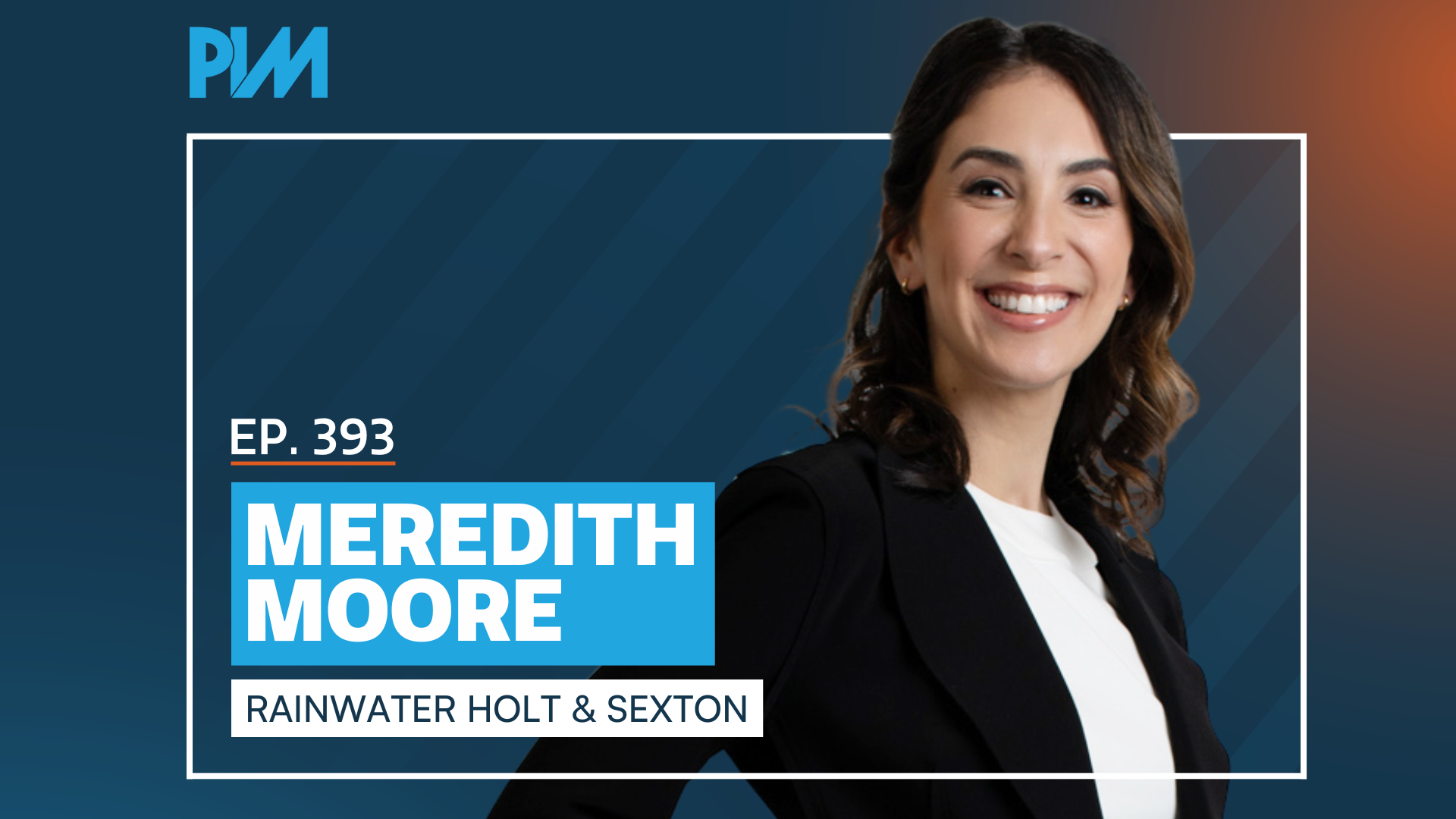
Meredith Moore:
We have DWI cases happening here and we're just not getting that same kind of value. What can we do differently?
Chris Dreyer:
Rainwater Holt and Sexton is Arkansas's largest personal injury firm. At the time of this recording, they had over 40 attorneys and 200 staff. The firm has recovered over a billion dollars.
Meredith Moore:
Bob was realizing that we just weren't getting the best value for those. And he kind of called me and a few other lawyers down to his office and said, "I think we can do better for our clients on these cases. And here's a list of all of our cases where we believe that the person was injured by a drunk driver or by somebody fleeing the scene or texting and driving. Without question, I don't care what the meds are, I want you to go get policy limits, make whatever arguments you need to make, do what you got to do, document it and report back."
Chris Dreyer:
Meredith Moore shows how she finds seven bigger outcomes inside cases most firms either decline or settle and don't get the max value for.
Meredith Moore:
And within that group of lawyers, I got them all done. I got through that list and got policy limits very quickly for all of them.
Chris Dreyer:
Sexual assault cases with civil liability, DWI cases hiding punitive exposure, abuse and neglect inside hospitals, nursing homes, and treatment facilities. She breaks down how those cases actually enter a firm, why they get missed, and what questions change everything once the phone rings. This is Personal Injury Mastermind. I'm Chris Dreyer, founder and CEO of Rankings.io. And on today's show, Meredith Moore exposes hidden value in existing PI cases. Let's go.
Meredith Moore:
We had a week-long jury trial, and that was a negligence case against the BridgeWay, which is a behavioral health facility here in ... It's actually in North Little Rock. And it is one of hundreds of similar hospitals across the country that are under the owner Universal Health Services. And they are like a multi-billion dollar company. They kind of use these independent facilities, almost like liability shields for the ownership. And the care is just historically not great at some of these facilities. In this particular facility at the BridgeWay, our client was 12 years old at the time. She had a number of mental health issues and had been admitted to several other behavioral health hospitals in the area prior to this one. But within the first 24 hours of her admission there for suicidal ideation, hypersexual behavior, she was sexually assaulted in a shower by a 17-year-old aggressive male patient and suffered obvious long-term issues as a result of that.
And so we sued the BridgeWay and litigated that over the past year-and-a-half, two years, and then ultimately went to the jury a few weeks ago and returned a verdict of $4 million for the little girl. It's typical profit over people, patient safety scenario. And so yeah, we were very pleased to get that outcome for our client.
Chris Dreyer:
Well, I think it sends a message to the broader community and congrats on the case. Circling around to the marketing side, to be Arkansas's biggest, you got to be doing a lot of things from the attraction, the positioning perspective. I guess first, how does the firm just think about attracting cases to get the opportunity to make an impact?
Meredith Moore:
I mean, I really have to give credit to Mike Rainwater and Bob Sexton, who are our partners. One, they put a lot of trust in me and they're hard cases. They're also expensive. We're talking $100,000 worth of expenses in cases like this. And so, and you hope that you're working them up properly and you're doing it right, but you don't know ultimately what's going to happen. And it's still important to send the message that as attorneys in Arkansas, we don't want it happening here. We're not going to tolerate it here. And I think our firm and Mike and Bob really see it as a duty of ours as personal injury lawyers in our state to protect our community. And if that means investing in a case that ultimately isn't profitable, that's okay because from that, you're getting a lot of press about, look, we are the lawyers that are going to stand up for this kind of thing, and that's what helps get the calls coming in.
And in cases when you're dealing with sexual assault victims, the people, not just the clients, but the people that are referring those cases to us, like for instance, advocacy groups or local government entities, they need to feel like we're not just in it for the money because it's the most vulnerable, arguably the most vulnerable population you're dealing with when you're working cases like this.
And so I think from a marketing perspective, they have to truly believe that your heart's in it. And so that comes ... The way we help do that is through educating different organizations and entities of how to help. And I try to do my part, not just on the cases, but to say, "Look, I'm here. If you think you have a client or somebody that you work with that may be able to ... We can help, that's fabulous for a case like this, but I'm also here just to help in other ways." A lot of these victims just don't have the resources or anybody to tell them, "Hey, this is how you can go get the financial services that you need to survive, and then let's tackle getting you justice."
Chris Dreyer:
So a few things like to give without expecting anything in return. And you said, hey, you get some free press. Just kind of ballpark, do you have an idea of like what percentage comes from like referrals, could be peer, any type of referral versus like your digital or traditional advertising, just taking on these complex cases?
Meredith Moore:
Yeah. So we are a large firm in our state and in this region, and we do a lot of advertising. The last jury trial we had during jury selection, it was like, "Okay, who's seen our ads?" Everybody raises their hands. "Who's sick of seeing our ads?" Everybody raises their hands. That's not really the case with these types of cases. You're really getting these through your connections and that means getting out in the community. That means working with advocacy groups. We work with DHS and Department of Children and Family Services. I am a former prosecutor in our area and that's part of how I got into all of this and why Mike and Bob approached me about some of this work. And so I keep good connections with law enforcement, prosecutors, public defenders, and it's really about spreading those tentacles in your community so that, for instance, cases involving a criminal component, which is the majority of what I'm doing, those criminal standards, that beyond a reasonable doubt standard is a really high bar to chin.
And so I get calls from law enforcement and prosecutors all the time who are ... They know something bad happened to the victim, but they can't pursue charges. So they'll call me and say, "Can you talk to this victim? Maybe there's an avenue that you can help them with." And so it's really more about that than it is your typical advertising in personal injury cases.
Chris Dreyer:
Due to the firm being a large advertiser and doing the complex cases, how do you approach that from an intake perspective? Because you're going to get a lot of volume on maybe like just the common auto stuff. And then it's like, "Oh, here's a complex case." How do you pull that out and identify if it's a case like worth pursuing and how does that work?
How intake teams miss civil liability when they frame sexual abuse and assault cases as purely criminal matters
Meredith Moore:
It takes working with our intake folks kind of regularly. We're always fine-tuning. For instance, we're scheduling a meeting next week just to talk about how to handle at an intake level just from this most recent verdict because it was in the newspaper and we're getting phone calls about other cases related to behavioral health facilities in our area. And so we're going to have a meeting and talk about, "Okay, here's kind of a criteria, here's what I'm interested in."
And so it does take really having your intake folks knowledgeable about what these cases look like from a civil perspective because oftentimes when you're dealing with any sex abuse case, anything that's kind of punitive in nature, when those calls come in, it just sounds criminal. It sounds like something that typically we would automatically reject because it's an intentional act. And so I really try to talk to our intake folks about, "If you don't know, call me. I'm happy to get on the phone with them because if you're dealing with a potential client that's been through a traumatic situation that is not your typical car wreck and things like that, it can be really difficult for them to even verbalize what's happened." And so I try to get them to ask the right questions, but always err on the side of getting me on the phone or setting up a time for me to talk to the client myself.
Chris Dreyer:
Meredith oversees the litigation side. She manages dozens of attorneys, different skill sets and cases that demand very different approaches. Some lawyers are built for pre-lit, others are built to push a case all the way to jury. So the real challenge becomes assignment and development. How do you spot the attorneys who can take a case to trial and win? How early do you decide which cases need that level of pressure and are you working those cases up with litigation in mind from day one and making that call later? That's what we get into next.
Meredith Moore:
Yeah. So I'm one of our managing litigation lawyers and I think a good trial lawyer has to be somebody that just has a bit of a bulldog mentality. And you can have really, really smart, experienced lawyers, but if you don't have that grit that you're just going to bite on and not let go if you feel like it's right, it's not personal. It's just not right for everybody. I was a trial court assistant for a criminal judge here in Pulaski County while I went to law school and I went to night school and I only thought I ever wanted to do criminal law, had no civil experience whatsoever, came over here because I honestly got tired of working the sex crimes at the prosecutor's office and said, "I just want to do car wrecks, simple, nothing complicated. I want to go home and that's it."
Bottom line is I think Mike and Bob brought it out in me and said, "It's just in you. It's just something that you can't let go."
Why routine auto-claim assumptions result in undervalued DWI and reckless-driving injury cases
Chris Dreyer:
So you have attorneys that have different expertise, that do different case types. So when did that come about? Did you get a certain volume of leads and you wanted to have these different areas that you could focus on? When did you make the decision to say like, "Hey, I have the DWI, the Department of Sex Abuse." You've got the big truck. How did that evolve over time?
Meredith Moore:
So for instance, the departments that I manage, the DWI, the punitive damages, and then the sex abuse, the sex trafficking, we saw the litigation happening in other big states and big cities and realized we have DWI cases happening here and we're just not getting that same kind of value. What can we do differently? And so within my time that I've been here, so I've been here for, I think coming up on close to 10 years, I think bringing over some of my knowledge of the criminal side of things and looking at the personal injury cases from that perspective and saying, there's more than just negligence here. For instance, the DWIs, the punitive nature of some of these cases, they should be worth more. And so what can we do to make sure that we're getting good value for our clients on cases where it's negligence plus? You're at that level of recklessness almost, which is what a lot of these cases are.
Why early filing and policy-limits demands force insurers to reassess case value
Meredith Moore:
And so it was putting our resources into, "Okay, we're going to take a bunch of these cases and we know we're not getting good value on them from a pre-litigation level. Let's file suit. Let's send a demand and say, 'We're demanding policy limits, either get to it or don't,'" and going ahead and drafting the complaints, getting them filed, maybe holding on service for a period of time to let the insurance company get right or make it right, and then getting those types of cases with the right lawyers that know how to push them and push them hard and just not say yes to bad value.
Chris Dreyer:
So circling back, I love the grit. Our core values are excellence, execution and grit. And like the grit, the true grit, how do you identify those individuals that, like you said, that got it in them when they get an offer that, "Hey, that's not enough. I know I can do better for my client."
Meredith Moore:
Bob and Mike tested me years ago when I first came here and I didn't even realize I was being tested. But for instance, the DWI cases, Bob was realizing that we just weren't getting the best value for those. And he kind of called me and a few other lawyers down to his office and said, "I think we can do better for our clients on these cases. And here's a list of all of our cases where we believe that the person was injured by a drunk driver or by somebody fleeing the scene or texting and driving. And I want you to take this list." And he kind of divided it up and said, "I want you to go get policy limits. Without question, I don't care what the meds are, I want you to go get policy limits, make whatever arguments you need to make, do what you got to do, document it and report back."
And within that group of lawyers, I got them all done. I got through that list and got policy limits very quickly for all of them. And he said, "Why would I put these cases with anybody else? If you're going to go get it done, follow direction and just fight, I'm going to have you work on these cases." And so I think that was really instrumental for me, obviously, to be able to come in and kind of tackle a niche area of the cases at our firm, but it was also really smart of Mike and Bob to say, "We're going to find somebody that can go do what we know can be done on these cases and we're going to let that person sort of lead the charge." And I mean, I think if you've got somebody at your firm or yourself and you're just interested in a type of case or you know you have somebody that can do it, let them run with it and prove it to you.
And that's really kind of how these sort of niche departments at our firm within our litigation world have come to be.
Chris Dreyer:
I love that from the top down, the high standards, holding people to the highest standards, given the opportunity to succeed and just pushing as the rising tides effect. What's something that they should look for to potentially partner with your firm on one of these cases that maybe other firms would overlook? Like sometimes this conversation is like a product's liability after something catastrophic, you want to scrub for products, but like what's something to look for with one of these types of cases that they could maybe refer out?
Meredith Moore:
Yeah. I mean, I think a lot of times people get cases, for instance, nursing home cases, facilities where it looks like a medical malpractice case and maybe they don't do that and that's not their area, but a lot of times these cases are ... They're right there on your plate and you don't even know it. If you've got somebody calling in who's been injured or hurt in a facility, ask those questions: "Tell me more about that." What were the client's vulnerabilities going into that facility? If you've ever got a child involved in anything and you're getting a phone call and it's not a car wreck, you've got to be looking for some type of negligence, some type of abuse that might be going on. And I didn't even know that these cases existed until I started thinking about my prior experience and my connections.
And so if you've got somebody at your firm that has any experience, whether it's prosecutor, public defender, if you're getting any cases or you're handling any cases that involve criminal law, they're there. Because I didn't know this until I really started thinking back to it, but a number of the people that I prosecuted, especially the women for drug crimes, a majority of them were also being sex trafficked. And so it's really a matter of awareness and figuring out what connection you have out there, whether it's through a nonprofit organization that you work with, whether it's through your church, whether it's with some government entity, Public Defender's Office, Prosecutor's Office, to be able to talk to them and educate them about, "Hey, these cases exist." And you can really, really help somebody out if you're asking the right questions. So I would just say on its face, a lot of these cases look like something that is not negligence.
People will call in about a rape or a sexual assault and you can be really dismissive and say, "Look, that's just not my area. You need to call the Prosecutor's Office or you need to call a criminal lawyer." And it's about asking those follow up questions of where the abuse happened, where the crime occurred, and you will be amazed at what you find.
Chris Dreyer:
Incredible, that's going to be really helpful for our audience. I appreciate that. And for our audience listening, this has been amazing. What's the best way to get in touch with you if they have one of these cases, if they have a question about what we've discussed, what's the best way to get in touch with you?
Meredith Moore:
So my direct number is 501-485-6179, and my email address is my last name, which is more, M-O-O-R-E, @reinfirm.com.
Chris Dreyer:
Amazing. Meredith, thanks for coming on the show.
Meredith Moore:
Thanks for having me. This was great.
Chris Dreyer:
Everything Meredith talked about starts before a case ever reaches a lawyer. The quality of the cases you work is dictated by the signals your marketing sends and who attracts it. At Rankings, we help PI firms build performance marketing systems that drive better cases, not just more leads. I'm Chris Dreyer. Thanks for listening to Personal Injury Mastermind.