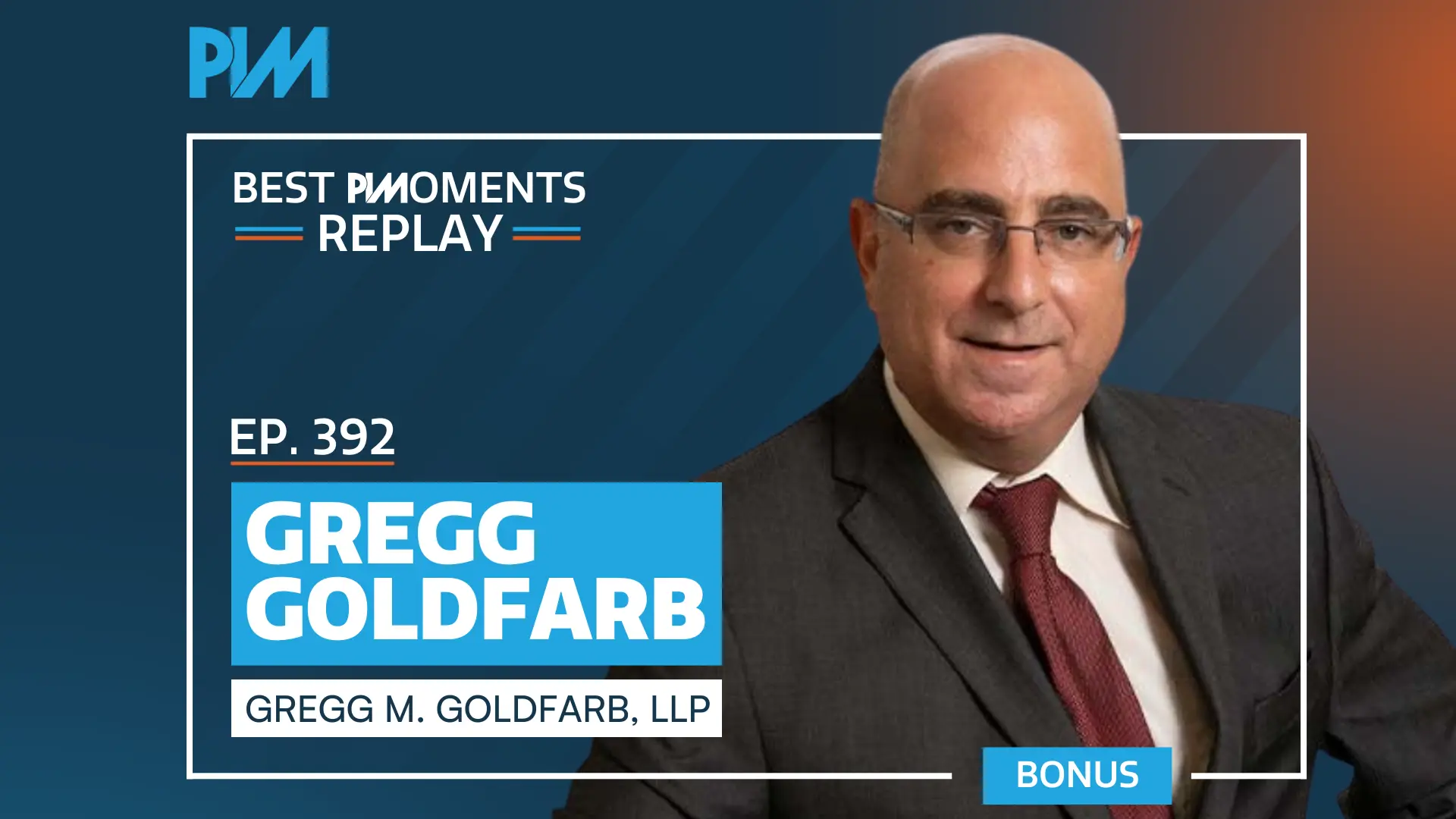
Gregg Goldfarb:
What I've done over the last five to ten years is I basically outsourced everything, including my work.
Chris Dreyer:
That's Gregg Goldfarb. Over the past three decades he's put in the reps, from Rodney King-era police brutality cases to Camp Lejeune water contamination. Gregg has always been at the front lines of the biggest fights.
Gregg Goldfarb:
I've done everything but the standard bodily injury accident cases. And I said, "Listen, whatever you get that's not an auto accident case, send my way."
Chris Dreyer:
This is Personal Injury Mastermind, where we dig deep into the best personal injury firms in the nation with the leaders who got them there. I'm your host, Chris Dreyer, founder and CEO of Rankings.io, the elite marketing agency for PI firms. On the docket today, mass torts for modern PI firms. Gregg has managed large teams, built full operations, but now he runs a skeleton group by choice. His lean model is one any PI owner can learn from, and he's crushing it.
Gregg Goldfarb:
I try to stay ahead of the game and see where the future is going. And throughout my practice, I've always had to shift. Whatever the hot new trophy was, was what I was chasing.
Chris Dreyer:
Gregg shows us the four strategies of a modern PI practice, so you can compete with the giants in mass torts. First up, how he stopped wasting $50,000 ad buys and found a smarter way to bring in cases. Let's go.
Gregg Goldfarb:
It's so difficult today, because there's a few big players out there that have an enormous, enormous marketing budget, and no matter where you go, everybody seems to be national, and you've got the Morgan & Morgans of the world. They're swallowing up the smaller law firms out there, the more boutique outfits out there in the world, so the marketing has become tricky.
Chris Dreyer:
What you're doing in marketing and how you're getting cases, are you more advertising? Just due to your practice and how you do things that other people don't do, are you more marketing more to B2B, to your peers? Are you doing the B2C? Talk to me about the different components of advertising.
Gregg Goldfarb:
In the entirety of my 32 years of practicing, in one form or another, I've been doing marketing. So over time, what I've learned is that instead of saying, "Okay, I'm going to spend $50,000 and hope I get leads," and then you realize, "Oh, $50,000, what's my ROI? I got one case. It wasn't good." So what I've learned is that there's case acquisition. There's some really good marketers, and that's all they do and they market for lawyers, and you basically give them a chunk of money and you set up criteria and you say, "I want Camp Lejeune cases, okay, and I want cases where the only injury that I'm willing to accept is," let's just say testicular cancer.
So I sort of shifted into that, because it was a level of certainty that I think helped me stay committed to the marketing world. I still market organically. I still go out. I still go to events, go to fundraisers and all that, but I think it's almost become my bread and butter right now. The video game addiction is a big case that's coming up. Ultra-processed foods, a lot of people now are starting to wrap their brain around that, and social media has now really taken over this sort of case acquisition, case-specific type of marketing, and I've been happy with it.
Chris Dreyer:
Without naming names, you always hear the downside, like, "Ah, they're cherry-picking for this firm or that firm," or, "They start you off hot and you get a bunch of good cases, and then they kinda water it down." What's your experience been?
Gregg Goldfarb:
I've had the complete range, from really bad to good, okay. In the mass tort space, because it's so big and there's so many people affected, and the companies that get sued oftentimes have multiple types of litigation that they're fending off, they're slowing it down as long as possible, so you have to sorta be ready for the long haul.
Chris Dreyer:
I guess a few questions here. The first thing is the cash flow, right? If you're auto or whatever, 12 to 18 months is one thing, but we're talking torts. It might be five years, and that's part of their strategy, is delay, delay, delay.
Gregg Goldfarb:
Yeah.
Why diversifying your personal injury practice helps law firms survive lengthy mass tort litigation
Chris Dreyer:
How do you think about the portfolio? Do you wait 'til you got some high risk before the science is established? Do you wait until the science is later? How do you think about selecting these?
Gregg Goldfarb:
So I am definitely a big fan of diversification, and I wanted to diversify the types of cases, the law firms that I was going to work with. And when you go into the types of cases, it's not just, okay, I'm going to do sexual abuse cases, where you don't have any really complicated science that you're going to have to convince the judge that your theory and your expert is solid, all right? And so going back to the length of these cases or whatever, the baby powder talc cases, they're like 10 years old. Now they've already filed three bankruptcies. They did the Texas two-step or what have you.
Chris Dreyer:
Gregg just showed us how he stopped wasting money on ads and started buying the exact cases he wanted. To be successful in mass torts, you need diversity in cases. The real edge comes from catching the next wave before it comes to shore.
How to identify and prepare for the next wave of profitable mass tort opportunities
Gregg Goldfarb:
I try to stay ahead of the game and see where the future is going. And throughout my practice, I've always had to shift. I want to have cases that are new because those are going to be cheaper to get, and then I want to get the ones that are advanced, that have gotten past the motion for summary judgment, the Daubert and all that, and there's cases that are set for trials.
Chris Dreyer:
So far, we've seen Gregg play offense, filling his pipeline smarter and jumping headfirst into the next big wave. But the truth is, these cases are never clean. The companies he goes after, Fortune 500 giants, they stall. They appeal, they file bankruptcies. They'll drag things out for a decade if they can. To run a modern firm, you must be adaptable and willing to learn along the way.
Gregg Goldfarb:
I've done everything but the standard bodily injury accident cases. I mean, I have in the court, but I started out, I was like a C+ student, so I wasn't getting big offers and I had to market from the ground going forward, as soon as I got my bar license or whatever. And so my dad, he's also an attorney. He's been around, still practices, 94 years old, and I went to him and I said, "Listen, whatever you get that's not an auto accident case or your buddies, send my way."
Chris Dreyer:
You got on the conference circuit. You can identify who the agencies are that the ex-social media bought and stuff like that. They're out there advertising to get clients. How do you go about identifying who you're going to send the cases to? Do you just look at the steering committees? Is that where you start? Is it just you get in this world and you start getting the relationships and that's how it goes? I know Papantonio has Mass Torts Made Perfect and wants every ... and I like Mike, and look, it's smart from a marketing perspective, he wants everything referred to them, but how do you find the right firms to send the cases to?
Gregg Goldfarb:
I figured at the beginning I should go with the heaviest of the hitters, right? So you would go to the Mass Torts Made Perfect conference, you would see who's speaking, then you would hear who's in leadership, who's going to be the one trying the cases, who's going to be the one settling the cases. So my initial take was, "Let's go with them," so I just started like that. Then I started like, "Wow, they're too big. Well, who am I? They don't care." So then I started to go with smaller operations, who I was getting to know at these conferences and having longer conversations and who I felt like, I got their cell phone number, I know where you live, you know what I'm saying? So I figured let me try them too.
So everybody sort of has their good and their not-so-good. There's nobody that's been perfect. As far as me and my, I'll have some of the clients call me up, "Hey, I want an update." And then I'm like, "Okay," and I'm like, "Hey, this guy needs an update." And then it's like two weeks later, the client calls me back, "I never heard from anybody."
Chris Dreyer:
I kinda want to hit this just a little bit more, because just, I mean, the whole way that you structure a firm's different, right? You're using these providers to get cases, then you're working with partners for the monetization piece, so what's the team look like? I imagine you're a more leveraged, more lean team overall. How do you put this together and make it all work?
How to outsource intake, IT, and legal work to run a lean mass torts practice with low overhead and high adaptability
Gregg Goldfarb:
So you have to know. Like you said, the world today is completely different. You can have companies answering your phone just for regular calls. You could have a call center that is specifically trained just to handle intake for lawyer cases. And we know, and I'm sure you know too, if the phone rings and somebody's looking for an attorney, if you don't call them back in a minute, they're gone. They're gone. In the old days, it used to be, oh, you got 24 hours to get back to you. So nowadays, you cannot afford to do that. So what I've done over the last five to ten years is I basically outsourced everything, including my work.
Chris Dreyer:
Big teams managed, full-scale operations built and run. Gregg's done the traditional law firm model at scale and then he walked away from it, because he found something that works for him. The way Gregg structures his firm could change how you think about your own practice.
Gregg Goldfarb:
A lot of my work, I'm just referring out to other firms. My bread-and-butter work was first-party insurance claims, and I had just so much of that that I had two buddies that are close in Miami, close geographically, so I gave them the work. I gave them my employees, and I've just basically outsourced everything. There's a couple things more I'd like to. I'd like to outsource my accounting so I don't have to deal with the accountant anymore. I mean, that would be ... outsource my IT system. That would be wonderful also.
So that's more to where I'm at right now. I'm 59 years old. Maybe in two or three years from now, I'm going to shift back and I'm going to be like, "You know what? I need to have my crew back in place," but right now I'm a very lean, skeletal type of structure.
Chris Dreyer:
So I wanted to ask that, because it's a highly leveraged model, right? It's like you're the strategist, so you can pick the partners. A lot of times people think of ... these other people are experts and they niche in that area, right, so a lot of times they have leverage on those different. They can have different economies and scale, and so I think that's super smart. If you were going to say, "Hey, here are the things that you need to do to be successful with torts, with this kind of model, just 80/20," what would you say? What would you recommend?"
Gregg Goldfarb:
Well, I think knowledge is key. And what's going on is that ... and I think maybe you've seen this as well ... you go to law school, they don't even really show you how to be a lawyer. Then you come out and you're like, "Okay, I gotta figure out how to be a lawyer." Then you're like, "Wow, I'm a lawyer now. I know how to be a lawyer, but now I'm not happy with what I'm doing, and I'm not making enough money and I'm seeing other people doing that."
So you start scratching your head, and then you start saying to yourself, "Well, gee, I don't want to do that type of work because I want to stick with what I know." So a lot of lawyers are just in this brain funk where they're like, "I can only do family law. That's all I know how to do. I don't want to take a chance." And the downside to going outside of your comfort zone is sleepless nights. You mess up, and when you mess up, you're affecting a client or another.
Chris Dreyer:
One final question, where can our audience that has questions that wants to connect with you, where can they go to learn more?
Gregg Goldfarb:
My website is the best place, Gregggoldfarb.com, G-R-E-G-G, G-O-L-D-F-A-R-B.com. I'm the original Triple G.
Chris Dreyer:
Gregg built the perfect practice for his goals. You can too, but you can't do it alone. Look, no one wants to see you win more than I do. That's why I created Personal Injury Mastermind Conference, PIMCON, and it's this October in Scottsdale, Arizona. Every person on that stage will be a personal injury attorney sharing what they have learned in practice. If you're serious about building a modern personal injury practice that can compete in today's market, you need to be there. The relationships alone will pay for the trip 10 times over. Tickets are at pimcon.org.