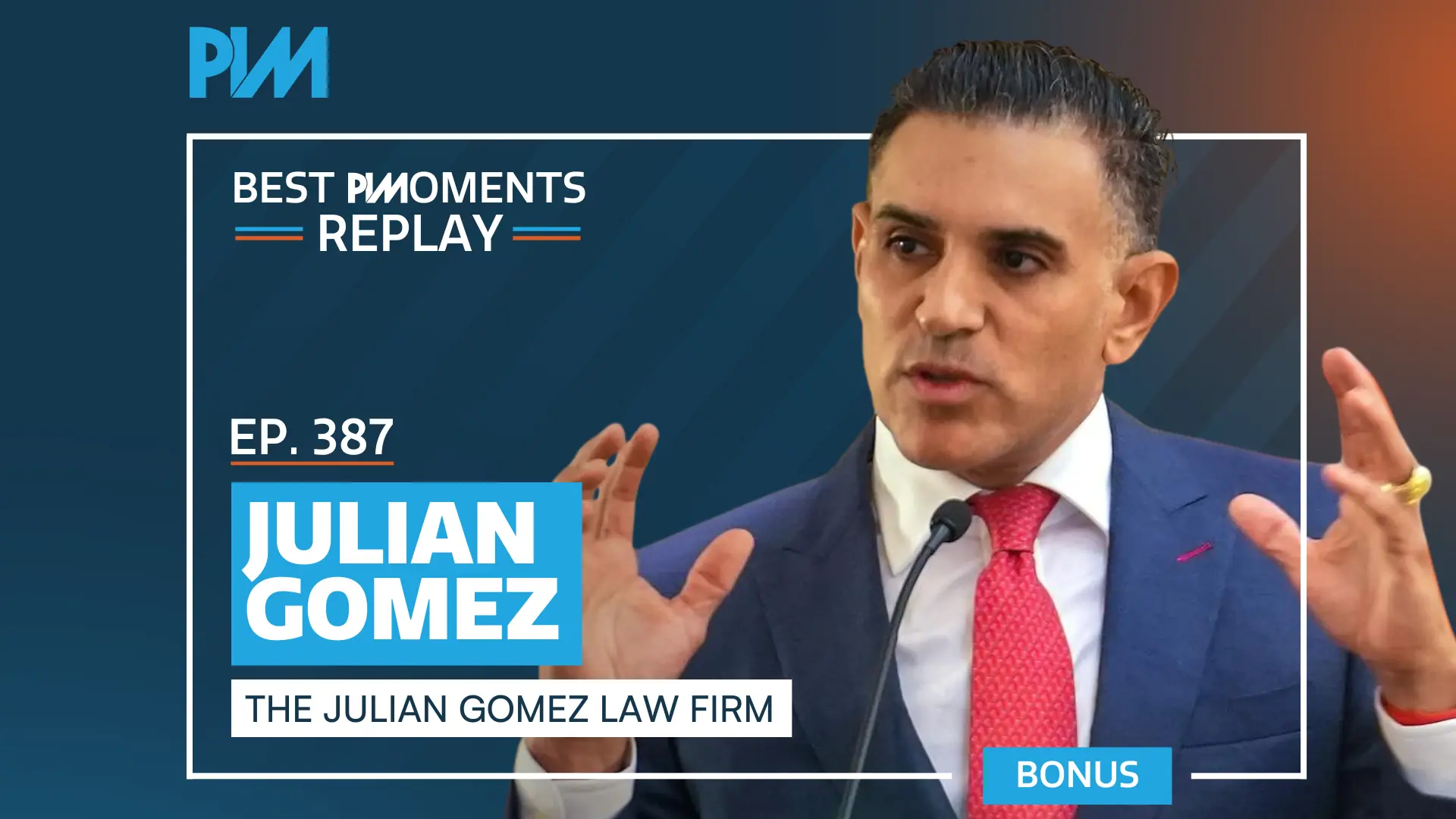
Chris Dreyer:
In almost every catastrophic accident, there's a product liability case hiding in plain sight. Julian Gomez built a national practice by seeing what other PI firms miss. I'm Chris Dreyer, founder and CEO of Rankings.io, the SEO agency of choice for personal injury law firms. Julian learned that spotting opportunity is only half the equation. The other half is knowing exactly which opportunities to pursue. In this episode of Personal Injury Mastermind, Julian reveals how he dominates auto product liability nationwide and why mastering a niche can be more valuable than casting a wide net.
Strategic framework for evaluating and pursuing high-value auto product liability cases
Julian Gomez:
Case selection is beyond important. 45,000 people, give or take, die in cars a year. Another four point some odd million are seriously injured. There's not that many lawsuits out there. And so I know cases are falling through the cracks and they are, but there's also probably a lot of cases that we're filing or we're litigating and we're not able to get top dollar for because we didn't do as good a job in case selection. And if we had put those aside, then we probably would be doing a better job for the ones that we're taking.
Chris Dreyer:
Yeah. So let me lean into that because look, I'm the SEO nerd. We work with over 100 PI attorneys, but this is a unique area. Most of the time it's just straight car accident lawyer, truck accident lawyer. You run a catastrophic injury practice. Tell me about this area of law.
Common auto defects often overlooked in standard accident cases and how to spot them early
Julian Gomez:
We do a very tiny amount of personal injury law like everybody else, car wrecks, that type of stuff. And then we've got two areas of the law that I work on, which would be commercial motor vehicle stuff. And then we've got all others, which is medical malpractice that comes in and that all just gets referred out to somebody that's better at it than I am. But the bulk of what we do is auto products. And that would be like a tire that the tread comes off, a roof that crushes in on a vehicle. That's a crashworthiness. That's a seatbelt that doesn't work. The seat backs in cars fail all the time. This morning, a firm out of Ohio gave me a call, they had a flat front garbage truck that was in a head-on collision. And because of the design, there's no space for crush.
That's a defect. The new defects right now are what I call automatic crash mitigation failures. That's a car that has automatic emergency braking that doesn't work and it smacks into something in front of it. It leaves its lane of travel. There's no way to quantify it for certain, but I bet I've looked at probably over 2,000 police reports in my career that are catastrophically involved. Rarely, if ever, can I think of a case where a product defect did not in some way contribute to either the injury or the wreck or both.
Chris Dreyer:
It's kind of blue ocean. You got this unique expertise versus the car, everybody wants the 18-wheeler catastrophic, secure the vehicle, get the big case, but this is kind of unique. It keeps you on your toes in terms of your expertise. And this is the consumer here talking, so driving a new car and you get those recalls. Is that the consumer's responsibility? The manufacturers, a lot of times, they know they have these issues, and that's what you're leaning into.
How to become the go-to attorney in your auto product liability blue ocean niche
Julian Gomez:
Sure. So you do not have to have a recall for there to be a defect. And sometimes we use the same word to mean different things. So in the Federal Motor Vehicle Safety Standards, there is, or at NHTSA, the National Highway Traffic Safety Administration, they use the term defect, but that's not the same as defect in the law. So we've got design defects, that's the actual design of the product is defective. You have a manufacturing defect, that's the product is not manufactured to spec, which creates a problem. And then you have a marketing defect where the design is made, the product is manufactured to spec, but it doesn't warn of the dangers.
So like a tire. This is one of the ones, tires essentially that are six years old or older, regardless of the amount of tread should be taken off of a vehicle, like a spare. They take a spare, it's full of tread, they put it on the vehicle and a day or two later, the tread comes off and something happens. But you look at your tire, it's not on there. That warning isn't there. And so whatever that defect is, that's what you're looking for. It doesn't require the government telling you that there's a defect.
Chris Dreyer:
How you started your firm is different. And so we got to talk about this story. I mean, you started out of the gate, you had a double fatality auto product case. It's a massive undertaking for a new firm. Tell me the story of that and how it impacted the firm.
Julian Gomez:
This bounces around. You can only connect the dots looking backwards. So in law school, I worked with this guy and right after my first clerkship, I'm working for Fred Barron and Lisa Blue in Dallas. He calls me up and he's like, "Hey, I have this rollover in D-tread. Do you think you can do it? " And I was like, "Hold that case for a year. I'm going to work for the federal judge that is trying the first Ford Explorer Firestone case in the country." And I taught myself how to do auto products by taking that case apart and then hung a shingle with that first case as soon as that finished. I went to Jerry Spencer's Trial Lawyers College. You're supposed to not be accepted until you've tried a couple of cases. I write him this letter, "I have this case, please let me come." He lets me come and I just didn't know any better. And I didn't know that I couldn't do it. So we did.
Chris Dreyer:
You've also had some challenges with some practice area closures. So was there a particular practice area that you were leaning into and it closed and you had to change? What was that? Did the product, did they actually improve the safety? Was it related around that area or a different area?
Julian Gomez:
So that first Firestone Ford Explorer case, what very few people know is that that rollover happened in Mexico. And so the form non-convenes and choice of law at the time allowed you to litigate that case in the United States because the conduct you complained of, the manufacturing, the design of that product occurred in the United States. 10, 12 years into my practice for let's say zero to that time, I almost had a monopoly on these cases and I was litigating them in Delaware. A case that I had rejected, another law firm took it and made some bad law out there and it just completely shut what I would call foreign situs litigation down. There's still a few cases that'll snake through it like aviation law, but it just closed. And I had to pivot from foreign situs auto products to US situs auto products. And that's the vast majority of what we do now.
Chris Dreyer:
Not only have you built this catastrophic practice, you're also doing it, never missing a family event, still getting out on the slopes, I think 20 plus days a year. What systems do you have that make this possible? How can you help the attorneys listening improve better work-life integration?
Julian Gomez:
So I think one of the things that I think I changed as I've gotten older, I used to want it all and I've learned that I don't need to have it all, I just need to have enough. I'm 51. I probably didn't learn that until I was like 45. I don't have a jet, but I'm really rich because what I mean by that is that I love my parents, they're coming over to the house for dinner tonight. I love my kids. My kids love me. I get to vacation with them. I got a great wife. I'm healthy. And in that way, like I've been very, very, very fortunate in doing that. I only look at email once a day or I try to. You become Pavlovian's dog and just ding and you stop what you're doing. I calendar everything. Time is our most precious commodity.
And so if you get my time, I really care about you. I limit the stuff I work on. And so I don't... There's a saying in Spanish, which is if you put your arms around too much, you can't tighten down on anything. Imagine a bunch of logs, you can't hold onto them because it's too much and they'll fall out, but if you just have enough, you can bring them home and have a fire at the house.
Chris Dreyer:
Julian's story is the perfect example of what happens when you become the goat of your niche. He transformed from a ranch kid making a bet with his father to one of the nation's leading experts in the field. Not by chasing every case, but by deeply understanding which ones matter. His method is surprisingly simple, be the best at one thing. Really share your knowledge and let your expertise create opportunities. In a world where most PI firms are fighting over the same cases, Julian found his blue ocean. The question is, what's yours? For more strategies on owning your niche on the national level, visit Rankings.io or grab a copy of my book, Personal Injury Lawyer Marketing: From Good to GOAT. Thanks for listening to Personal Injury Mastermind. I'm Chris Dreyer, founder and CEO of Rankings.io.