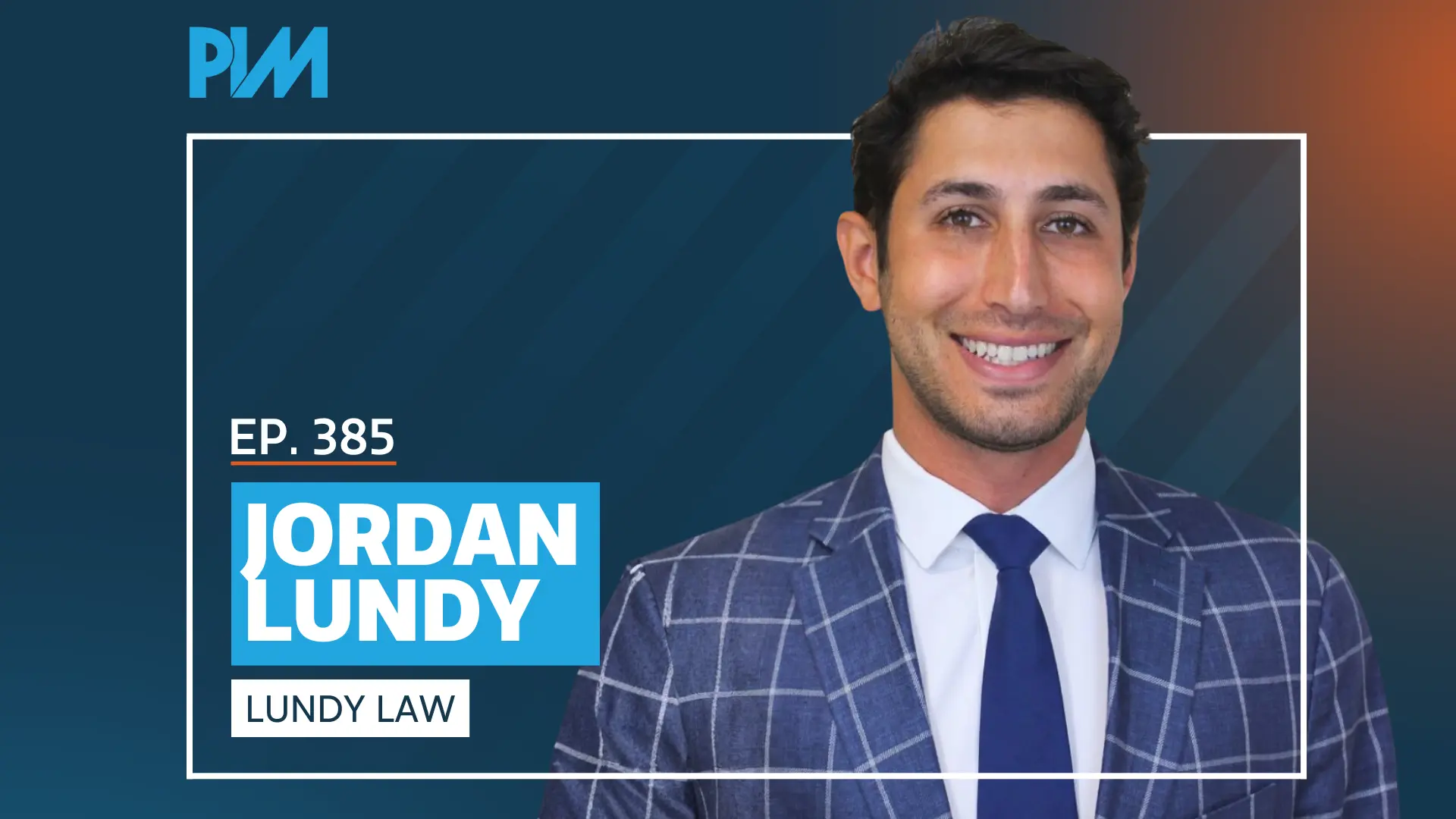
Chris Dreyer:
Three generation firms don't usually think like startups. They rely on what's always worked. Brand recognition, legacy spend, inherited ways of operating.
Jordan Lundy:
Marketing's working, intake's working, great machine, everything's cruising.
Chris Dreyer:
But Jordan Lundy made a different call. He questioned assumptions inside a firm that had every reason not to. He tested marketing instead of protecting it. He audited intake instead of trusting it, and he treated growth like something that had to be earned.
Jordan Lundy:
I really got a wake-up call from some guys that did some digital search with me and I was like, "Guys, you're doing okay, but I thought you would do better." And I give them credit because they sat down with me and they pressed play on a recording, and they had a recording of one of my intakes and they're like, "No, we delivered you that case. You guys dropped the ball." That was my, oh my God, moment. I've always just so focused on how good is our marketing that I never really focused much on intake.
Chris Dreyer:
What followed wasn't a cosmetic tweak. It was a full recalibration. Traditional brand backed by disciplined digital investment. Intake rebuilt to match how people actually choose firms today. And to see
Jordan Lundy:
Double the signups is just unbelievable for what we're able to do now as a business.
Chris Dreyer:
Lundy Law passed a hundred million in settlements in 2024 alone.
Jordan Lundy:
From this time last year, we've doubled our signups.
Chris Dreyer:
This is Personal Injury Mastermind powered by Rankings.io, the elite search marketing agency for personal injury law firms. Today's episode breaks down what happens when a legacy firm operates with startup urgency without losing the wisdom that got it there. And what other firms can learn from the shift before growth stalls. Let's get into it.
Why non-branded legal marketing now matters more than firm name recognition for personal injury growth
Jordan Lundy:
I'm the third generation at Lundy Law. I've been there for about 13 years, but the firm's been around for 70 years. So, we got really comfortable sitting on the fact that we have brand recognition, that we've been in the market forever. And what I started to realize as I dug on more and listened to intakes and got an idea of what's happening is that brand recognition is not as important as it used to be. And so, companies like mine that were just relying on good old TV, billboards, and we're obviously the only firm people are going to go with are going to start losing.
And I started to notice in intake, I was hearing more and more people calling and saying to the intake team, "I'm also talking to two or three other lawyers." So, what that did was that woke me up to, okay, if I was a brand new law firm, if I just started today, would I be acting differently than I am having a law firm that's been around for 70 years? And the answer is absolutely I would. And so, about a year, a year and a half ago, changed my entire mentality to, let's pretend I'm a startup. First off, get hungry like a startup and explore all opportunities and throw out the door the concept that because I have brand recognition, we're going to be fine.
Chris Dreyer:
We have to dig into this. So, I have had some former guests on. You have Frank Azar that's built that brand in Colorado, the utmost dominant brand in Colorado. Then you've got an Angel Reyes and say Texas that says he doesn't give a shit about brand and he pulled all of his TV and so he does more of the performance. Expound on this, hey, brand isn't enough. Talk to me through some of the things that you started to think about and implement and making the shift.
Jordan Lundy:
Yeah. So, one of the big things was really focusing in first on our Google Pay per click and start to look back at in a given month, what keywords, what campaigns are we getting action on? And starting to realize that the non-branded campaigns, the LSA clicks were starting to overshoot the branded. So, what I started to realize is, you know what? It's no different than me. I live in Philly, we're in Philly, but if somebody, if I had a friend who was visiting Philly and wanted to get a cheesesteak, they're probably just going to Google best cheesesteak Philly. They're not going to say to me, who should I use?
And even if they asked me for somebody, they're still going to Google best cheesesteak Philly. And if the recommendation I gave shows up, that will solidify their decision of, oh yeah, Jordan Lundy said that's a good one and Google says it's the best one. And so, we started to really shift our focus into the non-branded search and understand that all of our other marketing is great. But the whole concept is that when somebody does a Google search, most likely a non-branded search, then they see us because we have a great digital presence. They will then say, "Oh yeah, those guys who I see eight times on my way home from work. Oh yeah, those guys who I see all over the place."
And really if somebody's doing a branded search, they already picked us. That's the big difference.
Chris Dreyer:
Right. Let me ask you this. So, I have said this, you take Google Ads as a channel and I think you take any of these and a lot of times people will look at it as a standalone channel. But what I've noticed is if people do Google Ads, then they're organic and the direct traffic starts to increase, even if they have the dedicated landing pages. So, it's like when you look at the direct attribution, even for pay-per-click when you can have a dedicated landing pages, even it gets murky. Just any thoughts on that?
Why legacy personal injury law firms relying on past marketing success face the highest growth risk today
Jordan Lundy:
Yeah. I mean, the game's always changing. And so, the worst things can do is say, "Wow, this was a good month. This was a good quarter. Let's keep doing it the same way."
Chris Dreyer:
Right.
Jordan Lundy:
That's a losing strategy.
Chris Dreyer:
Okay. So, you've been doing TV for years and I would like to know your thoughts on this. We just spoke with Ross Cellino recently at PemCon and he was talking about how, hey, he's done TV for a long time, but he's starting to put more in digital and the attention's shifting. There's programmatic. And is that still though your base when you think of distribution? How do you think of TV today?
Jordan Lundy:
So, yeah, this has been a battle crying the firm. My dad is a generation behind me. I grew up in the digital world. And so, for me, it comes down to, I'm a data guy. I look at the numbers. I don't look at, oh, I think everyone's off TV. I think everyone's watching TV. I look at the data. And what I noticed is as we started dropping our TV spend and increasing our digital spend, we hit a key metric. We hit the point where our digital spend was higher than our TV spend for the first time. And that was also the first time that the fountains opened and we had to hire new intake staff. We couldn't keep up with the volume.
So, number one, it said to me, TV is still important, but again, all the advertising we do is great, but how are people getting to us? They're not just picking up the phone and dialing our number anymore. And so, if we don't spend time, energy and money to make sure we show up when somebody searches for our industry, it doesn't matter how great the rest of our marketing was. It's basically a loss. But we did try to continue to chop down TV, chop down TV. We did start to see a point where the volume was coming down, but really the game has changed. I just think my dad was doing this. You would run a new TV ad and you would get calls that day. And I now look at it as much more branding.
I am on TV, but the reason why I'm on TV is so that a year from now, if somebody needs us, we can still be in their mind somewhere. Or when they do that Google search and they see us, maybe they'll remember that commercial. I'm not doing it anymore as a direct response. I'm doing it solely as branding, but because of that, there's no reason to spend 50% of my marketing budget on TV. And we do mix up the TV and we mix up streaming now, which I think is helpful. One of the things that I don't think we paid enough attention to is the average personal injury client, how many of them are paying for streaming subscriptions.
So, even if we're on streaming, are we on the right streaming? When I see a client in my office who's on their phone watching something, I'll stop by and say, "Hey, Ms. Smith, just curious, what are you watching right now?" And about 90% of the time it's YouTube. And nonetheless, so many of us are on Paramount Plus and Peacock and all the sexy names, but I do think at times it's no different than TV. Being there can be helpful, but it's not helpful if we're in the wrong places.
Chris Dreyer:
And not only that, I mean, you look at something like Hulu who's supposed to have this quality audience and then they're doing the double viewership, they're counting their CPMs a little bit differently. It's interesting. YouTube TV specifically, I've got a 4-year-old son, right? So, we're watching tons of YouTube and you watch this show called Unspeakable. And for whatever reason, on all of the other apps, I don't know if it's because of how they advertise or what they're doing. I don't see ads, but for YouTube, for whatever reason, I'm still paying for the ads and I got to wait and wait to click through.
I don't know what that is, what psychological element they've kept me paying the ads, but I've noticed that as well.
Jordan Lundy:
Yeah. And I think Google on YouTube, they make it expensive enough that it's hard for us to justify paying for the premium on YouTube. If it was $4 a month, we'd probably all do it, but I think it's something $20, $25. They purposely recognize that they're better off serving ads to us than letting us pay a low amount and avoid getting the ads. I have young kids too. I will say it does make me feel good that my kids have to see ads because other than YouTube, I don't know how often my kids see commercials anymore.
Chris Dreyer:
Yeah, that's fair. That's fair. Sometimes you get those commercials and it's like, "Ah, they're getting brainwashed here." Then I'll be on the kids show and I'll be like, "Cover your eyes." And it's like, "Okay, why is this on this show?" But let's talk about... I want to go back. Even the definition of brand and performance can be, because some people would say, "Hey, Facebook ads is performance marketing where, I don't know, you're on your mobile watching a commercial, it's brand." How do you segment and how do you think about these different channels from brand to performance?
Jordan Lundy:
We're talking about what I call direct response versus branding or... So, yeah, what I look at it as most of the advertising we're doing except for digital search is branded. The exception to that is maybe if it's a social media where it is a mass tort, for example, or it is a email campaign. I consider when we give away Eagles jerseys and ask people to enter their email addresses, I look at that as that's direct response. We actually want you to interact with that ad and I'm going to judge the performance of that ad based on how many people interacted with it.
But my other stuff, when I'm talking about call Lundy Law, we're the best, we're the greatest, we'll get you a ton of money, just like everyone else is saying, that's just purely branded. I don't really expect anyone to interact with it. I'm just trying to make sure that we don't fall so far back in their brains that when they see us on a Google search, they can't remember who we are.
Chris Dreyer:
Interesting. A lot of times you read the Ogilvy or whatever, it says, talk about the outcomes less than the features. And I always see these boards, these billboards, and it'll say the wins versus the outcome is the results. And it's like that's looked against. When I think there's a casino land, it's called, it's Tunica Mississippi. When I'm like driving a Tunica, I'm in the Midwest and I see these billboards and I see this person's face and how much money they want. And I think Dan Newlin does that because that's the outcome versus the feature. Do you have any thoughts on that, on just the messaging component from the brand perspective?
Jordan Lundy:
That's why the A/B testing is so important because I was at a conference and somebody was showing me, they were showing me an article and then they showed me two other articles. They asked which article I liked the best. I liked article number three. Well, it was the same exact article. They just had different titles and different graphics and different colors. So, part of it is if we're not testing, it's silly. If somebody's spending millions of dollars advertising or hundreds of thousands of dollar advertising and isn't testing what happens when somebody interacts with your advertising, it's a real loss. And it's amazing to see the human psychology when we look at heat mapping and it's wild.
You have the same ad and 50% of the people go to one version of the landing page, 50% go to the other, and it's just amazing to see how much... We all want to be so individual, but we are all so the same. It's amazing to see people's mouses moving the exact same way to the exact same places, and there's generally always a clear winner between option one and option two. And so, I think that's part of it. And the other thing is, we have to realize that there's some people that are never going to pick our firms. For whatever reason, there's certain people that have just said, "I'm never going with Lundy Law." And there's certain people that are saying, "I'm only going to use Lundy Law."
So, the people that I need to reach are those people in the middle, the people whose opinions can be swayed. And so, I think it's important to stick to, am I the guy who wants to have a picture of me with a humongous check and money flying in the air? And if so, that's great because there's certain people that only want that. Or am I the guy who's in a suit and a tie and shaking hands? That's great. And there's some people that only want that. The question is, have any of us really tried to do both? Have any of us tried to run ads and do our messaging, but beat both of those firms with the hope of grabbing... I haven't done it. We've tried to keep our image, keep what we're going.
And what I've noticed though is with the results, I've had some people who say that's so important to them that these firms have gotten so many good results. I've had other people that say, "That's bullshit. Billions of dollars, what a lie." I'm already skeptical of using a lawyer and here you are lying about how much money you've recovered. So, I wish I had a better answer. I think there's two ways to look at it.
Chris Dreyer:
There was an interesting debate. I had a retreat where two of the biggest firms in their city was at this retreat. It was like a 15 person retreat and it was the exact debate of like the professional, I'm your trial lawyers lawyer versus the humor component. And the debate was like on which consumers they would reach and what would be more effective and, "Hey, should we bring in a second brand to attract each audience?" And so, it's very interesting on, I think there's a lot of unknown in that aspect.
Jordan Lundy:
I think that's where the AI is going to start to play a much bigger role in the marketing also.
Chris Dreyer:
Once someone finds you and understands what makes you different, the moment that matters most is the call itself. These potential clients are comparing options in real time and how that conversation is handled and the words used in that moment carry real weight. When a potential client says they're talking to other firms, what happens next? Jordan explains how Lundy Law signed the cases.
How reviewing intake call recordings reveals exactly where personal injury cases are lost
Jordan Lundy:
In the past six months, I've spent more time working on our intake department than I ever had in the 12 years before. And I think that's a huge hole for all of us. All of us advertising lawyers have done a terrible job, somewhat neglecting intake, and we're so focused on where we're advertising, how much we're advertising, what our messages, what our colors are, how many people are interacting with it. And I really got a wake-up call from some guys that did some digital search with me who I sat down with them after the 6-month mark and I was like, "Guys, you're doing okay, but I thought you would do better."
And I give them credit because they sat down with me and they pressed play on a recording and they had a recording of one of my intakes and they're like, "No, we delivered you that case. You guys dropped the ball." And I was like, that was my oh my God moment where I realized that I've always just so focused on how good is our marketing that I never really focused much on intake. A lot of us, our intake is some of our lower paid employees, we don't pay attention as much. So, to get back to your question, what I basically did about six months ago was I changed it from my intake team to my sales team.
And I talked to them, I sat down with them and said, "Hey, let's pretend that you guys worked for Coca-Cola and you had worked for Coca-Cola your whole life and your parents worked for Coca-Cola and your job was to sell Coca-Cola and somebody called you and said, "Hey, I'm interested in Coca-Cola, but I also might get Pepsi and I might get Sprite." How would you react? You'd probably be somewhat passionate about it. Listen, Coca-Cola is the greatest strength ever. We've got the best reputation. It is delicious. There's nothing that makes you feel better than when you get that first sip of Coca-Cola in your mouth.
So, I was explaining to my intake team, I need you guys to act that way towards our intakes. If me, Jordan Lundy is trying to sell a client, I have no problem saying, we do an amazing job. We've been around for 70 years and there's a reason why and businesses don't last that long when they don't deliver results for their clients. And basically get the intake team to change the mentality and let them understand you are salespeople. You are selling people this product and this service and you shouldn't be taking no as easily because I can't tell you how many times I hear they're on the phone and somebody says, "Oh, I'm in traffic. I got to go." Okay, we'll call you later.
Or the person says, "I actually think that I'm going to get in the elevator now, so I'll call you later." And what I notice is I'm willing to say 80% of the time we hang up the phone, we don't sign that client. So, it's how aggressive are we willing to be? And we have to look at it as we are selling us. We're selling what we do and you have to have pride in that.
Chris Dreyer:
This is an emergency, like you're doing them a service. Don't talk to the insurance company. They're the enemies. They're going to low ball you. I mean, that's what their job is to do. And deploying advertising like a good neighbor and all these, they're great taglines and they're deploying a billion dollars to condition the individual. Let's talk about the intake. So, you've really dove in, what's your tech stack look like? I would love to hear how you think about after hours too. So, let's start with the tech stack
Jordan Lundy:
Though. Our phone service is on Vonage. So, we have every first call that comes in is we have a recording of it, even if they just call them directly. So, that's helpful to be able to have that information to be able to audit and look for. We've got web form, we have web forms that are on our site and our landing pages. We have chat, we use intaker for chat and we have our in house calling. One of the things we noticed, again, I'm a data guy. So, I started to look at it and say, "Okay, if I look at everybody who's come through web form, everybody who's come through chat and everybody who's called in directly, we are more successful when they call in directly."
So, now let's go back and look at our websites and our landing pages. Are we making it too easy for people to use the chat? Are we making it too easy for people to fill out a web form when we want them to call us? So, that was step one, moving that around, but then getting better at, they're still going to chat, they're going to do web forms. So, we still have to have a better role. So, the question was, I wonder how long it takes. When somebody presses submit on one of those, how long does it take us to call them? Does it take us one minute, two hours? And so, put together a formula and got it all working out where we figured out how long does it take?
How faster responses to chat and web forms increase intake conversions without increasing lead volume
Jordan Lundy:
We set metrics for the intake reps when you're responding to a chat or web form. It's got to be under seven minutes from when they submit it until you make your first call attempt. We started right away seeing our conversions going up on the chats and the web forms because we were contacting them much faster. I mean, I guess those would be the core pieces to our intake. So, it's not a ton of tech. We're not using a lot of AI in there and things like that, but it's more so just grinding it out. And then we do have it in overflow call center and we also use them for after hours. And so, what I did with that is I compared our conversion rates when our in house team answers a call to when our call center answers a call.
And I saw that we were about 8% more successful in house handling calls. So, then what I did was I broke down days by hour of the day and day of the week to figure out if we know we're 8% better during each hour of the day and day of the week, what percent of our leads is the call center answering? And whoa, what do you know? Around lunchtime, they're handling 24% of our leads, so we're losing money, but during the morning they're not answering as much. So, it became a, okay, we got to change our staffing here. That's on us to move our staff hours around to make sure that we don't have somebody who's doing not as good of a job as us answering such a high number of calls.
So, we pushed our staffing around, manipulated to get those numbers down, and then we started pushing our staffing back a little later. What we did notice though is I don't run paid ads at night because what I noticed is if I go back two years, it's probably $30,000, $40,000 we've spent on digital ads in the middle of the night and maybe two cases we got out of it. So, the cost per case doesn't line up. And I think in this day and age, most people understand they can call the lawyer at 8:00 AM, 9:00 AM. So, I really think that most of the calls we're getting at 2:00 or 3:00 AM are probably not cases we're going to end up keeping anyway. So, I don't staff overnight.
I have the call center, but I have shift my people. So, my in house team, I have at least three people working until 8:00 PM each night.
Chris Dreyer:
That's great. Yeah. I think the staggered shift, the lunch hours when they're on break and it's an interesting balance on the capacity. If I got an SES specialist, I got a writer, I want them as high utilization as I can, I want them writing. But it's interesting because if your intake reps are on the phone at all times, well then they don't have availability to answer the phone. So, it's a balancing act on that utilization. Yeah.
Jordan Lundy:
And the other thing I did was I started looking at my metrics and stats by intake reps. So, for example, I looked at first as a whole, how do we do on web forms, chats and in house calls? Then I said, "How does each individual intake rep do?" And what I noticed was there was a couple intake reps that were well above average on chats and web forms. So, I said to them, "Do you guys prefer doing that? Do you prefer calling somebody who's filled out a form and chasing them down?" And they're like, "Yeah, I'm just more comfortable with that than I am answering a call. I don't know why." So, all right, that's your job now.
Some of the people that were answering calls doing it all, yeah, I just prefer when the phone rings, I answered I'm ready to roll. I don't do as good of a job getting the web form, reading about it. And I was like, "All right, so you're done with that then. You don't have to do it ever again." Little things like that have really changed even if my marketing hasn't changed. Even if we haven't brought more leads in, we're still signing more cases just by using our resources in a way that you have strengths, I want you to use your strengths.
Chris Dreyer:
If you segmented the inbound versus the chase and it seems like you even want to step further, like maybe you have someone just on forms and maybe some person just on chats.
Jordan Lundy:
Yep, exactly.
Chris Dreyer:
Yeah. So, also talk to me about those big cases. Do you just round-robin to your reps and then that big one comes in and do you have a QA person that steps in and takes over? How do you think about like when the big case comes in and prioritizing it versus the standard minimum policy auto?
Jordan Lundy:
Yes, that's a good question. And with the big case, I look at it as there's two types of the big case. One type of the big case is no doubt big case, terrible injury on a construction site, everybody in the world knows this is a big one. So, that goes from intake right to my senior litigation team who have their hands on it from hour one. But the other type of big case that we've done a much better job at over the past couple years is the not so obvious big case, which is the one where it sounds like a car accident with an ER visit, but what we're tuning into now is we're on Litify. And so, we had our insurance drop-downs for the limits and all that and we used to wait till we knew the limits to fill it in.
But we started changing something where when we have a situation like somebody who's rear-ended by a UPS truck, we're changing that limits dropdown to commercial limits. We can eventually switch it to one million five million, but we're switching it to commercial limits. We have a report that we're subscribed to and anytime a new intake is signed and the limits have been selected as commercial, that goes right to the senior litigation team because what I'm trying to do is focus on, we know what we have available to us.
Let's not overdo it focusing on what type of accident, what were the facts, what was the property damage, what did the ER say? No, let's flip it around and say, "All right, this is a case that we can do great job for this client." This client is not going to be left to only have $50,000 available to them. So, from day one, let's do everything we can for this client to get them the result they deserve because if we just treat it like an average case and then we confirm it's a million dollar coverage, we've lost six months. So, basically working backwards. What do we know even if we don't know the exact limit? To me, that is a big case and it takes some training on the intake.
They have to start to realize that if somebody is sideswiped by a garbage truck, that means commercial. There's some of the more obvious ones, but somebody was sideswiped by a delivery van, commercial, and start to really teach them what to look for and don't be scared to select commercial if it turns out there's not.
Chris Dreyer:
I think that's very smart. Often you hear like, "Hey, should I have my attorneys do an intake, this or that?" And you don't want your attorneys for the most part doing these smaller cases, but getting them involved, I think they'll be more than happy to talk to someone, an 18 wheeler or one of these commercial policy cases. And it's not the volume so they could spend the time necessary to lock it down and close it. And maybe even helps with the treatment, the evidence, preservation and all that stuff.
Jordan Lundy:
Oh, yeah. And also, I feel like at time the intake reps can start to try to be a lawyer too much at times. It's not our intake rep's job to ask how bad the property damage was and make a decision. It's not their job to ask what the ER said. It is their job to hear car accident, injury, sign up. And when it's a major one and they're not signing up directly, "I'm warm transferring you over to one of our partners right now." And then my senior guys know that if they get that call from intake, I don't care if you're in a dep, I don't care what you're doing, you're answering that call because they're doing that because this is a huge potential case.
Chris Dreyer:
Once the marketing is working, the real leverage happens inside the firm. Demand only matters if the experience keeps up with it. And in a world where reviews shape map discovery, AI search engines and trust before the first call ever happens, client experience stops being a soft concept, it becomes measurable and operational. So, let's talk about how Jordan thinks about delivery intake and the systems that actually turn attention into long-term growth.
Jordan Lundy:
I've always been concerned about the client experience and especially now with the significance that Google reviews have because it's just amazing how important Google reviews are for people to come to our firm and it's also amazing how hard it can be to get somebody who's happy to leave a review and somebody who's unhappy is happy to leave a bad review. So, with the client experience, we try to do the basic of, we have regular intervals, each client has to be contacted, somebody can't go two months never hearing from somebody. We try to do what we can.
We started using case status to try to make it more like they have an app just like if somebody's working with their bank or Amazon, people are using apps and they're comfortable with it, which has helped a lot. But the next piece is trying to get that to be much more personable. So, I now have banners on Litify. If a week before somebody's birthday, a banner comes up saying client's birthday in seven days, six days, five days, and anybody who talks to that client, "By the way, I see you have a birthday coming up, are you doing anything fun for it?" And that goes such a long way for people to feel like we care about them and we understand them.
If somebody says that their sister had a baby, we type it in, we have a banner up, sister just had a baby. Anyone who talks to them, "Oh, hey, by the way, how's the baby doing?" Those things I think are so much more valuable than any of us realize to show the clients that we care and that we're paying attention to them and we could get the same result for a client in the same amount of time, but have a happier client depending on some of those little details of did we actually care about them and do we know them or were they just another COG in the wheel?
Chris Dreyer:
The humanizing them, the client experience versus the customer, the widget, I think that's fantastic.
Jordan Lundy:
Yeah. And I think about when we're on 1-800 numbers, we all know if we call a 1-800 number, we know in the first five seconds if it's going to be a bad call, right? So, depending on how the person answers and what's going on there, this is either going to be miserable or not so bad. And I know I've been on 1-800 calls where during the call I've had, one of my babies was crying and the person was like, "Oh, I hear the baby, how old?" And to me, I'm like, "Oh, that's nice. I'm not so angry now that I had to wait 30 minutes to talk to you." And so, it's also just looking at our real life experience and how some of these little things can really go a long way for us.
Chris Dreyer:
Let's talk about the team too. Third generation, you said 70 years. How do you identify, retain, recruit those eight players? How do you keep them involved? Talk to me, there's so much competition for trial lawyers now too. They're getting recruited away and like how do you keep people on board and rowing in the same direction?
Jordan Lundy:
To be honest, a big part of it is money. People that feel that they're paid and paid well and paid for what they do are going to stay. And if we have a lawyer who is making us a ton of money, it's really silly to cut them short and try to penny pinch with that person who's making us a lot of money. But if we can let that lawyer know that for the work you do, you're going to be paid well and honestly paid well enough that if you went to find another job, you're not going to get paid like this. So, that's a big piece of it. We're in the same situation as everybody. It's so difficult when we have to hire.
But what I will say is the worst decisions that we have made is letting somebody stay with us who shouldn't be with us anymore. One of the best things we've done in the past three years is be faster to fire people that shouldn't be with us. I think every firm should have is clear metrics for the staff. So, each department, each employee, they have metrics, they know what the metrics are, it's visible to them. They have reports and dashboards showing them their metrics. And the next thing though is, what do we do about it if they go under their metrics or they go over their metrics? If somebody's under their metrics, there's two options.
Number one, we can fire them, but if we're not going to fire them, let's not waste our time talking down on them for two days in a meeting with eight people. Let's figure out what tools do they need, what resources do they need to get these metrics to improve? Or is there another problem in the firm that's making it difficult for them to do their job? So, one of the things I try to do is have the metrics, know the metrics, do something about the metrics, but not just complain about the metrics and how people are not meeting them or why they're not. And that's another big thing with intake with the metrics. A lot of us use conversion percent.
And what I noticed my intake team was doing is they're smart people. Towards the end of the month, I started seeing we had less retainer agreements being sent out. And I was like, "Oh, you know what? They like their conversion percent right now and they're worried that if they send 10 out today and seven of them don't come back, it's going to kill their conversion percent." So, we changed our metrics with intake and change it to numerical based metrics. For example, each intake rep should be answering at least this many phone calls every month, regardless of if they're new leads or not.
Each intake rep should be sending at least this many retainer agreements each month, each should have at least this many sign. And that really pumped us up when all of a sudden now the intake team was based on how many of these things they did, not what percent they were at because with that percentage, you could extend five retainers and get five back and you're at 100% and that looks great, but I'd much rather you know, send a hundred out, even if you only get 75 back, way better for me.
Chris Dreyer:
So, you got the leading indicators from a quantitative production perspective, and then we have the lagging, I guess, is the results. So, when you didn't have the leading, it would say, "Oh, my wanted case conversion was 94%," but maybe you had a couple cases on the fence that like, "Ah, if I send those out, they may not sign and it'll drop down to 92 and I'll look bad."
Jordan Lundy:
Yep. And look, they're human. I get it. I completely get it. When we're throwing down their throat, conversion percent, conversion percent, conversion percent, I completely get how that can happen. So, that was on me. So, again, metrics are important, but it's also important to know what metrics and how to measure the metrics.
Chris Dreyer:
Great advice. Great leadership. Jordan, this has been amazing. One final question for our audience that maybe has some questions about what you spoke about today, or maybe they have a case in Philadelphia they want to refer to you. What's the best way to get in touch with you?
Jordan Lundy:
Yeah. So, again, we're at Lundy Law. We have offices in Philadelphia and New Jersey and Delaware, and you can give me an email at jlundy@lundylaw.com. So, that's J-L-U-N-D-Y at lundylaw.com. And feel free to reach out, whether it's about cases or referrals, but also if you want to share information, I strongly believe that we can all grow together and there's a big enough pie here that we can all get a slice of it. So, I would love nothing more than to connect, network, and let us all grow together.
Chris Dreyer:
This is what modern growth looks like, marketing that's tested, intake that it's aligned, and decisions made with data not habit. That's how we approach digital marketing at rankings. We help personal injury firms build visibility that turns into real cases. You can learn more at rankings.io. I'm Chris Dreyer. Thanks for listening to Personal Injury Mastermind.