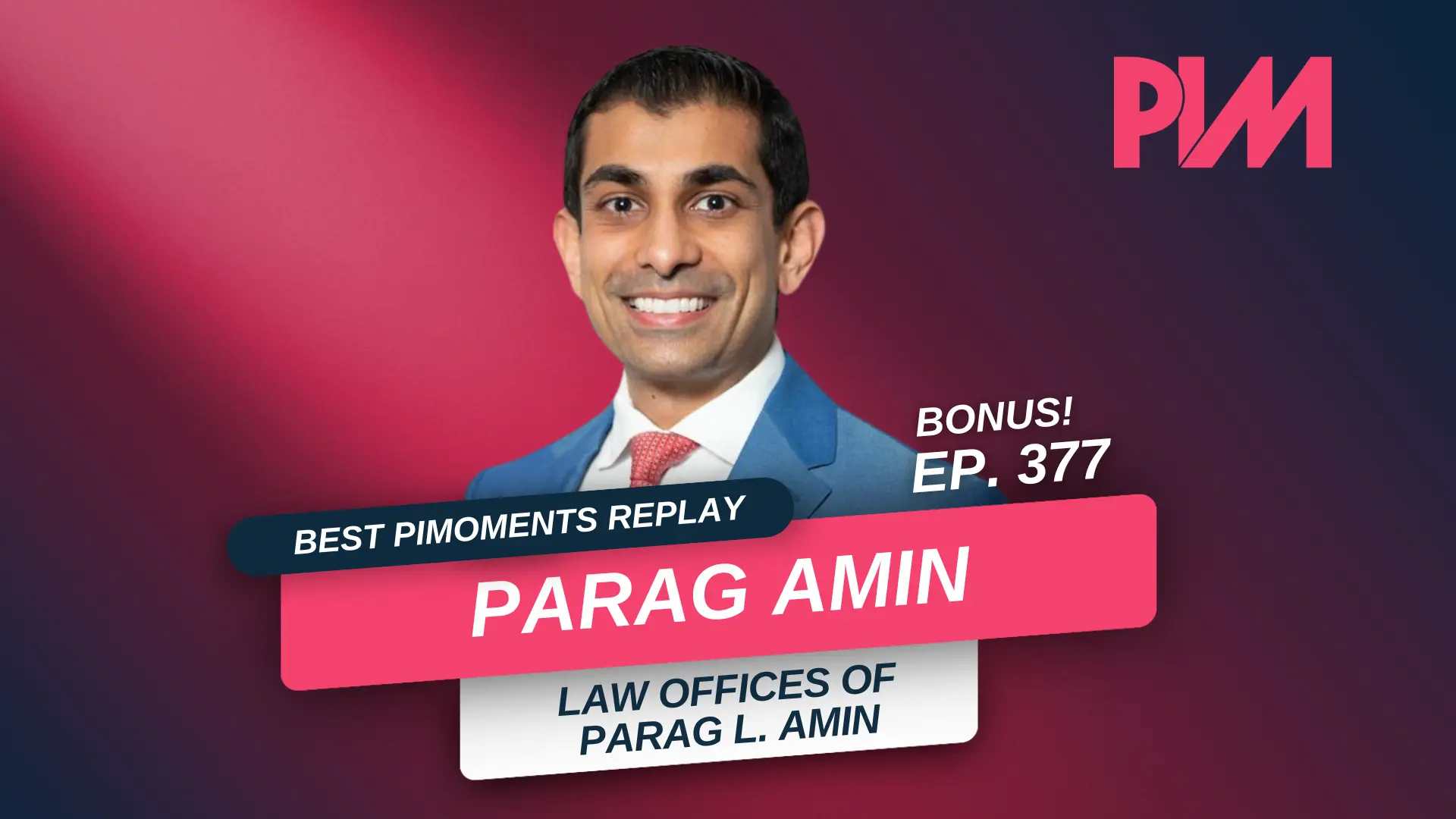
Parag Amin:
A great recent win is for a client of ours, we were able to ... It was a multi-hundred million dollar dispute, a little over 200 million in dispute.
Chris Dreyer:
Maybe you thought about adding personal entry to your firm. Parag Amin did, and today his firm secured top 100 settlements and verdicts in California. This episode is your starter pack to making the same move.
Parag Amin:
A big name in the personal injury space is Nick Brow, and he says something like, "Hey, I've got this issue on my mac. Does anybody know how to fix it?" I was like, "I'll fix it for you. But if I fix it for you, can you help me with my opening and closing statements?" It was my first trial. He just stares me dead in the eyes for five, 10 seconds, and then he just laughs and he's like, "All right, deal."
Chris Dreyer:
When you expand into personal injury, you can't do it halfway. Parag went all in, and that's why his firm delivers nationally recognized results.
Parag Amin:
So I actually had no idea how to use a mac. And true to his word, he's like, "All right kid, record your opening and you're closing," and he walked me through it.
Chris Dreyer:
This is Personal Injury Mastermind. Each week you'll hear how to capture territory, defend market share, and scale with discipline from the best in the game. I'm Chris Dreyer, CEO of Rankings.io, the marketing agency that will take your firm to the top. Today, Parag delivers the Quick Start Guide to adding personal injury to your firm. Let's go.
Parag Amin:
We primarily help business owners and business disputes. We do have a bit of a personal injury practice. It was one of those situations where I had a client, business owner client, she'd gotten into an accident and she asked me for help and I said, "Look, I don't do personal injury law."
Chris Dreyer:
If you're looking to add PI to your firm, start with trust. That's how Parag made the jump. A client already believed in him. Trust is the cornerstone of every great personal injury brand. You market it by showing proof. Proof in results, proof in how you treat people, proof over promises.
Parag Amin:
And so I helped her out with it. It worked out for both of us. Frankly, I looked at the numbers and I was like, "Okay, well, this is good leverage on my time." And it felt good to be able to help her in that situation, and so I've added a bit of a PI practice to my firm, litigated and tried PI cases. I've got multiple top 100 personal injury settlements and even the top 100 personal injury verdict with a case that I tried with a friend, and for here in California.
Chris Dreyer:
Let's start with getting the clients, right? There's so much competition. Let's focus on the business practice. How are you thinking about getting clients?
Parag Amin:
To paraphrase Simon Sinek, I think people don't care as much about how you do things or what you do until you tell them why you do it and they know and understand your why. You have to be not only a great marketer, but you also have to be a very great attorney and deliver on the things you're marketing on.
Chris Dreyer:
Business is typically like B2B, right? Talk to me about the B2B marketing versus direct B2C.
Parag Amin:
At the end of the day, you've got a client who needs help. And so first and foremost, whether it's an individual who's injured after an accident or a business owner who's facing their first lawsuit or a second or a third, this is stressful stuff. They want somebody who they can count on and who they really believe in. You're talking to people at the end of the day. Decision makers, whether it's an individual or a corporation, it's going to be people.
There's also similarities with the social proof, meaning if your name's been mentioned a couple times or a few times as the person in the space who really knows what they're doing, that helps tremendously. And the marketing just adds to it. It just echoes your name in different places as well. Or somebody might hear your name on an ad somewhere or see it on the internet somewhere and then they might see a video you've posted and maybe get a recommendation from a friend or something. And I think that each one of those little touches ends up helping build trust in that person's mind that I should at least talk to this person and consider this person to help me in my situation.
Chris Dreyer:
There was this study the consumer has to see, or the prospect has to see you at least seven times before they make a decision. And that study was recreated I think last year, and it was up to 13 times just because of how fragmented attention is. And maybe they start at Google, then they go to Facebook and then they go here or there. So I think what you're saying is absolutely true for the state of the environment, the omnichannel kind of approach.
Parag Amin:
Yeah, 100%. Look, it's like rain in the ocean. It's going to take a lot, a lot of rain to increase the sea level. So ultimately, I think it's just an aspect of being out there and having your name in as many places as possible, because there is so much chatter and so much noise around everything these days.
Chris Dreyer:
Marketing brings the cases in the door. Talent wins it in the courtroom. And when you win, the cycle feeds itself. More trust, more cases, and more growth. If you want to scale in personal injury, you can't do it with average players. You need trial lawyers who can close big cases and protect the ground you fought for.
Parag Amin:
When it comes to top talent, everybody wants the best and the best want to get paid, and they deserve to get paid because they deliver the results that are the best. And so in terms of attracting talent, it really kind of, I think, depends on what your unique skillset is. So the size of the firm compared to the other firms and what is your unique selling proposition? Why should they want to go with you? Because again, at the end of the day, the person making the decision is a human being, it's a person, and you've got to kind of understand what really matters to them.
Look, some people, it's all about the money, right? So you've got a mercenary and you pay them the most and they might be up for it. But the nature of that transaction is that that is a mercenary and you have to accept that. That there may not be loyalty and it goes to the highest bidder and that's that.
And so sometimes there's room for mercenaries depending on what it is you're trying to do. And other times you're looking for somebody who's more loyal who's going to be a company person and you want to invest in them for the long term because you see some sort of integration of them into your longterm future.
Well, what are your thoughts on Chris?
Chris Dreyer:
It's interesting, because I've really evolved my thoughts here. Because I think we're around 170, maybe even 180 people now. And also at this point, professional services are driven by talent. So even to the degree where I don't care, as long as it's not my clients or firm, we will try to get the best. I'm more on the if my competitor's drowning, putting my foot on top of their head type of guy, if they have great talent, and that's just the way it is. I think most people aren't as transparent about that, but at the end of the day, we got to provide the best service and it's the business owner's responsibility to keep the talent. So that's kind of my approach lately. It's a little bit more ruthless. I would say maybe in the first five to six years of business, I was more everybody's my friend and buddy, but at the end of the day, we need to provide value to the clients. And if there's someone that's better at that, then I think it's our responsibility to try to obtain that individual.
The best players are on the field. You got to convince them and have some reason for them to come join you.
Parag Amin:
Yeah, that's right. And so do you utilize like LinkedIn direct messages or anything like that, or is it a different kind of approach?
Chris Dreyer:
Oh yeah. So we have in house recruiters. We use ... There's an AI agent called Mainus. You give it the criteria that you want and it will actually create a database of prospects for you to reach out to with their contact information, works off of Anthropic. It'll actually be clickable and sourceable, and it's all just a very simple prompt. It's not complicated. So we use that.
And then I'm kind of old school on my Chrome extension I've got a recruit folder and anytime I see somebody that's impressive, I'll save their LinkedIn profile and I'll put it in there and I just touch base with them for years. I'm talking years, just occasionally touch base with them. And then a couple of those will come off the list and they'll come join us. It's just the right timing, the right scenario. So that's, I think too, and I'd be curious to hear your thoughts on this, but I think my role, your role, it evolves over time.
And in the beginning, you're washing the dishes, you're doing everything, right? And now it's like, I need to find the best talent to do these things. So I find myself doing that a lot more than I used to.
Parag Amin:
Yeah, 100%. It's interesting because I was reflecting on that of the maturity model of an entrepreneur. And part of it is in the beginning, it's one to one, right? Whether it's you got to stuff the envelopes yourself and mail them and then print out a stamp or go to the post office. All these little things when you first start off a business, especially if you started off like I did, I was just one person. Because I didn't have any seating or family background or anything to find something different. But anyways, and then you move on, you become a leader, a coach, you've got to find the multipliers, you got to find the leverage, those leverage points. Otherwise, you just stay a tactician and only a tactician and it's just you're self-employed and it's not really a business, which is fine if that's what you really want to do. But I think it's important to not fool ourselves into using words to define ourselves that we're really not. I'm an avid believer in that.
Chris Dreyer:
I think that's fair. I love Naval Ravikant's, kind of his thoughts on the leveraging.
Parag Amin:
Yeah, that's right. It is interesting. Naval is very interesting because he does have that very human element to him, but I think it's also, it depends on which chapter of him you're on. So meaning you see Bill Gates today, which is very different from Bill Gates when he was building Microsoft, because it's interesting how people's feedback changes in what they value. And I always wonder if that person, like for example, Bill Gates would be advocating what he is now, or even Naval, if they hadn't accomplished what they had accomplished being the person they were in their 20s and 30s.
Chris Dreyer:
The best firms show their strategies because a rising tide lifts all ships. If you're serious about expanding into personal injury or you've already added it and you're ready to capture more market share, talk to us at Rankings.io. We'll help you plant your flag at the top. You don't have to chart this territory alone. Look to the greats for inspiration and guidance.
Parag Amin:
Just in the legal space, there's so many great thinkers and leaders.
What was interesting was like a big name in the personal injury space is Nick Rowley. So I remember as a younger lawyer, I had like my first trial coming up and somebody at his firm invited me to ... They would do these focus groups. And so they had like their own little office that they had bought and it's got a one-way mirror, and so they do jury focus groups for an upcoming trial, which was incredible to see how they think through things. And he's just a nice guy. So he'd ask everybody questions and that kind of stuff. He had no idea who I was. And what was interesting was at a certain point he was working on his mac and he says something like, "Hey, I've got this issue on my mac. Does anybody know how to fix it?"
And so I was like, "Nick, I'll fix it for you, but if I fix it for you, can you help me with my opening and closing statements?" It was my first trial. He looks at me, he just stares me dead in the eyes for like five, 10 seconds, and then he just laughs and he's like, "All right, deal." So I actually had no idea how to use a mac. And so I didn't even know how to fix what he was talking about. And true to his word, he's like, "All right, kid, record your opening and your closing, send it to me." So I sent him the videos and he hopped on a call with me and he walked me through it. He's like, "Here's what you're doing well. I think this is good and here's where I think you can improve on." So I think there's a lot of people in this space who are willing to give back and just help out.
Chris Dreyer:
For our audience listening has questions, employment questions in California, business questions, has a PI case, how can they reach out to you and get in touch?
Parag Amin:
Yeah. So my email's parag@lawpla.com, so P-A-R-A-G @lawpla.com, or check me out on Instagram or Facebook, Parag Amin ESQ, so P-A-R-A-G-E-S-Q, and my website is www.lawpla.com.
Chris Dreyer:
If you take one thing away, it's this. Trust opens doors, talent keeps it open, and the firms that master both are the ones that rise to the top. If you ready to add PI to your practice or scale the personal injury work you've already started, don't just wait for growth to happen, make the move. If you want me in your corner, head to Rankings.io. We'll help you capture territory and defend it. Until next time, keep pushing forward.