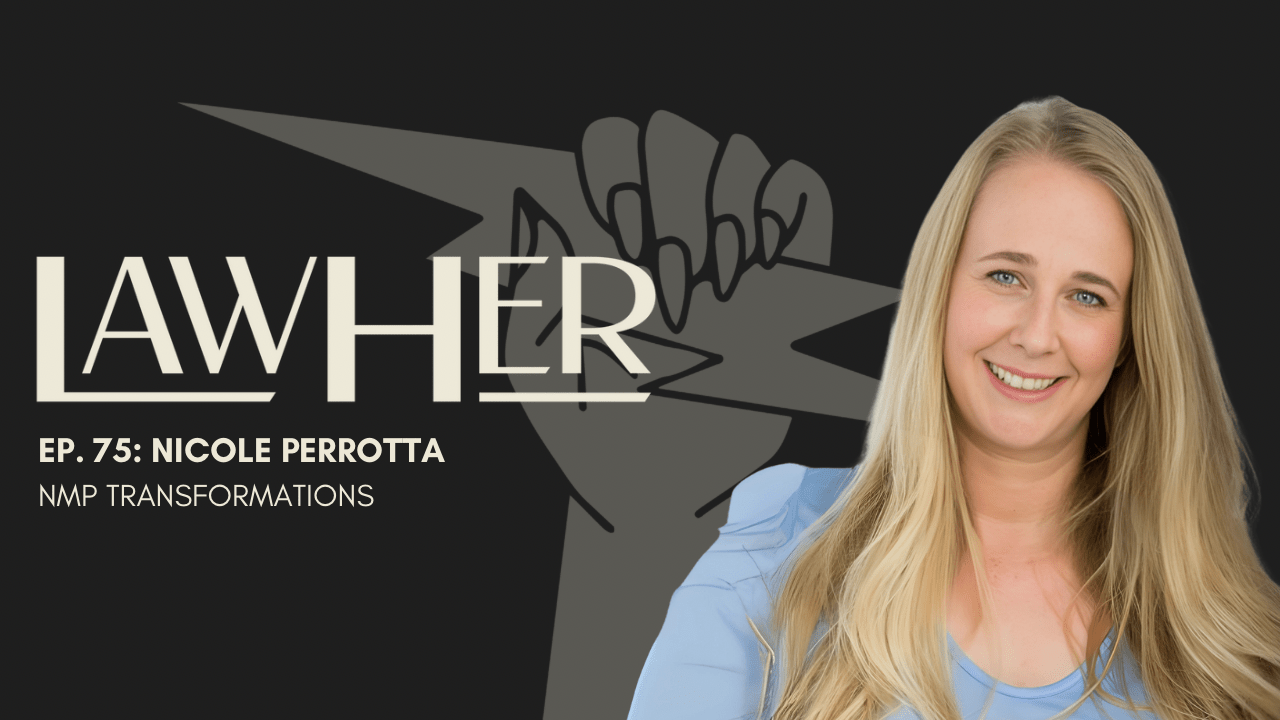
Nicole Perrotta:
What do you want to do with your wild and precious life? As we mature and evolve as women, our stories need to change to the season that we're in.
Sonya Palmer:
Nicole Perrotta is a business strategist, leadership coach, and a woman who rebuilt her entire life around what really matters.
I am Sonya Palmer. Welcome to LawHer, powered by Rankings.io, where, as the SPP of operations, we help ambitious law firm owners secure their rightful place at the top.
Today's story is about knowing when your story needs to change and having the courage to live into a new one
The hidden career costs for women who stay in unfulfilling roles—and how to rewrite your professional story
Nicole Perrotta:
At some point, I just believe that if I showed up to work, if I worked extra hard, if I put in 60 hours, that I would get noticed, I would get that promotion. It didn't ever occur to me that I was getting paid significantly less than the man that was sitting next to me doing half of the work. And because I hit my goal of six figures by the time I was 30, I was like, "Oh, I did it. So now, I have to do this the rest of my life." And that story no longer served me by the time that I got there.
Sonya Palmer:
For decades, women were told work twice as hard and you'll be rewarded, but research tells another story. A 2022 McKinsey study found that women leaders are leaving corporate America at the highest rate in years. And nearly one in three women leaders say they've considered downshifting or leaving entirely, not because they can't handle the job, but because the culture isn't built for them. The higher you rise, the lonelier and more inequitable it often gets.
Nicole Perrotta:
And so, I think women get stuck when they don't take a moment and create the awareness of like, this doesn't feel good, let me take a pause back and examine the stories and the mindsets that I have around this because that's where things will change. When you get your story right, your actions will align with it, and transformation happens.
Sonya Palmer:
Nicole's story isn't rare, a lot of women reach what they thought was success and realized they're still not aligned.
What makes her story different is what she did next. She didn't double down on the hustle, instead, she paused long enough to ask, "What if the problem isn't me? What if it's the story I've been told?" That pause led to a new kind of strength, one that comes from trust, trust in herself even when confidence wasn't there yet.
Using core values to build career confidence as a woman attorney, even in high-pressure legal environments
Nicole Perrotta:
A lot of us think that confidence is this feeling, right? We all know when we feel confident, you're like, "Ooh, I feel so good," right? But what about those moments when you're facing something that you're like, "Oh, my goodness, I don't know what I'm going to do"? Like, "Whoo." It happens a lot with imposter syndrome. That is a feeling of not confident.
But there's a second definition of confidence, which is with trust. And so, if we can just dig back into, "I know I've faced things in my life before that were super challenging and I got through it," you can remember in that moment that I don't have to feel confident, to just trust that, "I am enough to handle this moment. I'm perfectly made for each and every moment of my life, and I'm enough to handle this."
Sonya Palmer:
Nicole had done everything right on paper, the title, the income, the performance, but when your success no longer feels like your story, you have two choices, keep performing or start over. But how did Nicole get here in the first place?
Nicole Perrotta:
I actually graduated from the University of Texas, hook 'em, Longhorns, at McCombs Business School with an accounting degree. I actually went out into field marketing. I worked for a food distributor. And then, I actually got to be one of the very first 30 people hired in the U.S. for Red Bull. And then, I just made a hard shift into telecommunications, and I spent a long time, probably 10, 15 years in telecommunications, until I got married and had my first child.
And when I had my first child, I, all of a sudden, realized I had been hustling just chasing that dream, like I had to have the six figures before 30, and I had to climb the ladder, and I had to do this, and this, and this.
And I was doing this in a very male-dominated world. So I just kept feeling this isn't right, this doesn't feel good, but I didn't know what else to do. I was just chasing the ladder and doing everything that everyone had told me.
And I think it was when I had my first child, which is a daughter, I started to really realize, this does not feel aligned, this does not feel good. And so, I very quickly had a son after that, they're a year apart. And yeah, tried to do it all, right, as a lot of women do.
And it was at that point that I just had hit burnout, I had hit dissatisfaction. And I decided to step back from the corporate life and be a mom while also trying to start a business. I went through two or three failed businesses because I did not know what I was doing.
But along the way, I ran into a business coach and I asked him, "Can I apprentice under you?" I did for two and a half years. And that's where I really cut my teeth and figuring out what this coaching is about, and specifically, small business coaching.
And then, I was like, "This doesn't feel right either. The coaching, helping people feels good, but I feel like there's something more I can contribute to it." And they always say, "Go back and teach and coach who you were five, 10 years ago." And so, that's what really got me into coaching.
I started coaching around conflict transformation because again, I was in a very male dominated, very conflict rich environment. And so, I started coaching on that. And then, I started coaching, specifically, women, and that lit a fire under me. It felt so aligned. I got up excited every day to go and build a business.
Being an entrepreneur is hard, right? It takes a different set of skills than it does to be in the corporate world in a traditional nine-to-five, and yet, I was still so excited every day.
So that's my origin story. It really started with coaching who I was before and really empowering women to realize that they don't have to be locked in to this job that is nine-to-five and be miserable, embroiled in conflict, but they can truly thrive in that nine-to-five and thrive in their life outside of it as well. So I really try to help them find that balance.
Sonya Palmer:
The moment you start designing your life around what matters, that's when power begins to shift. Nicole's transformation didn't start with a new job title, it started with a new definition of success.
Nicole Perrotta:
So I was living in this world of I love my job because I had a great team that I was working with, which was wonderful. However, the leadership I was working for, I was finding myself avoiding them, dreading them.
Like when I would go on trips, I would call the CEO's assistant and say, "Can you make sure that he is somewhere else when I'm traveling?" because then he would try to travel with me.
It was those signals of when I'm avoiding something, when I'm dreading something on Monday morning, when I'm having those, I call them the Sunday Scaries. And then, I made up this term, The Terrified Tuesdays. So it's like you have the Sunday Scaries, you wake up on Monday, you get into work, and then on Tuesday, you realize it is as awful as I thought it was. They were not treating me as the valued contributor that I was.
And so that was really what started getting me thinking about it. And then, when I started looking at, "Well, maybe I can just leave because I can't change the leadership," I didn't want to go anywhere else, I didn't want to do the same thing. And so, I had to really think about what was in my values and what was important to me.
And it was the first time in my life that I had to do that, and I didn't know what I was doing, which was why it took me three to five years to figure it out all on my own. But had to get really centered on what are my values? What do I really want for my life? And how can I set it up so I can spend time with my children?
Sonya Palmer:
Sometimes we don't even realize that we're out of alignment, until life reflects it back to us. For Nicole, motherhood was that mirror. It forced her to ask, what am I teaching my daughter if I don't even believe in the life that I'm living?
Practical ways women in law can reclaim career power with side hustles, boundaries, and a personal financial safety net
Nicole Perrotta:
Do the work to make sure that your nine-to-five job is supporting your life and you're not giving your life to it. And then, make the plan of how you're going to adjust that and realign and make it work for you or find something else that does work for you.
I really believe in a side hustle. I believe in having multiple streams of income, it is so important. And I've coached so many women, and when they even just make that first $1,000 a month, their whole perspective changes.
How they show up at work changes because they're no longer saying yes to things that people think they should do or that they think that they do because everybody else is, and they start really pursuing projects and opportunities that align with them.
Because all of a sudden, they've gotten their career power back and they're like, "Wait, you can't treat me like that." It just gives them this power and this shift to believe and have that confidence that they can set boundaries at work, which are so important.
I had an office with a window. I had an unlimited expense account. I was clearing way more than six figures.
Sonya Palmer:
Nicole could have stayed, many do, but the cost would've been everything that matters most.
Nicole Perrotta:
It would've cost me my sanity. It would've cost me my relationship with my children, it would've impacted it negatively. I mean, it might've even impacted our marriage because when you are so miserable and you're trying so hard to put on this front that, "Yeah, I'm happy," on paper, it looks so good, but I was so miserable and I was dying inside, and I was reaching burnout.
And it was kind of fortuitous because when my daughter was six years old, we found out that she had an autoimmune disease, which would cause us to do a lot of more doctor's visits and stuff like that.
And I remember, at that moment, I was like, "I had no idea that six years ago I was making the right decision." But I was just so confirmed right there because I had already set up my life so that I got to dictate my schedule.
And that doesn't work for everybody, but for me and my values and what was really important, which is family first, I had already set it up, so my life was already ready to absorb that and to be able to be the best mom that I could be.
Sonya Palmer:
When you know what matters, decisions get simpler. When your values lead, confidence follows. That's what it means to walk fully into your wild and precious life.
Nicole Perrotta:
It meant everything. When you can just wake up with a peace, knowing that you're walking into your day with joy and fulfillment and purpose, then no matter what challenge comes my way, I can really dig deep into the trust of the confidence that I have, that I can figure it out.
I know I've faced things in my life before that were super challenging and I got through it. You can remember in that moment that I don't have to feel confident to just trust that I am enough to handle this moment.
Fear has played a huge role in my life, and at one point, it propelled me, like when I was younger, like, "Oh, my gosh, I'm so scared that I'm not going to be able to eat, I'm not going to have a roof over my head." When I was in college paying for it by myself, I was like, "Oh, my God, please, I just need someone to give me a big tip tonight so I can eat." Right? So there was fear in that aspect and that fueled me.
But once I kind of had my life figured out, then fear held me back. "I don't want to lose it." Right? "What if they find out that I don't know what I'm doing and I'm just figuring it out along the way?"
What I've come to now is recognizing that fear is just a signal. Fear is an emotional signal telling me, "Hey, pay attention right now. What's really important to you?" Because fear was, I think, originally there so that you wouldn't touch the hot stove or so that when the lion was coming at you, you would be smart enough to freeze, flee, or fight.
And now, it should be more of a signal of like, "Hey, pay attention. Something's important. Do I need to shift? Get back into alignment of what are my values? And if these are my..." I always recommend people choose their top three values just so in those moments of indecision and in those moments of fear, they can be like, "Okay, what would this woman do?" And so now, I look at fear as just an opportunity to step up and make a good decision that are aligned with my values and dig into that courage.
Sonya Palmer:
Growth is rarely graceful, it's awkward, uncomfortable and slow, but in that discomfort, Nicole didn't shut down, she tuned in because emotions aren't just obstacles, they're information.
Nicole Perrotta:
What surprised me the most was that once I embraced it, how much easier decisions were to be made and how much growth I experienced. And I kind of looked back and was like, "Dummy, why didn't you figure out that before?" And then I was like, "Wait, wait, no, no judgment, just curiosity."
And so, it kind of cued me in to start really digging more into, "Okay, what other signals and what other messages can I learn from the emotions that I'm struggling with?"
So the emotions that I started struggling with a lot, I started thinking about, "Oh, okay, maybe I can figure out the message that that's sending me and I can get the same gift and growth that I did when I figured it out with fear."
Growth is uncomfortable, and so a lot of people will resist it, but now, it's like, "Oh, I'm feeling really uncomfortable, ooh. Where am I going to grow?"
Sonya Palmer:
Doubt doesn't mean you're wrong, it just means you're human, but when your decisions are grounded in values, you don't need perfect clarity, you just need direction.
Nicole Perrotta:
I faced a lot of doubt when I was in the nine-to-five world. I faced a lot of doubt as a mom. I've faced a lot of doubt as a wife, as a friend. I think it's just part of life.
And when I get into that doubt, again, I come back to my values, I come back to what do you want to do with your wild and precious life? And since I've been doing that, I am so subtly grounded in what I'm doing right now that I might doubt like, "Oh, is this the wrong right versus left?" but at the core, I'm very solid in knowing what I'm doing and that I'm going in the right direction because of that.
Sonya Palmer:
Alignment isn't abstract, it's pickleball, it's travel, it's waking up to a calendar you designed and a mission you believe in.
Nicole Perrotta:
I've designed a business that I can still be present for my family. That's number one for me.
From the personal, just joyous side of my life, there's two things that I absolutely love that bring me me personally, self-care, and that's pickleball and traveling. And so, I've designed a business that allows me to play pickleball and to travel because I get to go to clients.
And then the third thing is I have full joy, fulfillment, and purpose when I'm working, either with organizations to create transformation across the leadership team or working one-on-one with women, to really help them connect it to what is their dream life and what can they do to create that, and looking at their career as like they aren't their career, they're the CEO of their career.
Sonya Palmer:
Nicole helps women reclaim authorship of their lives, their calendars, their careers. The WILD coaching program is less about escape and more about evolution, about helping women rewire the belief that burnout is the price of success. It's part of a larger shift happening across the workforce. More than half of women under 45 now say flexibility is more important than compensation.
Nicole Perrotta:
The WILD coaching program is a five-session program. People usually choose to either do it in five weeks or sometimes six months. But we take them through this journey of really transforming from where they're stuck right now because everyone's stuck at different points within their career and how it maps to their life. And then I take them through this process of helping them shift their mindset.
So I always go through this process of, one, you have to create awareness. Where am I stuck? Two, what mind shift? What story am I telling myself that's keeping me there? Then we find the tools and best practices that they can use in order to support that mind shift and get them to where they want to go. And then we turn the ones that are working really well for them into habits.
It's never going to shift, you're never going to get your power back, until you really shift that mindset and look at it as the career is honoring your life.
Sonya Palmer:
Nicole didn't wait for someone to hand her a better life, she rewrote the story guided by her values, grounded in purpose, because living your wild and precious life doesn't begin with a title, begins with a choice. Power, after all, isn't something you wait to be given, it's something you decide to claim.
Nicole Perrotta:
I had to learn that in order for me to serve my kids and my husband and my business and my friends and my parents, I have to start with taking care of myself first and giving yourself permission first. And you can only do that if you say yes to your own power. That's it. You got to choose.