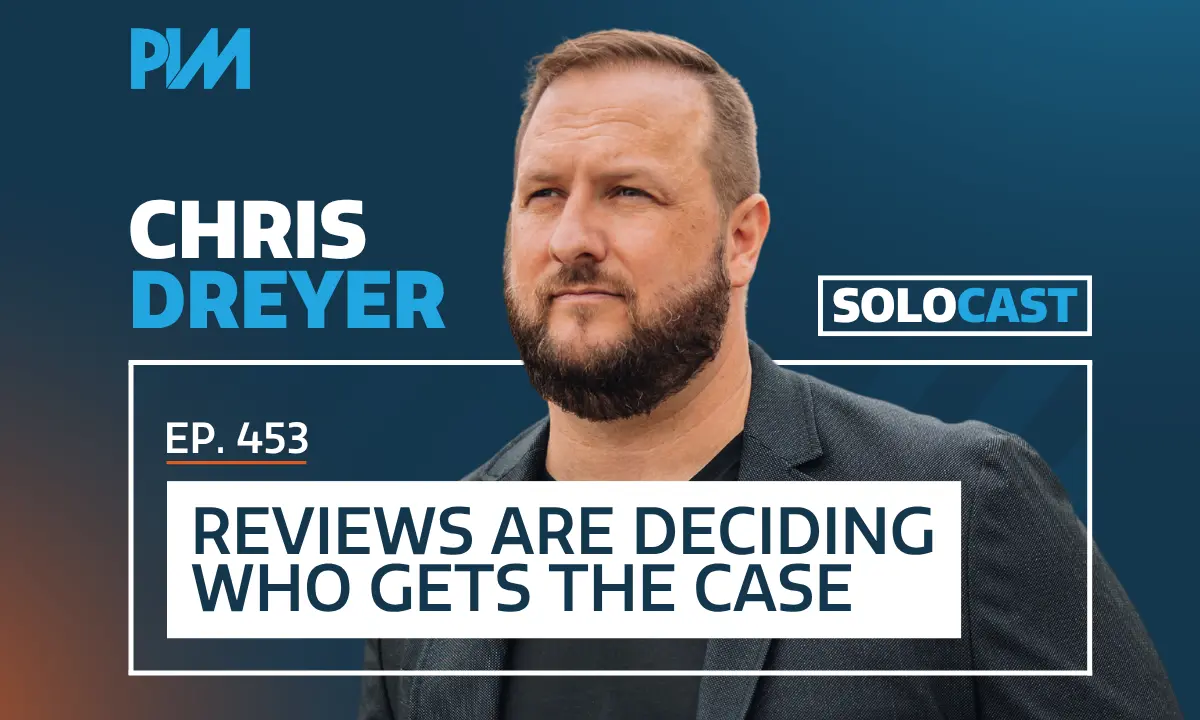
Chris Dreyer:
You're dumping hundreds of thousands into billboards, TV, and radio. You're creating high name recognition and massive demand. But when that injured victim picks up their phone, they aren't calling you. Your potential clients are typing your name into Google, seeing your 4.4 rating and calling the guy down the street with a 4.9. It turns out that you're spending a fortune to market your competitors.
Top-of-funnel awareness is worthless if you can't capture the demand. To dominate Google Maps and local services ads, you need more than just good lawyering. You need a relentless systemized review engine. This is Personal Injury Mastermind. I'm Chris Dreyer, founder and CEO of Rankings.io, the elite performance marketing agency for personal injury law firms.
Today, we're tearing down the mechanics of online reputation from how to get more reviews, the surprising importance of Yelp, and how to incentivize your staff for five star feedback without violating Google's terms. Let's get into it. So reviews. Let's just paint the picture from the consumer side, what kind of goes through their mind, what they're doing. And I'm going to use this as an example to help any personal injury attorney listening.
So I'm a consumer. I get in an auto accident. I'm probably in my car, right? I'm on my phone. So there's a couple destinations they could go. They could potentially go to ChatGPT, go to the LLMs, and do some discovery on what to do after the wreck, what attorneys to call. But let's just assume by the majority, because by the percentages, they pick up the phone. Here's the thing that a lot of PI attorneys don't realize is Apple Maps uses Yelp.
So I understand that Google's rankings and it's powered and a lot of it is used for the LLMs and discovery and relevance and all those things, and in Maps and LSA, but from the consumer perspective, they're going to pull up Apple Maps. They're going to click on the firm. They're going to look at the reviews. So if you don't have a presence on Yelp, that's a big issue. That's going to dramatically impact your conversions. Maybe it's not as important from a rankings or discovery perspective as say Google Business Profile or Google Maps, but it significantly impacts your ability to convert.
So that's number one. The other thing too is let's just say they go to Google. They use Google Maps. So those are the two they're going to use. They're going to use Apple Maps, they're going to use Google Maps. They're using one of those two. They go to Google Maps, they're going to read the reviews. And what do we all do? We sort by the lowest rank. We all do that. We go to Amazon and we look at the dirty. We want to find out what people are saying.
And there are some things that what we're hoping to look for and find is a wacky consumer, a nut job, right? Because we don't want the company to be bad. We want to see the lunatic. It's kind of entertaining, but that's what we do. However, if we see the response from the owner is not professional, it is a real situation, that's a problem that could dramatically impact your ability to convert. Even if you're a 4.9 or five, we all do it.
We're all going to sort and see what happens if there's a bad experience? Because we all know that we're talking to consumers and trying to get reviews and the business owners have friends and family leaving reviews. We're trying to find the raw and real. That's what's happening. So when it comes to reviews, I guess my key takeaway here is from a conversion standpoint, you need to be thinking about Yelp because of Apple Maps and Bing, and be thinking about Google Maps, Google business profiles, and you need to be thinking about how to respond to any negative reviews and try to keep your review rating as high as possible.
We're often asked like, "How should you respond to the negative review?" And I am more own it. "Hey, we'll do better. Clearly you didn't have the best experience. We should do better. Here's what we're going to do to make things right for you." Because I always think of when you reply to the negative review, not only does the individual that left the review get a notification and you got to think about your responses sometimes, "Will that trigger them to be even super crazy," right?
But it's for everyone else reading it. That's what matters. I think it's own it, be professional, talk about what we can do better. Don't fall on the sword. Don't try to use humor. Don't make excuses. Nobody likes excuses. People like to see accountability. So that's what I would do. I would lead with radical candor, professionalism, and that's how I would reply to negative views.
One of the biggest things that you need to take into consideration if you're a personal injury law firm is the type of firm you are and the implications of that structure and how it affects your marketing. Let me explain. If you are primarily a pre-litigation firm, which means that you have a lot of case managers, maybe you got a few pre-lit paralegals, but maybe you're pretty lean. You have a lot of case managers, maybe some pre-lit attorneys, and your case selection criteria is minor injury, soft tissue, and you're doing volume, you're going to have a ton of opportunities to get reviews because you keep a lot of clients.
However, if you're a firm that is more a litigation boutique, maybe you have your more niche, or maybe you're looking for cases that have broken bones or surgery. They're not going to Cairo, they're going to the doctor. If you have a higher case selection criteria, you just don't have as many opportunities for reviews. So that's going to significantly impact your ability to market. That's why the biggest firms, when you look at how they're set up, they do pre-lit and they do lit.
So there's a reason they do it from a marketing perspective because they have more opportunity for reuse. And let me expand. When it comes to ranking and maps and LSA, it's by relevance, distance, and prominence for maps. Prominence, under the definition of prominence, it's your review rating and quantity. So the quality of your rating and quantity. Local services ads is region, response, reviews. Reviews is under there as a category. And here's the thing, we have multiple studies that we've seen. It is not a scenario of just batching reviews.
Say the top person in your market has 500 reviews and you're at 450 and you're like, okay, well, I'm going to go get 80 reviews and then stop. Okay. That's not natural. What Google's looking for, they're looking for consistency, a consistent cadence of trust. In fact, if you went and batched all the reviews, there's a high percentage chance that many of those would filter out and wouldn't even stick. So they want to see consistency. So I guess where I'm going with this is the question was asked like, should I focus on quantity or quality?
It really depends. If you're a B2C marketing firm and you're marketing to the consumer and you want to use local services ads and maps, it's going to be really difficult if your case selection criteria is too high. But if you're a litigation firm, maybe you're a B2B, maybe you're getting your cases through referrals, and peer speaking engagements, and belly to belly marketing, so really take that into consideration. But ultimately if you're thinking about local service ads and maps, you need quantity, and quality, and consistency.
Let's talk about benchmarks. Let's talk about like, how would I review how I'm doing versus my competitors and just ... I wanted to get a gauge in this area. So the first thing is 4.8 is a minimum. That's table stakes. If you don't have at least a 4.8 rating, you're in trouble. Think about this. I use this example all the time. If you go on vacation and you type best restaurants near me, do you expect to see a 4.1? No. You expect to see the high rated restaurants.
The same. Do you think a consumer's not going to use superlatives? They're going to say, who's the best car accident lawyer? Who's the best personal injury lawyer near me? They're going to use superlatives. Absolutely. So in order to rank for the superlatives, you need to have a high rating. That means a minimum 4.8. I would go a step further. I wouldn't be happy with the 4.8. I would want at least a 4.9 or higher.
We've worked with one of the biggest firms in the country, built up their domain rating, completely audited all their content, fixed their technical SEO. Their review rating was shit. They had like a 4.4 rating and I'm not going to say the number of reviews, but let's just say in the thousands and it's like, okay, you're not going to rank in maps. It just is what it is. You're not going to have the opportunity to rank in local services ads. It is what it is.
So the next part of this, if you're trying to audit yourself versus your competitors is you need to look at their cadence. How many reviews are they acquiring per week? Don't look at the total number. Look at the cadence, like the consistency. Are they getting one review per week? You need to be two. Are they getting four per week? You need to be six. You need to be getting more reviews than them on a consistent weekly cadence.
Don't worry about the total number. That'll come later, and really Google likes the consistency, the speed, and that's what you should be doing. You know who your competitors are. Go look at them. Go track them. I have some of our top clients in their report, they actually get their competitor's reviews like what their total is every single week. It'll show plus four, plus three, and they just want to make sure that they're outpacing them.
Let's talk about processes that you can implement for your injury firm and how to acquire these consistently over time. I'm going to just brain dump a lot of stuff that comes to mind. There are points of what I would say delight that you need to try to identify at your firm and every firm's going to be a little different. One point of delight is orientation. It's my favorite time to ask for a review where you're setting expectations of what's going to happen in the case. Every case is a little different, but you can estimate, you can give them an idea of what's going to happen and how they're going to be communicated with.
It's also going to prevent a lot of future calls, right? So if you set expectations, you can help them out. You can be a resource. And if it's an amazing experience, they get maybe a folder, maybe they've got some graphs, maybe they have the contact information of the attorney. They have all this information, right? It's going to count our buyer's remorse. They're not going to go to another attorney. It's going to set expectations, and it's a perfect opportunity to ask for review because they've now had an experience with your firm. That's process number one, make the orientation and onboarding incredible.
The second time that I would consider it is after treatment when they finish treatment. Now, I'm not an attorney, but I would expect that now they're feeling better, right? Because as a case manager, you're trying to make sure they get treatment because it impacts their case and it allows you to have empathy and touch base with them and show that you care. And that's what they're looking for. So there's an opportunity there that's a point of delight. The third, of course, is the closeout when you hand that check.
I would just have a little caveat here is sometimes people come up with these unrealistic expectations. They go look at another personal injury website and see a $1.6 million settlement when they have $100,000 policy limit. And so that's important in setting expectations, having those conversations and because even though you may have given them a great experience, you have to ensure that they had a great experience, that they're appreciative. Don't just take it for granted. So I would say the orientation, finish treatment, and the closeout are three. Those are three that you can absolutely put in. You can even use automation for those. A lot of the CRMs can kick out these documents and there's a lot of tactics there.
The next thing that I would look at as just a trigger is anytime an individual says thank you it's an opportunity for review. That's a process that's training. And then let's just talk about incentives. Incentives drive behavior. They make it top of mind. If you pay $100 per review to your employee to incentivize the behavior, not to pay for the review. Let's make that clear because paying for reviews is against Google guidelines. If you incentivize the behavior and you give your case managers this little bonus, you give your intake staff, you give your attorneys this, I promise you, you'll get more reviews.
Let's take that a step further. If you only talk about it once, it's in one ear, out the other. People have to be told multiple times to understand its importance. So things like if you have Slack, anytime a review's obtained you can have a channel that posts the review. People like to feel good about the work that they're doing. They like to see the review, right? Okay, that's a reminder that they're important. So, "Hey, we want to congratulate so-and-so case manager on their bonus for receiving this review for the firm. Here's the review. Kudos to Jane, or John, or whoever." That's one way to keep it top of mind.
Another way is a monthly all company newsletter. I like internal newsletters. You can talk about policy changes. You can talk about updates for the company. You can keep the company ... When you grow and you're above 150 people, which is Dunbar's number, which is about your ability to remember everyone when you're above 150, that's when the HR teams really have an impact and that's where company newsletters and all hands really have an impact. So do a newsletter that every single month shows how many reviews you started, how many you ended up with, who got bonuses, and show what we're up against as the competitors. Make it a challenge, gamify it.
There's another thing too in incentives drive behavior. If you are trying to hit a target, like maybe you're really trying to hit 1,000 reviews and that's a big milestone, right? 1,000 reviews, that's awesome, right? Not very many people get to that. Maybe, "Hey, when we get to 1,000 reviews as a company, we're going to shut down on a Thursday. We're all going to this restaurant. We're going to celebrate, dinner's on us. That's what we're doing." So everyone's like, "Oh, we got to get this 1,000 reviews. Not only do we get our incentive, but hey, we get the day off. We get to go eat. We get dinner on the boss." Those are some things you could do.
Okay, so that's process, that's incentives. Let me go a step further. Now you got tech. A lot of tech out there, a lot of software. Even your CRMs are starting to do this. You've got even the relationship management tools like Kona has some of these, case status. Those tools have this built in. But if you want dedicated reviews oriented tools, you look at Bird Eye, look at GatherUp, look at Podium. And what they'll do is they'll send text and email review requests. And it's just a way to automate it. You can use tech to help facilitate this. It'll send the link to the individuals right to their phone. Text has the highest chance of converting.
Also when you're talking to someone and they say that they're willing to leave a review. Don't say, "Oh, look for the email that I'm going to send you." No. "Hey, Jane, I just sent you a text. There's the link. Do you mind leaving a review? I'll stay on the line with you. If you have any questions, let me know." Get it while they're on the phone. Don't try to catch the fish again, throw the fish out in the water and try to catch it again. Do it on the phone. Those are all the things you could do. Now, what's changed? In the past, you may have heard me talk on this podcast because it is a psychological trigger, it does work to have them leave a review for the individual.
That's actually against Google's guidelines now. It's so wacky. I don't know why they would do that, but you can't say, "Hey, I worked with John Smith and blah, blah, blah." You got to leave it just for the entity, just the firm now, or you have the chance of your review being buried, being filtered. So I would encourage you to always look at Google's guidelines because they're constantly changing, but those are some tactics to help you get reviews today.
All this that I just talked about may seem overwhelming for ... You don't have a ton of resources. Maybe it's just you. Maybe you're the solo practitioner. What's the first thing that you should do? The first thing that I would say is use your existing sphere of influence. Your friends, family, past clients, go to them first to get reviews. Don't think about implementing some crazy process or incentive program. Go to the people that you've already developed trust and have this past relationship. Send them a text. Really easy-peasy. You don't have to use some advanced software. That's the thing that you can do.
Now, if you're a little bit more seasoned and have the resources, I would say the first thing, and you have the capital, create an incentive program. Incentives drive behaviors. I promise you, your employees are going to like it. And for 100 bucks, is a review worth a hundred bucks? It absolutely is if it's five star.
That's it for today, guys. Remember, hope is not a marketing strategy. You can't cross your fingers and wait for happy clients to leave a five star review. You need to build a relentless system into your firm's DNA. Try capturing those reviews to incentives. Make it part of your culture and focus on getting more reviews than your competitors every week. If you're ready to dominate your market and you want an elite performance marketing agency in your corner, headed over to Rankings.io. We help personal injury law firms command the search results and sign more high value cases. Find out how we can help you dominate your market at Rankings.io. I'm Chris Dreyer and this has been Personal Injury Mastermind. Catch you next time.