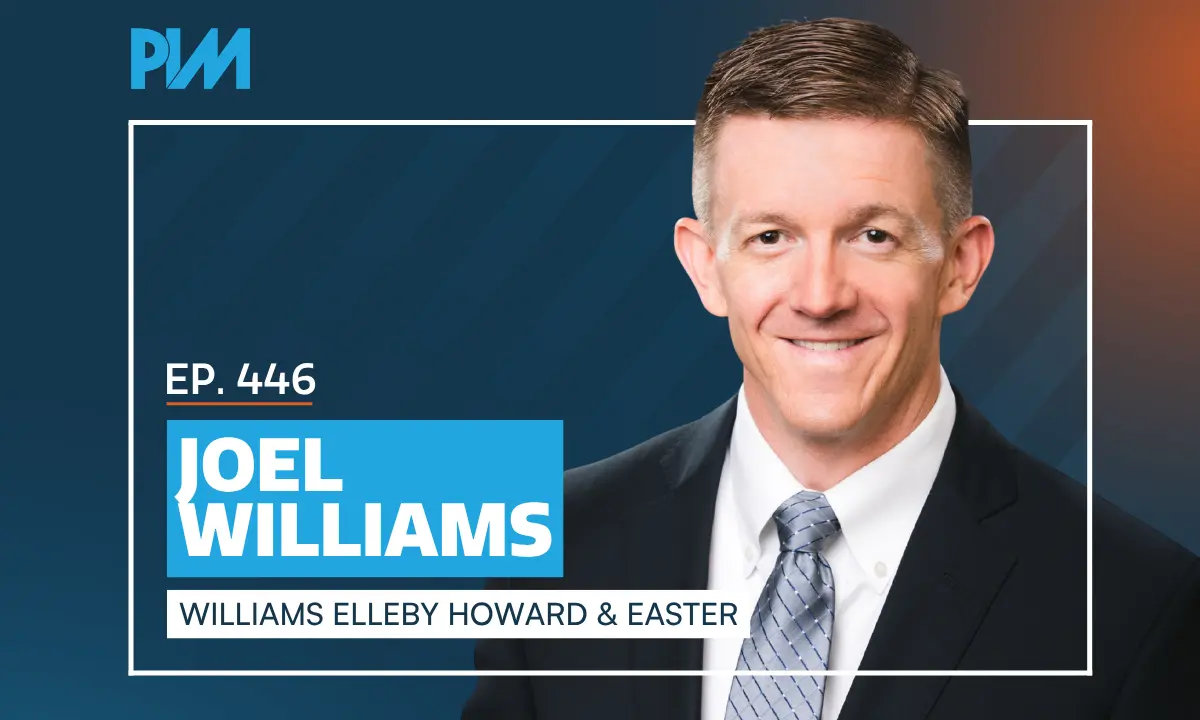
Chris Dreyer:
In a hyper-competitive market like Atlanta, planting your flag in the ritzy downtown district feels like the ultimate goal for ambitious lawyers. But sometimes the big city just brings gridlock, burnout and some unintended consequences.
Joel Williams:
Snowmageddon came and I've never had to relieve myself more in my entire life than been stuck on I-75, not with the restroom anywhere nearby.
Chris Dreyer:
For some attorneys, it might feel like they have no other choice but to just stick to the plan, grind it out, grow the business and hope the money is worth it. But there's a heavy cost to that approach.
Joel Williams:
This is not me. This is not the person I want to be. It's not the father I want to be.
Chris Dreyer:
Today's guest took back control. He moved out of Atlanta and built a firm strictly on his own terms. And oh yeah, his business exploded too.
Joel Williams:
I literally went from having about 15 cases when we were in Atlanta to multiplying times 10 within a year of moving to Kennesaw. It was the best life decision. It was the best business decision I've ever made.
Chris Dreyer:
This is Personal Injury Mastermind. I'm Chris Dreyer, founder and CEO of Rankings.io, the elite performance marketing agency for personal injury law firms. Today I'm sitting down with Joel Williams, the founding partner at Williams Elleby Howard & Easter in Georgia. Joel talks about the role of intake on protecting his five-star reputation, how much it costs to take a medical malpractice case to trial, and his thoughts on private equity in the future of personal injury. Let's get into it. I love kicking things off with a win. You've got a lot going on, so let's start there. What's a recent win that comes to mind that you're excited about?
Joel Williams:
Oh man, it's probably the biggest wins for me and the ones that make me the happiest are the ones I have to fight the hardest to get. Med mal cases that we handle. I mean, lots of them, super hard. You're going up against excellent defense attorneys. We just recently got a $7.2 million verdict in a case where a guy missed an internal bleed because he didn't order a CT scan and we were in a small town, judge was a ex law partner of the defense attorney, legal rulings didn't necessarily go our way, but the jury saw it our way and that was pretty gratifying.
Chris Dreyer:
That's incredible. Why don't you give our audience of attorneys listening, how did you get the case? How did you identify a case that they could potentially take?
Joel Williams:
Yeah, so this one was super out of the box, I guess, because one of our newest law partners that we brought on, the deceased in that case was a lawyer who he knew. So the widow reached out to Mark Howard. And so that's how we got the case and he kind of brought it over with him. So that was one of those B2B acquisitions for the cases, didn't come directly from the public.
When you're talking about the med mal world, that seems to be if you have the right referral source and somebody that's going to take the time to vet a case and make sure that it might have legs, that's good because we get tons and tons and tons and tons of calls about potential med mal cases that are nowhere close to a med mal case. And once they get past that sniff test, it takes a lot of time, it takes a lot of resources to evaluate them. So just finding a good source for those, that doesn't require too high of a referral fee because the referring attorney understands what you're going to have to put into it is super helpful, at least in the products liability, the med mal world.
Chris Dreyer:
I'm not an attorney and I speak to a lot of PI attorneys that are primarily auto accident. So I have a decent understanding of what goes into those cases, the life cycle. I mean, you just mentioned double-digit expert witnesses. With not this case particularly, but what's a typical life cycle, the time and how much money goes into a typical, I guess typical is probably the wrong word, but med mal case that you got to carry?
Joel Williams:
I'll tell you, there's one exception to the rule that I'm about to tell you, that the rule is at least in my experience, I've never been able to get a med mal case to trial without putting at least $150,000 of expenses into the case itself. It's usually more. The exception to the rule is a foreign object. If somebody leaves a scalpel or leaves a sponge in a person, that's what I call a never event. That should absolutely never happen. But with most cases, you're going to have experts on standard of care. I'll give you the perfect example.
One case, it was a missed diagnosis case where the doctors thought that the man had cancer, but he actually had an invasive fungal infection that started in his lungs and spread to his brain. The treatment for cancer is vastly different than treatment for the fungal infection. So they assumed he had cancer, they pumped him full of steroids, they gave him whole brain radiation. All of these things weakened his immune system and caused this infection to spread throughout his body. Well, we had to have pharmacology experts, we had to have infectious disease experts, we had to have emergency room experts, hospitalist experts, oncology experts. Then of course this kind of bleeds over into car wreck cases sometimes too with life care planners and economists and things of that nature. So they're very expensive and they're very risky because even the rule at our office is basically if Mark and I who primarily handle the med mal cases, if we aren't both fully on board that this is a case that we should take, then we don't take it.
Chris Dreyer:
Smart.
Joel Williams:
Yeah. Because if it's 50-50 in med mal, you're probably going to lose.
Chris Dreyer:
One of the things that just popped up is, look, you've got 128 reviews, perfect 5 star rating and I couldn't help but ask because I've worked with a lot of med mal attorneys across the years. They don't have that 5.0 because exactly what you said, you got to turn down a lot of cases. So how are you coaching up the intake to avoid those scenarios because you got to say no so much?
Joel Williams:
Yeah, that's the hardest part. I rarely worry about getting negative reviews from cases or from clients whose cases we have taken because I am extremely confident as I'm sure a lot of people who are listening to this podcast are confident in their personnel and their legal abilities and their client relations. It's how do you say no and how do you say no with empathy? Because especially now in this world that we live in, when we can go to Claude or ChatGPT or any AI source and type something in in a certain way, sometimes it's going to tell us what we want to hear, not what we should hear. So then we're not only competing with knowing that this is not a legally viable case, but we've got a potential client calling us, giving us information where AI has already told them they have a case. And the longer we do this, the more I become concerned that people actually trust AI advice more than they trust the legal advice.
So it's tough, man. And I think the biggest way that we have tried to avoid getting negative reviews by turning people down is by listening, because sometimes that's what people need. They just need their story heard. And a lot of that is just being a good human being, but you also have to balance that with time versus money, because the more time you spend with a case you know you're not going to take, the more money it costs your business. Where is that line? I don't know. At least at our firm, we tend to err on the side of, we'll just spend more time than we probably need to listening to people. And yes, it probably cost us money in the short term, but I look at it like, well, they need that. And then maybe they get in that car wreck later on and they go, "You know what, Joel?" Or whoever it is at our firm that's doing the intake, "They took the time to listen to me. I'm going to call them back."
Chris Dreyer:
Protecting your five star reputation isn't just about winning massive verdicts. It's about how you treat the people you can't help. Taking that extra five minutes to listen builds long-term goodwill, but Joel doesn't just play the long game with his intake. While most ambitious attorneys are fighting tooth and nail in Downtown Atlanta, Joel made a strategic contrarian move to the suburbs. It was a choice that paid off massive dividends for his firm and his family. You made a deliberate decision a lot of attorneys would never make you. You left Atlanta, you planted your flag and correct me if I'm wrong, Kennesaw.
Joel Williams:
Kennesaw, like saw it.
Chris Dreyer:
Kennesaw. So I'm not the local because most are going right Downtown Atlanta, right in the heart, and it's competitive. You got all the freaking runners.
Joel Williams:
It's terrible.
Chris Dreyer:
Case runners in Georgia. It's horrible. Talk to me about the move to Kennesaw.
Joel Williams:
Hey, I love it brother. That's good.
Chris Dreyer:
I'm getting better, getting closer.
Joel Williams:
We moved to Kennesaw, in 2010, which was quite a bit smaller then, and I made that commute over and over and over and over. And I started missing kids after school events because I was stuck in traffic. Snowmageddon came and I've never had to relieve myself more in my entire life than being stuck on I-75, not with the restroom anywhere nearby. And I'm like, "This is not me. This is not the person I want to be. This is not the father I want to be." I started looking in my own backyard and I'm like, "There are plenty of people in Kennesaw, Acworth, Woodstock, Dallas, these smaller suburbs around me to support a firm my size." And I literally went from having about 15 cases when we were in Buckhead, which is kind of a ritzier area of Atlanta to multiplying times 10 within a year of moving to Kennesaw.
I did bring on a partner at the time, Chase Elleby, who had some more experience working, I guess, I hate to call any case routine, but more common car wreck cases that don't necessarily have tremendous value, but they have value and they can be profitable if they're worked the right way. Brought him on to handle some of that volume and it kind of took off from there. It was the best life decision, it was the best business decision I've ever made.
Chris Dreyer:
Did you adjust your marketing or it was just because of less competition, it was just more effective? Are you first heavy-digital? Do you do the boots on the ground? Talk to me about that.
Joel Williams:
When we moved to Kennesaw, there were like two other firms that did what we did. There were about 150,000 people that live in this city and you can multiply that significantly if you take the other suburban counties or cities around here and there was just less competition and the expense of marketing was much cheaper because there was less competition for back when everybody's doing Google keywords and all that kind of stuff and it took off. And then once we started getting the reputation as sort of the go-to firm here, I said, "You know what? Let's just double down, man. Let's help our neighbors and love on our neighbors and help the people that are in our backyard." And it's worked.
But I'll say this, that works for me and I don't think it will work for everybody because if your ambition as a business owner of any kind, but especially a PI attorney, is to go national or take over multiple states or anything like that, the approach that I took may not work for that person. I have no desire to do that. I have a desire to have a good work-life balance and actually still practice law. So having a goal of being the go-to firm in my backyard, it works for me and it keeps cost where they need to be as well.
Chris Dreyer:
That's great. And you get to design the life that you want and those long commutes, you get more time with the family. It's interesting. I think everyone tries ... You go through these different trajectories. When I started, it's like, I want to come out guns blazing. And now it's like, I got my son and it's like I've got a 35-minute commute and now I just bought a building because it's only 7 minutes away. So it's like, okay, because that adds up every single day, that extra ... I'm doing 60, 70 minutes and now I'm doing just 14, so I get another almost hour a day.
Joel Williams:
My oldest daughter, Chris, will be applying for colleges this summer and I start looking back on the past 17 years and it's exactly what you're saying. I know when she's gone, that every 30 minutes or every hour that I spent sitting in traffic when I could have spent being with her and developing quality time with her matters and I'm going to miss that. And so no matter who's listening to this, if you have children, if you have a spouse, if you have a partner, whatever, like if you can build your life in a way to grab hold of those moments and grab hold of the people that matter the most to you, there is nothing more important that you could ever do. And I know it's not always possible, but whatever little steps you can take to bring that home, it matters.
And I think when you're in situations where the kids are flying the nest and they're leaving home or any of that stuff, you're going to cherish those moments more because the reality as trial lawyers is sometimes we're going to have to be in a trial that lasts three weeks, four weeks or longer. When I'm in a trial that lasts three or four weeks, somebody's paying the price and it's usually going to be my family. So when they have to pay that price, I want to make it up to them when I can. You know what I mean?
Chris Dreyer:
That's great. Yeah.
Joel Williams:
That's what life's all about, brother.
Chris Dreyer:
That's great. I want to circle back. You had this amazing outcome, the $7.2 million med mal verdict and you mentioned auto. Being in a smaller TAM addressable market, is that to kind of necessitate and having a broader range of case types? Is that one of the strategies that went into this? And also how do you train the intake to recognize it's easy, rear end collision, got coverage, injured, et cetera, what goes into the intake and kind of identifying and also just working up a case that's so different?
Joel Williams:
Yeah. So for us, the car wrecks, the falls, the dog bites, I just kind of call those to keep the lights on cases.
Chris Dreyer:
Yeah.
Joel Williams:
And some of them can be very valuable, but it's not every day that a Coca-Cola truck creams a family of four and you get the case. Usually doesn't happen. If it happens, it's once in your lifetime for most lawyers. But as far as intake goes, if it's a car wreck and there's an injury, the intake team is taught to send it straight to a certain one of two attorneys in our firm. Because if you don't have it signed up at least in our area within 10 minutes, forget about it. You're not getting that case.
Med mal cases, products cases are quite different because most people don't want to take the risk that's involved with those cases or they would rather allocate their resources somewhere else, which I totally understand. It's fine, whatever floats your boat and whatever works for you. But the number one question with any med mal or products case is what are the injuries? Because if they're not catastrophic, then the laws are written in such a way and the resources that would have to be expended to get to a resolution, at some point the math doesn't make sense because nobody in their right mind would ever spend $200,000 to make $250,000 when they've got to pay their attorney 40% of that.
Chris Dreyer:
Yeah.
Joel Williams:
You know what I mean? It makes no sense. So it has to be like a seven figure case and if it doesn't reach that seven figure case threshold or one that we think could get there, then we revert back to, "Okay, let's be empathetic. Let's listen to the story. Let's do what we can to ease their stress level." But ultimately the answer's got to be no that we can't take that case.
Chris Dreyer:
That makes sense.
When you structure your intake to filter out the noise and deliberately design a business that serves your life, you gain the clarity to see what's actually coming down the pipeline. And right now, the personal injury landscape is shifting fast. From the shady underbelly of case runners to the growing influence and influx of private equity entering the legal market, the traditional practice of law is facing unprecedented changes. You're really serious about the profession, so you're also running for the state bar board governors, which tells me you're thinking about the profession, not just the firm. Talk to me about this, what motivated you to do this and just the change. There's consolidation, there's PE, there's ABS, there's the MSOs. Talk to me about this decision.
Joel Williams:
I've been practicing 20 years. I don't know how much longer I'll do it. I hope I do it another 20 years, but who knows. And I worry sometimes now about how fast things are changing. And when I see private equity come into some states, I see lawyers who have to wrestle with loyalty and where it should lie. And when loyalty stops lying with the client and is lying towards that private equity, I think there can be some serious problems that arise. Georgia is one of the states that still has a prohibition on non-lawyers having an equity ownership in law firms, but private equity firms make lots of money because they're very smart. Now what we're seeing is they're not owning the law firm, but they're owning everything else that is required for the law firm to run. So they still have a financial stake even though they're not technically violating any laws or bar rules. And then also, as you mentioned earlier, running is a huge, huge problem, especially in the Metro Atlanta area as I know it is in other metro cities and other states as well.
Chris Dreyer:
I think it's the worst. I think it's the worst in the country.
Joel Williams:
It's terrible. It's terrible and it causes those of us who try to do things the right way to have to spend so much more just to get a case. I say that because I think that a lot of the leaders in our state bar don't come from a background of private practice so they don't understand how these things work and how to track and enforce the rules because they don't know what's really going on. The bar's been very nonresponsive. And so really what I'm trying to do and my opponent, I love her to death. She's a superior court judge in Cobb County. We're good friends. We just have different perspectives on what's very important and she hasn't had the experience I've had of seeing kind of that ugly underbelly of PI law that can cause problems.
But anyway, that's my biggest goal is education with the bar and to try to help them. They're very good. If somebody steals from a trust account or providing resources for some of our peers that may have substance abuse issues or whatever and trying to help them get through those things, which is great. But when it comes to sneakiness and things that go on in the background and when 911 callers are tipping off runners, they don't understand that and they need to be educated on it so that they can come up with a plan to enforce those rules and try to stem it. I don't know if we can ever stop it, but try to stop it.
Chris Dreyer:
Then touch on just the MSO. We had the big announcement from Dudley DeBosier, I think was one of the first ones. I think there's also postman law, a number of firms. I loved your thoughts on the run of the cases. Just give me your thoughts on the MSO and what you're seeing. And they're basically juking the stats in order to get the money in, but just thoughts on it.
Joel Williams:
So basically what you're seeing and what, at least what I've seen so far is we'll take my firm for example. So if I got in bed with a private equity group and I said, "Hey, listen, I'm going to need $5 million this year to fund marketing efforts, whether it's billboards or SEO or rankings or whatever. Also, I'm going to need some extra staff to take on these cases that I'm working," that kind of stuff. Then it's almost like they create this separate entity to fund all that and then when the firm resolves cases, then they pay it back on like a loan type basis, but they're not owning stock in the law firm.
And so I think technically from a private equity position, it's pretty smart because you're not breaking the rules. What worries me is what happens down at the bottom of the waterfall to the client that we're really supposed to be helping. Private equity may be great for the firm and increase the bottom line, but is it actually helping the client or is the lawyer more worried about, am I going to be able to pay back this money that PIs or PE is putting into my firm?
Chris Dreyer:
Yeah, I guess that's to be seen and there's consolidation in my space too. I mean, we had Herringbone Digitals bought Hennessy Digital and BlueShark and Everservices bought iLawyer and another company and it's wild. It's on our side too.
Joel Williams:
And I do think it's different. If you or I went into business together and we were developing some kind of IT product that we thought was going to be revolutionary, then if we need the resources to really mass scale this product, then private equity can be pretty beneficial to helping us do that. And it may be in our best interest to get it to a certain point and sell and that's great and you and I could go out if that's what you want to do, but when you're in a service industry, we see it in medicine all the time. I'm not sure about in your area of the world, but at least in our world, there are no doctor, I'm calling Dr. Chris, "Hey man, I got a sore throat, my nose is running." They're bought up by the hospital systems and it's all just automated, automated, automated.
And I feel like you're almost like you're at a dairy farm and you're ... You ever been to a place like Indiana where they bring the cows in, they put them on this thing that spins around and then they milk them and then they go back into the pasture? I feel like that as a patient when I go to a doctor's office now and I don't know if we can stop it, but I really pray and hope that the legal world does not end up in that situation.
Chris Dreyer:
The only counter that I have at least on my side, and look, I'm not an attorney, is the insurance companies, they're not fragmented. At least when it's them versus the PI attorneys, they're aligned. And you got the Uber initiative in California and it's like all this tort reform and it's like, if there wasn't so much fragmentation, I don't know, would that help counter the insurance companies? And then thereby would that actually improve the consumer, but who knows?
Joel Williams:
My law partner, Jared, and I were just discussing yesterday, because right now one thing, and I'm sure a lot of PI attorneys that are listening to this will relate, we're constantly getting sold on, "Hey, buy this AI platform and it'll do all your intakes." And I'm like, "You're out of your mind if you think I'm letting AI do an intake for my firm." But I could envision a world at some point and I hope I'm six feet under the ground at this point, Chris, but I can envision a world where on the plaintiff's firm's side, you've got this AI agent and on the insurance company side, you've got this AI agent and they're negotiating settlements. And I'm like, "Oh my goodness," I don't know, man. I'm going to be a fishing boat captain by the time that happens. I'm moving to Florida, we're going for some mahi and that's going to be the end of me.
Chris Dreyer:
Oh, that's good. That's good. Joel, I've really enjoyed this conversation for our audience listening that wants to connect with you, has questions about the pod, what's the best way to get in touch?
Joel Williams:
Oh yeah, I mean if you want to talk, I'm always willing to talk. My phone number's 404-389-1035. If you want some educational videos, our YouTube channel is quite extensive and we put a lot of effort into that. So just type in Williams Elleby Howard Easter. You can find us on YouTube and then if you want to see the silly side of us, check us out on TikTok or Instagram because my 17-year-old daughter has some ... What she thinks is really funny stuff. I don't understand it, but I do it and it tends to work. So yeah.
Chris Dreyer:
Love it. Joel, thanks for coming on the show.
Joel Williams:
Thanks brother. Have a good one.
Chris Dreyer:
Joel's journey shows us that excellence isn't about grinding yourself to the dust in the most saturated markets. Sometimes the smartest movie you can make is walking away, whether it's turning down a 50-50 med mal case, fighting back against bad actors in the profession or packing up your office and planting your flag in your own backyard, it's all about intentional choices. If you're ready to make intentional choices about your firm's growth and stop guessing about your marketing, head it over to Rankings.io and sign up for a complimentary growth audit. We'll show you exactly where the leverage points are to sign the most high value cases. I'm Chris Dreyer, thanks for listening and we'll catch you next time on Personal Injury Mastermind.