Quick answer: Personal injury lawyers get clients through five main channels:
- Organic search: SEO, Google Maps and, increasingly, AI answers from ChatGPT and Google AI Overviews
- Paid advertising: Google Ads, Local Services Ads, social, and TV
- Referrals: Other attorneys, medical providers, and past clients
- Video and social: YouTube, TikTok, Instagram, and Facebook
- Directories and community: Avvo, Justia, Super Lawyers, sponsorships, and events
The firms growing fastest in 2027 combine these channels in one strategy, so they appear on every platform where injured people search, and they convert inquiries quickly at intake.
Personal injury clients used to find lawyers in two places: a Google search or a billboard. In 2027 they also ask ChatGPT, watch a TikTok about their crash, read a Reddit thread, and check Avvo before they ever call a firm. The firms signing the most cases do not spend the most. They show up wherever injured people look for answers.
This guide covers how personal injury lawyers get clients today. We start with the main channels, then spend most of the guide on the strategies behind them: AI search, video, "search everywhere" optimization, and organic growth that compounds. If you are figuring out how to get personal injury clients, how to get more personal injury cases, or how to get personal injury attorney leads without overpaying, start here.
Key Takeaways
- Clients now search across many platforms, not only Google. Your firm needs to appear in Google, Maps, YouTube, social video, AI chatbots, and legal directories.
- AI answers have reshaped search. Google users clicked a traditional result on just 8% of visits when an AI summary appeared, versus 15% without one. Citations in the answers are the new rankings.
- Video builds trust before the first call. YouTube reaches 84% of U.S. adults, and short, helpful videos answer the questions injured people are already asking.
- Organic growth compounds. Paid traffic stops when spending stops. SEO, content, and reviews lower your cost per case every month they keep working.
- Intake is a client acquisition strategy. The fastest way to get more personal injury cases is to stop losing the leads you already pay for.
- Measure signed cases, not leads. Track which source produced each signed retainer, including AI referrals.
The Main Ways Personal Injury Lawyers Get Clients
Before the strategies, here is how the core channels compare. Most successful firms use three or four of them at once.
| Channel | Client intent | Speed to first case | Cost profile | Long-term value |
| SEO and Google Maps | High: actively looking for a lawyer | 6–18 months | Fixed monthly investment, cost per case falls over time | Very high: compounds |
| AI search (ChatGPT, AI Overviews) | High: researching their situation | 3–9 months | Built on SEO and content you already have | High and growing |
| Google Ads and LSAs | Very high | Days | Pay per click or lead, rising costs | Stops when spend stops |
| Attorney and medical referrals | Very high: pre-qualified | Varies | Referral fees (where allowed) and time spent on relationships | High, but hard to scale |
| Video and social | Low to medium: builds awareness and trust | 3–6 months | Production time, low media cost | High: brand recall and retargeting |
| Directories and community | Medium | Months | Low to moderate | Supports trust and AI citations |
For what each channel costs per signed case, see our personal injury cost per case benchmarks and personal injury lead costs breakdowns.
Why the Old Client Acquisition Playbook Stopped Working for Law Firms?
For a decade, the formula was simple: Rank in the top three on Google, run Google Ads, and buy a billboard.
Three things changed:
- AI answers the question before the click. Gartner predicted traditional search engine volume would drop 25% by 2026 as people move to AI chatbots. Pew found that users who see an AI summary click a traditional result on only 8% of visits, compared with 15% without one.
- Clients research on more platforms. 44% of U.S. adults have used ChatGPT, and many injured people watch videos or read forums before they contact a firm.
- Paid search costs keep rising. More PI firms and lead generators compete for the same clicks, so firms that rely only on ads see their cost per case climb every year.
The firms that adapted did not drop Google. They added the other places where clients now search.
Strategy 1: Modern Search Everywhere Strategy
"Modern Search Strategy" means making your firm the answer on every platform where an injured person looks for help, not only on Google's results page. Each platform needs a different type of content:
| Platform | What injured people search for | What your firm should publish |
| Google Search | "car accident lawyer near me," "how much is my case worth" | Practice-area and location pages, settlement guides, FAQ content |
| Google Maps / Business Profile | "injury lawyer open now," "truck accident attorney [city]" | A complete profile, weekly posts, photos, steady stream of reviews |
| ChatGPT, Gemini, AI Overviews | "Do I need a lawyer after a minor crash?" | Clear, direct answers, consistent firm facts, mentions on trusted sites |
| YouTube | "what to do after a car accident," "how long does a PI case take" | Searchable explainer videos with chapters and transcripts |
| TikTok / Instagram / Facebook | Crash videos, insurance horror stories, "should I take the first offer?" | Short-form commentary, myth-busting, local safety content |
| Reddit and forums | "Insurance lowballed me, what now?" | Helpful, non-promotional expert answers (follow each community's rules) |
| Avvo, Justia, Super Lawyers | Attorney profiles and Q&A | Complete profiles and weekly answers to legal questions |
Start with the keywords that signal intent. Our guide to personal injury keywords shows which searches turn into cases. Then adapt one core idea for every platform. A single settlement-timeline topic can become a blog post, a YouTube explainer, three short videos, an Avvo answer, and a Google Business Profile post.
Strategy 2: Get Cited in AI Answers (AI SEO)
When someone asks ChatGPT "how do I choose a car accident lawyer in Houston?" the firms named in the answer win the inquiry. Marketers call the process of getting there AI SEO or generative engine optimization (GEO).
It builds on traditional SEO but rewards different signals:
- Answer questions directly. Open each page with a short, plain-language answer, then the detail. AI systems pull clear, self-contained answers.
- Keep firm facts consistent everywhere. Use the same name, address, phone, practice areas, and attorney credentials on your site, Google profile, and every directory.
- Earn mentions on trusted third-party sites. Legal directories, local news, bar associations, and Q&A platforms all feed AI models.
- Find out which pages AI already cites. Then apply their structure to your other pages.
- Track AI referrals. Set up GA4 reports for traffic from ChatGPT, Perplexity, Gemini, and Copilot, and tie it to signed cases.
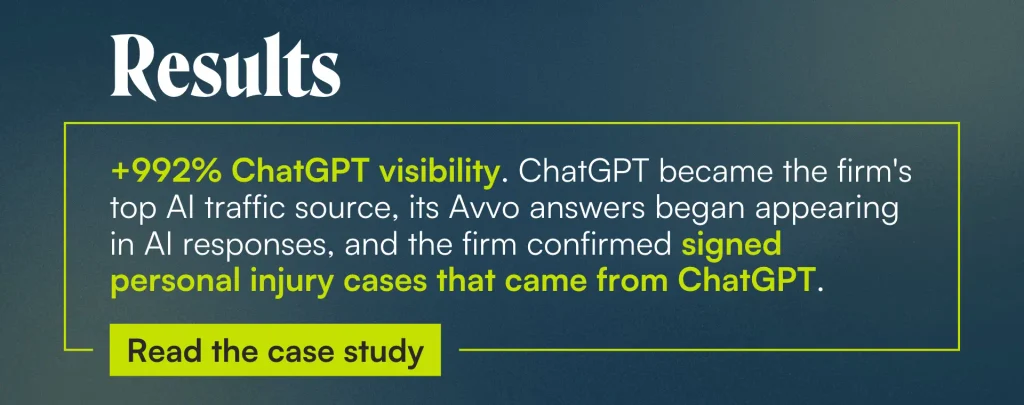
Real Case: +992% ChatGPT Visibility, With Signed Cases
A personal injury firm worked with Rankings.io to grow its presence in AI search. We built custom GA4 reports to track which AI tools sent leads, then applied the structure of the pages AI cited most to the rest of the site. We also tightened content so each page answered one question clearly, and answered 2–3 legal questions every week on Avvo and Justia.
Learn how we approach this for law firms on our AI SEO page.
Strategy 3: Build a Video Content Engine
Video is the fastest way to build trust with someone you have never met. Eighty-four percent of U.S. adults use YouTube, more than any other platform. Firms that publish consistently become the familiar face people call after a crash.
Video formats that bring in personal injury clients
| Format | Example | Where it works | Goal |
| FAQ explainer (2–5 min) | "Should I accept the insurance company's first offer?" | YouTube, website pages | Rank in search, answer high-intent questions |
| Short-form commentary (15–60 sec) | Reacting to a viral crash video with legal takeaways | TikTok, Instagram Reels, YouTube Shorts | Reach and brand recall |
| Myth-busting | "You don't need a lawyer for a minor accident." Here's why that's wrong. | All platforms | Engagement and shares |
| Local safety content | The 5 most dangerous intersections in [city] | Facebook, YouTube, local news | Local authority and links |
| Attorney introduction | Meet the lawyer who will handle your case | Website, Google Business Profile | Conversion on practice-area pages |
| Client stories | Client describes the experience (with written consent) | Website, YouTube | Social proof (follow your state bar's advertising rules) |
A simple weekly video workflow
- Pull the questions your intake team hears most often each week.
- Record one long-form answer (5–10 minutes) per week. All you need to start are a phone and a lavalier mic.
- Cut it into 3–5 short clips with captions and a strong first line.
- Publish the long video on YouTube with chapters and a transcript, and embed it on the related page of your site.
- Post the clips on TikTok, Reels, and Shorts, and share the best one in your Google Business Profile.
Real Case: 1,034% More Video Views
A Michigan personal injury firm worked with Rankings.io on organic social video. We built content from social listening, with legal commentary on trending stories and timely topics, rather than generic promotion. One Instagram stitch reached 14,300 views, and a Super Bowl–themed video drew 3,671% more impressions than the firm's average. Overall, its videos earned 1,034% more views and 182% more engagement than its average. Read the case study.
Strategy 4: Build Organic Growth That Compounds
Paid ads rent attention. Organic search builds an asset you own. Every page that ranks, every review you earn, and every link you win keeps bringing in cases with no click cost. This is how firms get more personal injury cases without raising their ad budget each year.
The four parts of organic growth
- Practice area × location pages. Build a dedicated, in-depth page for every case type in every city you serve (for example, "truck accident lawyer in Dallas").
- Helpful content. Publish guides that answer the questions people ask before they hire: settlement values, timelines, what to do after a crash, how fees work.
- Authority and links. Earn links through local sponsorships, scholarships, data studies, and media commentary. Links remain one of Google's strongest signals.
- Local SEO. Keep citations consistent, ask every satisfied client for a review, and post to your Google Business Profile every week.
Our personal injury SEO service covers each of these parts. For more ideas beyond SEO, see our list of personal injury marketing ideas.
Strategy 5: Turn Every Client Into a Referral Source
Referrals are still the highest-converting source of personal injury cases, because they come with built-in trust.
Treat referrals as a system, not luck:
- Past clients: Stay in touch after the case closes with a holiday card, a newsletter, or a check-in call. Ask directly for reviews and referrals when you have made the client happiest: when the case settles.
- Other attorneys: Build relationships with family law, criminal defense, workers' comp, and estate planning lawyers who receive injury inquiries. Referral fee rules vary by state, so confirm what your bar allows.
- Medical providers: Chiropractors, physical therapists, and urgent care clinics see injured people first. Educate them on when a patient should talk to a lawyer. Do not pay for patient referrals.
- Community: Sponsor local teams, host safety events, and award scholarships. This builds name recognition and earns local links at the same time.
Strategy 6: Fix Intake Before You Chase More Leads
The cheapest way to get more personal injury clients is to stop losing the ones who already contacted you. In Clio's secret-shopper research, 67% of law firms did not respond to emails from potential clients. Injured people often call the next firm on the list within minutes.
- Answer calls 24/7 with trained intake staff or a legal-specific answering service.
- Respond to forms and chats within 5 minutes.
- Follow up by phone, text, and email for at least 7 days.
- Track why every unsigned lead did not sign, and review the reasons weekly.
Strategy 7: Use Paid Ads to Accelerate, Not Replace
Google Ads and Local Services Ads bring in cases fast while organic channels grow. Run them for signed cases, not clicks. Split campaigns by case type, cut broad keywords, and import signed cases back into Google so bidding optimizes for retainers.
One firm we work with cut its paid search CAC by 42% in 12 months with these changes.
Organic vs. Paid vs. Referrals: Which Should You Prioritize?
| Factor | Organic (SEO, AI, video) | Paid (Google Ads, LSAs) | Referrals |
| Time to first case | 3–18 months | Days | Varies |
| Cost per case over time | Falls as assets compound | Rises with competition | Low, but relationships take time |
| Scalability | High | High (budget-limited) | Limited |
| Durability | Lasts after investment slows | Stops when spend stops | Depends on relationships |
| Best for | Lowering long-term CAC,; owning your market | Filling the pipeline now | High-value, pre-qualified cases |
Our recommendation: Use paid ads to keep cases coming in now, invest in organic so you rely less on ads every quarter, and build referrals as a steady base. Most growing firms shift budget toward organic as their rankings and AI visibility mature.
A 90-Day Plan to Get More Personal Injury Clients
| Timeline | Focus | Actions |
| Days 1–30 | Foundation | Audit intake response times, fix Google Business Profile, set up call tracking and GA4 AI-referral reports, list your top 50 client questions |
| Days 31–60 | Content and visibility | Publish or refresh your top practice-area pages with direct answers, record 4 long-form videos and 15 short clips, claim and complete directory profiles |
| Days 61–90 | Scale and measure | Start posting weekly Avvo/Justia answers, launch a review request system, build 2–3 local link opportunities, report signed cases by source |
Frequently Asked Questions: How Do Personal Injury Lawyers Get Clients
How can a new personal injury attorney get clients?
A new personal injury attorney should start with low-cost, high-trust channels: a complete Google Business Profile, referrals from attorneys in other practice areas, directory profiles on Avvo and Justia, and weekly helpful videos. SEO takes longer but builds the strongest long-term pipeline.
How do I get more personal injury leads without buying them?
To get more personal injury leads without buying them, invest in SEO, AI search visibility, Google Maps, video content, and referrals. These channels create leads you own, and your cost per case falls over time instead of rising with ad prices.